
Sieve analysis tells you how large the particles in a material are and how much of the material falls into each particle size range. For aggregate testing, ASTM C136/C136M is a standard test method for sieve analysis.
After a sieve analysis, you can see which particle size range contains most of the material, how much coarse material there is, and how much fine material there is. The results can also be used to check whether the material meets production requirements. If you later need to determine the sieve opening or select screening equipment, these data can also be an important reference.
How Do You Read Sieve Analysis Results?
The test does not just give you an “average particle size.” Its real value is that it shows how much material falls into different particle size ranges. These data can be used directly to check whether the material meets your requirements.
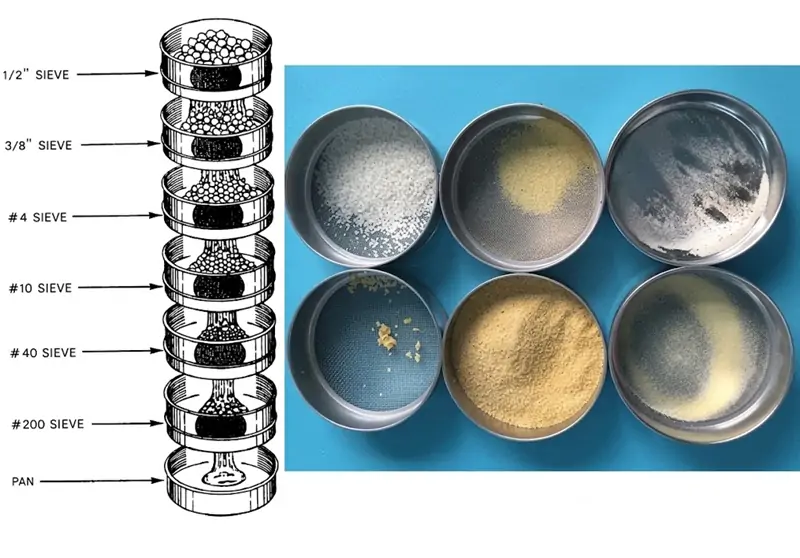
For example, suppose 200 kg of material is tested, with the following results:
| Particle Size Range | Material Weight | Percentage |
| >1 mm | 20 kg | 10% |
| 500 μm–1 mm | 50 kg | 25% |
| 250–500 μm | 80 kg | 40% |
| 125–250 μm | 30 kg | 15% |
| <125 μm | 20 kg | 10% |
The result is clear at a glance: the 250–500 μm range accounts for 40% of the material, making it the largest particle size range in this batch. Material between 500 μm and 1 mm accounts for 25%, while material smaller than 125 μm accounts for 10%.
So instead of simply saying “this is a fine powder,” you can look directly at the data. You can see where the material is concentrated and how much coarse and fine material it contains.
If your production requirement is that 95% of the material must be smaller than 500 μm, looking at only the average particle size is not enough. You need to know how much of the material is below 500 μm. This is exactly the type of information the test provides.
What Does Material Retained on the Sieve Mean?
Material retained on the sieve is material that does not pass through the sieve opening and remains on the sieve. For example, if you use a 500 μm sieve and 50 kg of material remains on the sieve, it means that this portion did not pass through the 500 μm openings.
What Does Percent Passing Mean?
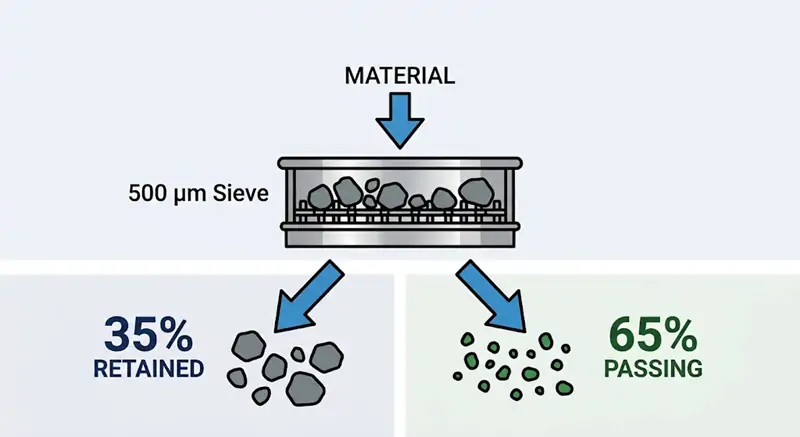
Percent passing is the percentage of the total material that passes through a particular sieve opening. For example, if the percent passing a 500 μm sieve is 65%, it means that 65% of the material in the sample passed through the 500 μm sieve. This allows you to directly determine:
- how much material did not pass through the target sieve opening;
- how much material passed through the target sieve opening;
- which particle size range contains most of the material;
- whether the particle size of the batch meets the requirements.
This is the most direct use of the test: it turns particle sizes that are difficult to judge by looking at the material into a set of data that can be calculated, compared, and used.
How Can You Use Sieve Analysis Results to Evaluate a Material?
After you receive the results, focus on three things: whether the material meets the requirement, where most of the material is concentrated, and whether the particle size distribution changes between batches.
Check Whether the Material Meets the Requirement
Suppose the requirement is that 95% of the material must be smaller than 500 μm. If the percent passing the 500 μm sieve is only 82%, then 18% of the material did not pass through this sieve opening. If the requirement is 95% passing, this batch does not meet the requirement. If the percent passing is 97%, the material meets this particle size requirement.
See Where Most of the Material Is Concentrated
Using the previous data:
- 1 mm: 10%
- 500 μm–1 mm: 25%
- 250–500 μm: 40%
- 125–250 μm: 15%
- <125 μm: 10%
It is clear that most of the material is concentrated in the 250–500 μm range. This is much more useful than simply saying that “the material is relatively fine.”
Check for Changes Between Batches
For example, suppose the results for three batches are:
| Particle Size Range | Batch 1 | Batch 2 | Batch 3 |
| >500 μm | 8% | 9% | 22% |
| 250–500 μm | 52% | 50% | 43% |
| <250 μm | 40% | 41% | 35% |
The first two batches are relatively similar, but the amount of material >500 μm increased to 22% in the third batch. This is a reason to check the crushing, grinding, or screening process upstream.
How Do You Read D10, D50, and D90?
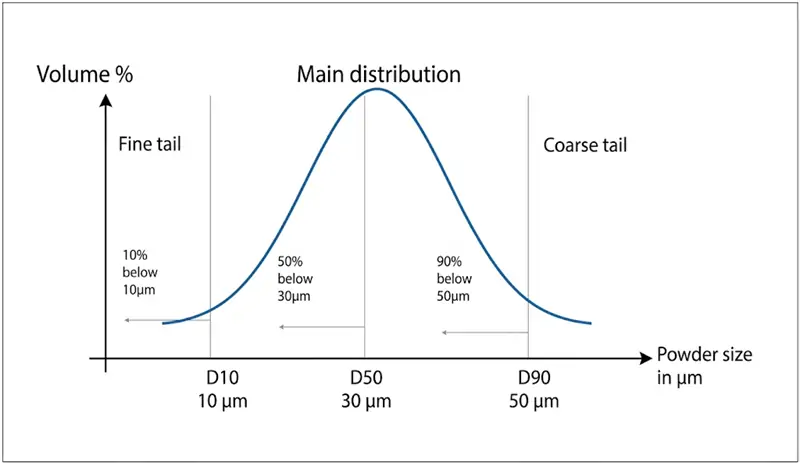
Some reports include D10, D50, and D90 to describe the particle size distribution. For example, D50 = 300 μm means that about 50% of the particles are smaller than 300 μm. But if your production requirement is 95% smaller than 500 μm, looking directly at the percent passing at 500 μm is more straightforward.
When reading the results, first look at the production requirement, then check the percent passing at the corresponding particle size, and finally look at the overall particle size distribution.
How Can Sieve Analysis Results Help Select Sieve Openings and Screening Equipment?
The test first helps you understand the particle sizes in the material, but you cannot select the equipment directly from a sieve analysis table alone. First, it needs to answer one question: which part of the material do you actually need to separate?If you need a basic explanation of sieve frame diameter, sieve opening size, and mesh count, see our guide to Different Sieve Sizes.
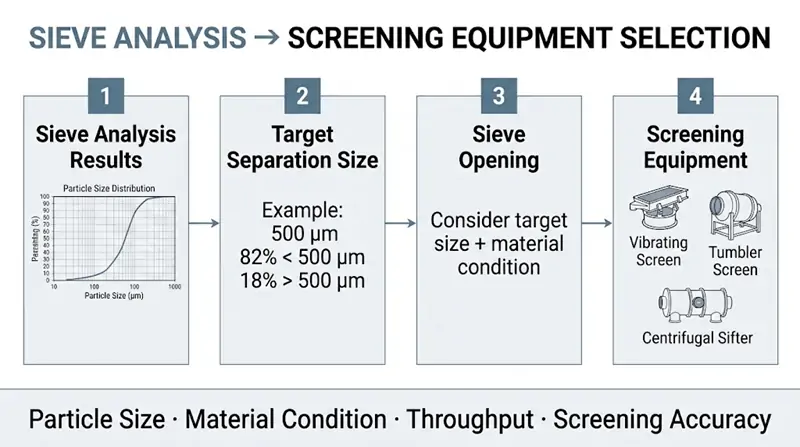
First, Determine the Target Separation Size
For example, the results show:
- 500 μm: 18%
- <500 μm: 82%
If your goal is to remove particles larger than 500 μm, then 500 μm is an important separation size. But this does not mean you should simply choose a 500 μm sieve. The sieve opening also needs to be considered together with the material condition and the actual screening requirements.
Then Consider the Sieve Opening
When selecting a sieve opening, you also need to consider several practical factors:
- whether the material is a powder or granules;
- whether the particles are likely to blind or block the screen;
- how much material needs to be processed per hour;
- whether the material needs a single separation or multi-stage classification;
- how strict the particle size requirements are for the oversize and undersize fractions.
Therefore, the target particle size is the starting point, not the final sieve specification.
Finally, Select the Screening Equipment
Once the sieve opening is determined, the equipment still needs to be selected based on the throughput, material condition, screening accuracy, and production method. Different screening tasks require different equipment designs. For example, fine powder screening needs particular attention to screen blinding, while high-capacity continuous screening needs more attention to processing capacity.
Sieve analysis cannot directly tell you which screening machine to choose, but it can first make clear how much coarse and fine material is in the material and where you want to separate it.
If you already have a sieve analysis report, Jiarui can help evaluate the suitable sieve opening and screening equipment based on the particle size distribution, target separation size, throughput, and production method.
FAQs
Can a sieve analysis show how fine a material actually is?
Yes. Sieve analysis results show how much material falls into different particle size ranges, such as how much is larger than 500 μm and how much is smaller than 500 μm. This is more specific than simply saying that the material is a fine powder.
How should I read a sieve analysis report?
First, look at how much material is retained on each sieve, then look at the percent passing. Focus on the particle size related to your production requirement. For example, if the requirement is that 95% of the material must be smaller than 500 μm, check the percent passing at 500 μm directly.
What does percent passing mean in a sieve analysis?
Percent passing is the percentage of the total material that passes through a particular sieve opening. For example, if the percent passing a 500 μm sieve is 90%, it means that about 90% of the material in the sample passed through the 500 μm sieve opening.
What is the relationship between D50 and sieve analysis?
D50 is a value used to describe particle size. It means that about 50% of the particles are smaller than this particle size. It can help you quickly understand the approximate particle size of a material, but it cannot replace the complete sieve analysis results because it does not show how much coarse and fine material there is separately.
Can I determine the sieve and screening equipment from a sieve analysis result?
Not directly. Sieve analysis results can help identify the target separation size, but the sieve opening and equipment also need to be considered based on throughput, material condition, screen blinding, screening accuracy, and production method.
Can Jiarui help select equipment if I have a sieve analysis report?
Yes. You can provide the sieve analysis results, target separation size, throughput, and production method. Jiarui can use this information to help determine a suitable sieve opening and screening equipment. If the existing equipment cannot meet the requirements, the equipment can also be configured or customized according to the specific operating conditions.