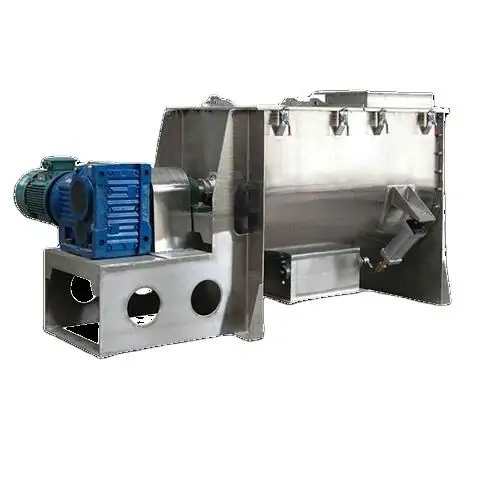
What is a horizontal ribbon blender machine?
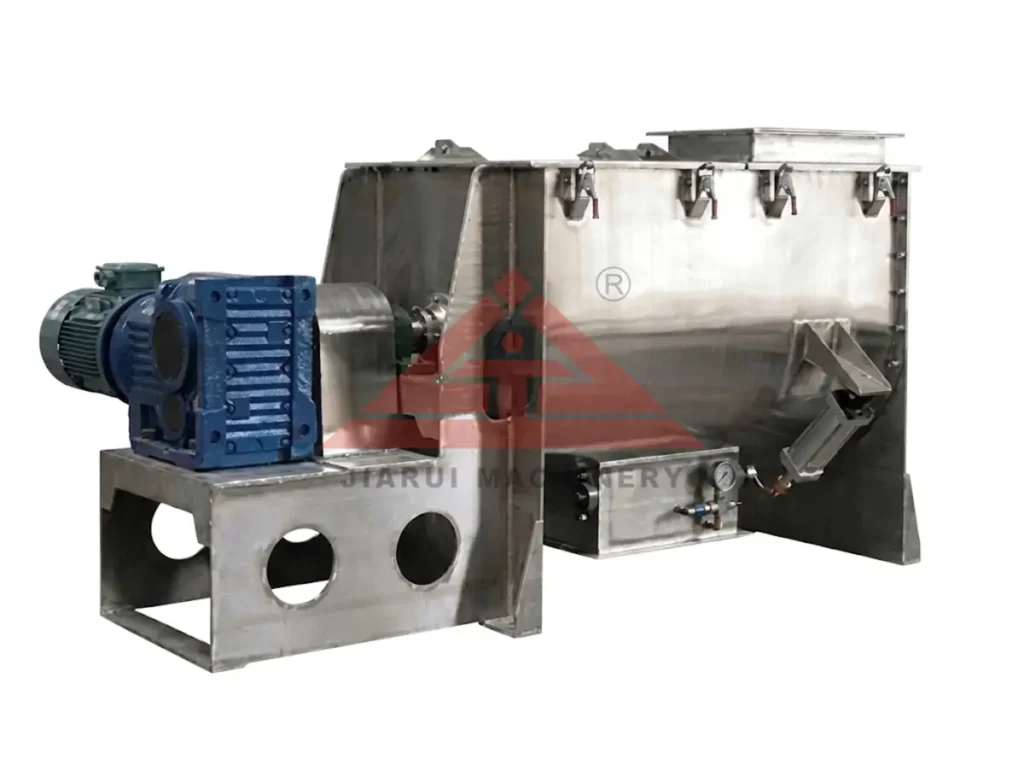
The horizontal ribbon blender machine is a new type of mixing equipment with advantages such as high efficiency, uniformity, high loading factor, low energy consumption, low pollution, and low material breakage. The special design of the double-belt mixer enables it to mix materials into a highly uniform state within a few minutes. In addition, the horizontal ribbon blender machines have a wide range of applications, capable of handling everything from powder mixing and powder-liquid mixing to mixing of paste-like or high-density materials (such as putty, stone powder, metal powders, etc.). It is one of the most commonly used single-shaft horizontal mixing devices at present.
The principle of screening powder with a horizontal ribbon mixer
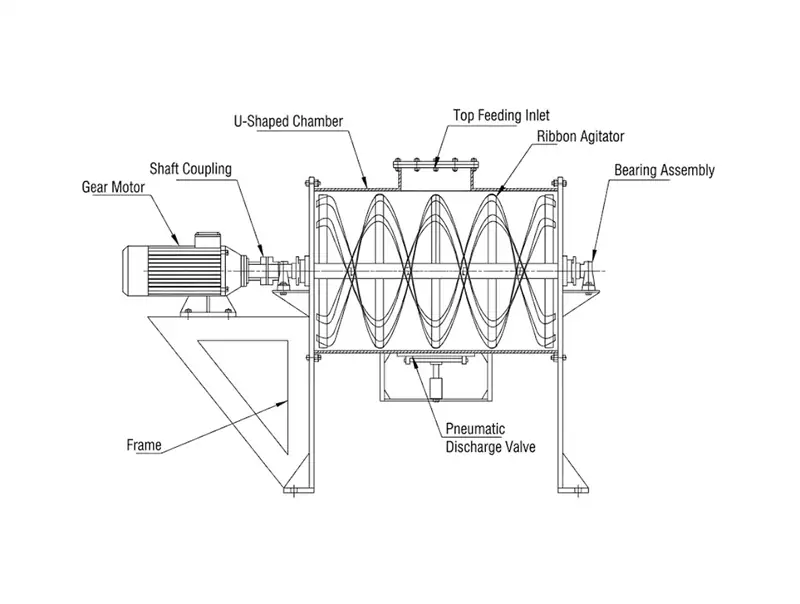
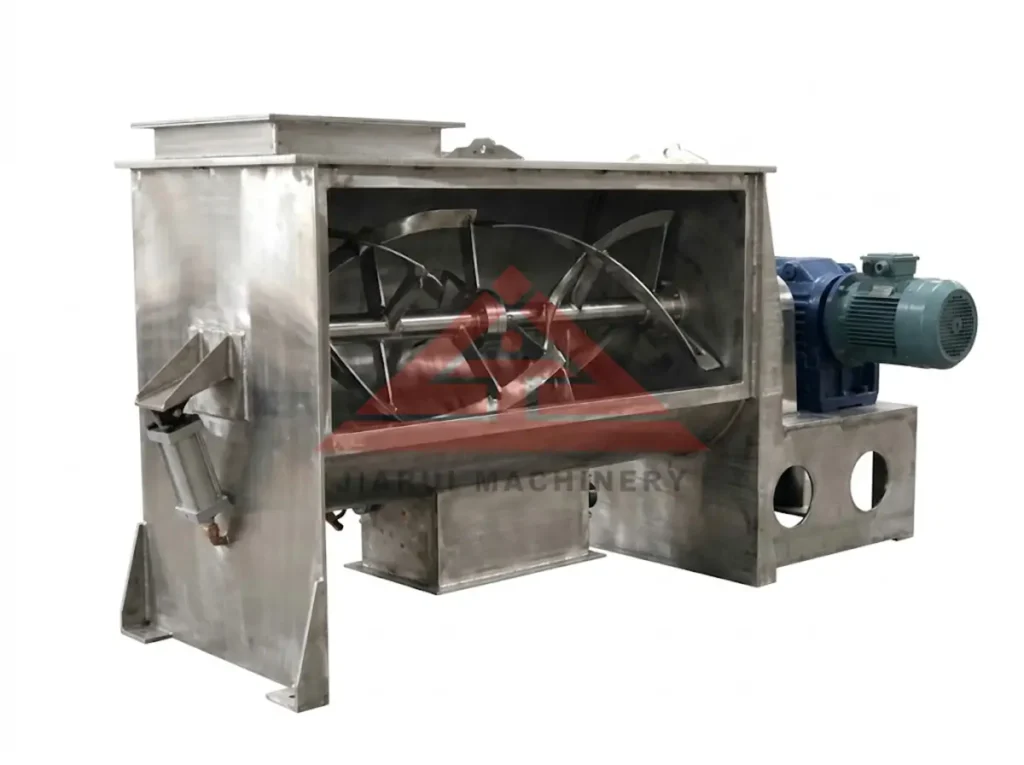
The working principle of the horizontal ribbon blender machine is as follows: the inner belt transports the material from the center to the outer side, while the outer belt transports the material from both sides to the center. During the material transportation process, the two belts are connected in the direction of rotation. The horizontal ribbon blender machines can help you achieve better mixing results in a shorter time.
Product Advantages
- Wider application range and less material damage: The special design of the double-band mixer is not only suitable for powder mixing but also for powder-liquid mixing, paste mixing, or high-viscosity, high-specific-gravity materials (such as putty, stone powder, metal powders, etc.). With a radial speed design range of 1.8-2.2 meters per second, this mixer offers good flexibility and minimal damage to the materials.
- Higher stability and longer service life: All major components of the equipment are made from internationally renowned brands, ensuring excellent quality. The reducer uses a K-series spiral bevel gear reducer, which features high output torque, low noise, long service life, and minimal oil leakage. The discharge valve and cylinder are designed with the same arc radius to ensure no dead zones for material discharge. In addition, the valve has been specially designed.
- Higher loading rate and better sealing: The angle of the mixing cylinder is designed according to the material properties, ranging from 180º to 300º, with a maximum loading capacity of 70%. There are multiple options for sealing. For ultra-fine powders, a pneumatic + packing seal is adopted, which can significantly improve the service life and effectiveness of the seal. For materials with good fluidity, a mechanical seal is a more optimal choice, capable of meeting the requirements of different operating conditions.
- Complete Specifications: The product can be customized according to different specifications, such as mixers with spraying functions, vacuum systems, lid supports, heating systems, explosion-proof devices, and explosion-proof bands. Materials available include 304 or 316. The cylinder lining can be selected as polyurethane or spray-wear-resistant materials. For valves, options include star valves, butterfly valves, flap valves, and ball.
How to discharge powder during the trial run of a belt-type mixer?
Discharge Methods of Horizontal Ribbon Blender Machines: For powder materials, an air-driven large-opening structure is adopted, offering advantages such as rapid discharge and no residue. For high-fineness materials or semi-liquid materials, manual or air-driven butterfly valves are used. Manual butterfly valves are economical and practical, while air-driven butterfly valves provide better sealing for semi-liquids but have a higher cost. In cases requiring heating or cooling, a jacket can be configured. Heating options include electric heating and heat transfer oil heating.
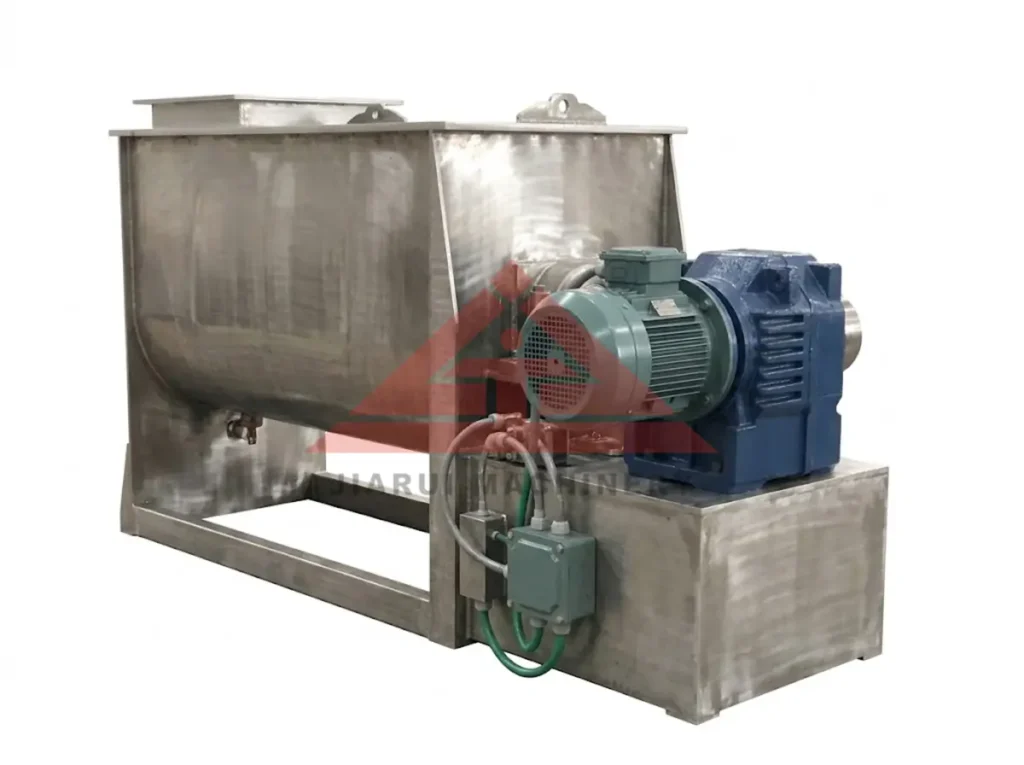
Electric heating is convenient but has slow heating speed and high energy consumption. Heat transfer oil heating requires additional oil tanks, oil circulation power, and pipelines, resulting in higher initial investment, but it offers faster heating and lower energy consumption. For cooling, cooling water can be directly injected into the jacket, which has a large heat exchange area and enables rapid cooling. The motor is directly connected to the mixing main shaft via a cycloidal pinwheel reducer, ensuring a simple structure, high operational reliability, and easy maintenance.
Applications of powders in various industries
Horizontal ribbon blender machines are used for mixing solid-solid (i.e., powder with powder) and solid-slurry (i.e., powder with paste-like liquid) materials in fields such as pesticides, veterinary drugs, food, chemicals, biotechnology, aquaculture, ceramics, refractory materials, plastics, and compound fertilizers. They are also particularly suitable for mixing viscous materials.
Food industry
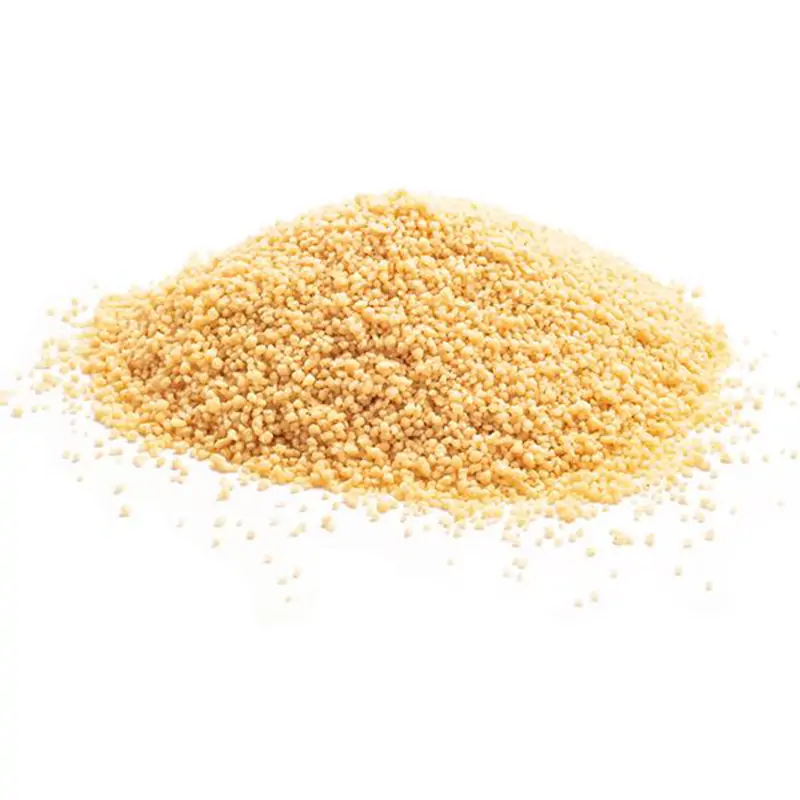
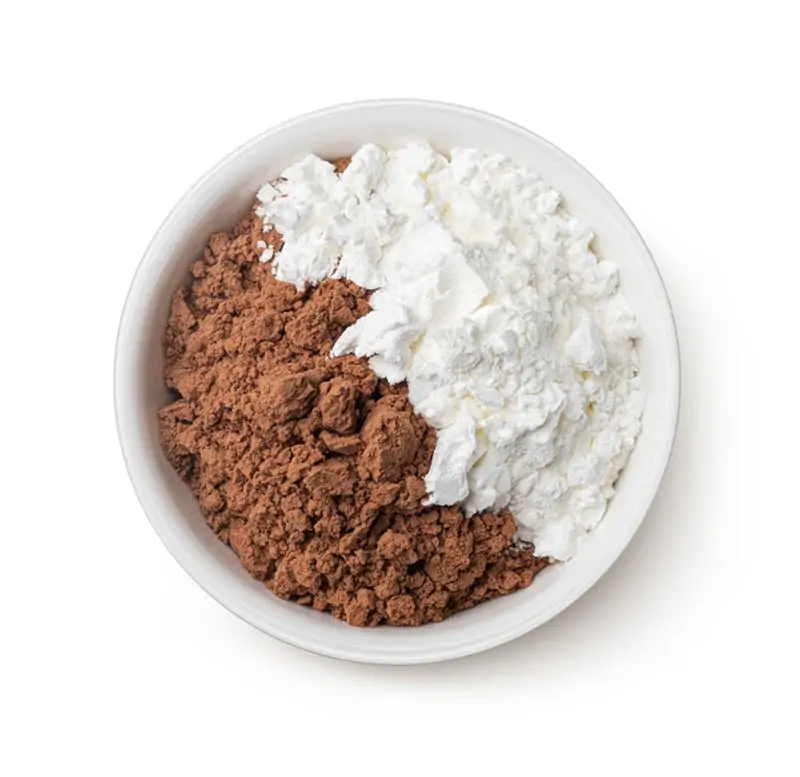
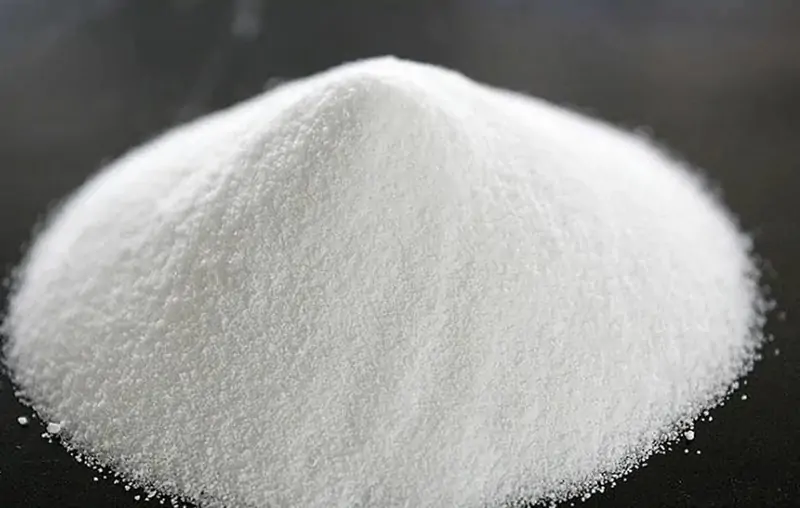
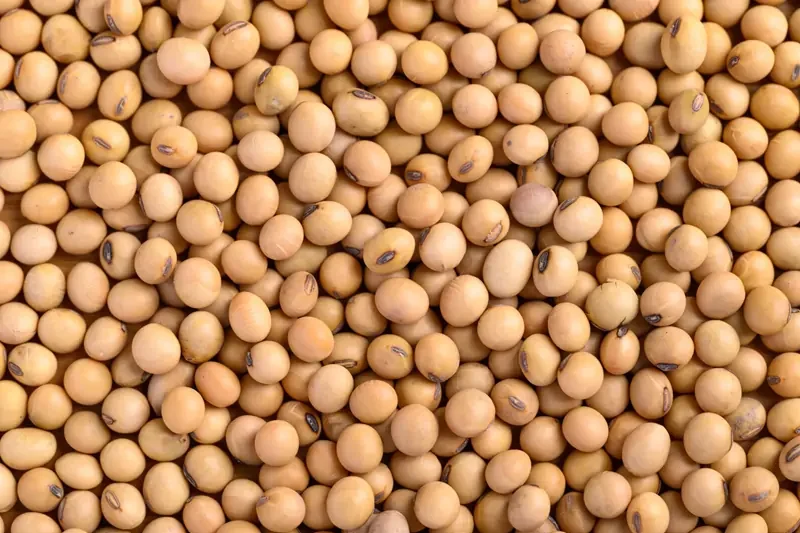
Horizontal ribbon blender machines are undoubtedly efficient and effective for mixing powdered materials such as cake mixes, grains, protein powders, salt, seasonings, coffee powder, and so on.
Healthcare industry
In the medical field, Horizontal ribbon blender machines are beneficial for mixing magnesium chloride powder, talcum powder, and all other types of medical powders and small particles.
Chemical industry
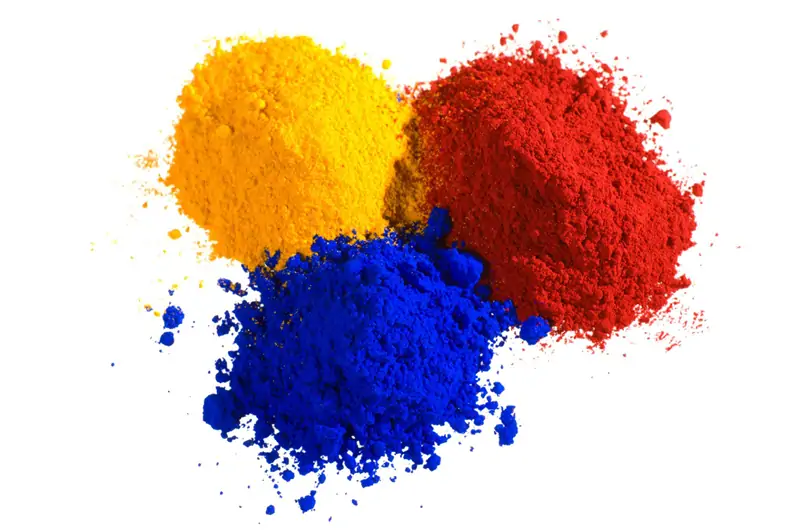
When using a Horizontal ribbon blender machine, it is very helpful for mixing metal powder mixtures, paint powders, polyester granules and powders, sodium hydride powder, and other chemicals.
Agriculture industry
Horizontal ribbon blender machines are used in the application of chemical fertilizers, organic fertilizers, bio-fertilizers, protein powders, minerals, fungicides, insecticides, herbicides, and other agricultural products.

Horizontal Ribbon Blender Machine VS Other Mixing Devices
| Feature Dimension | Horizontal Ribbon Blender | Common Mixing Equipment (Taking V-type and Three-dimensional as Examples) |
| Blending Principle | Forced Shearing and Convection Mixing | Gravity Dispersion and Convection Mixing |
| Internal Structure | Equipped with Agitator (Ribbon/Blade) | No mixing components, relying solely on container rotation |
| Mixed force | Strong (Mechanical Force) | Weak (Gravity-driven) |
| Mixing time | Short Mixing Time (Typically Minutes) | Longer mixing time |
| Degree of mixing uniformity | High Mixing Efficiency, Especially for Materials with Significant Property Differences | Materials with good fluidity have higher uniformity |
| Impact on Materials | There is shear force, which may break the material. | No shear force, protecting the original form of materials. |
| Load Factor | High (50%-80%) | Lower (30%-50%) |
| Residue and Cleaning | There may be dead corners, making it difficult to clean | No blind spots, easy to clean. |
| Floor Space Occupied | Large | Compact |
| Typical Applications | Scenarios involving large volumes, significant differences in material properties, and the need for rapid mixing | Small-batch, expensive, fragile, and high-uniformity-required materials |
Shopping Tips
How to choose a horizontal ribbon mixer for feed powder?
The livestock industry often prefers vertical mixing equipment. However, experts recommend that large-scale pig farms should choose horizontal ribbon blender machines when selecting feed processing equipment. These mixers offer high mixing efficiency, good mixing quality, short unloading time, and low residual material. However, there are several points to note when selecting and using horizontal mixers:
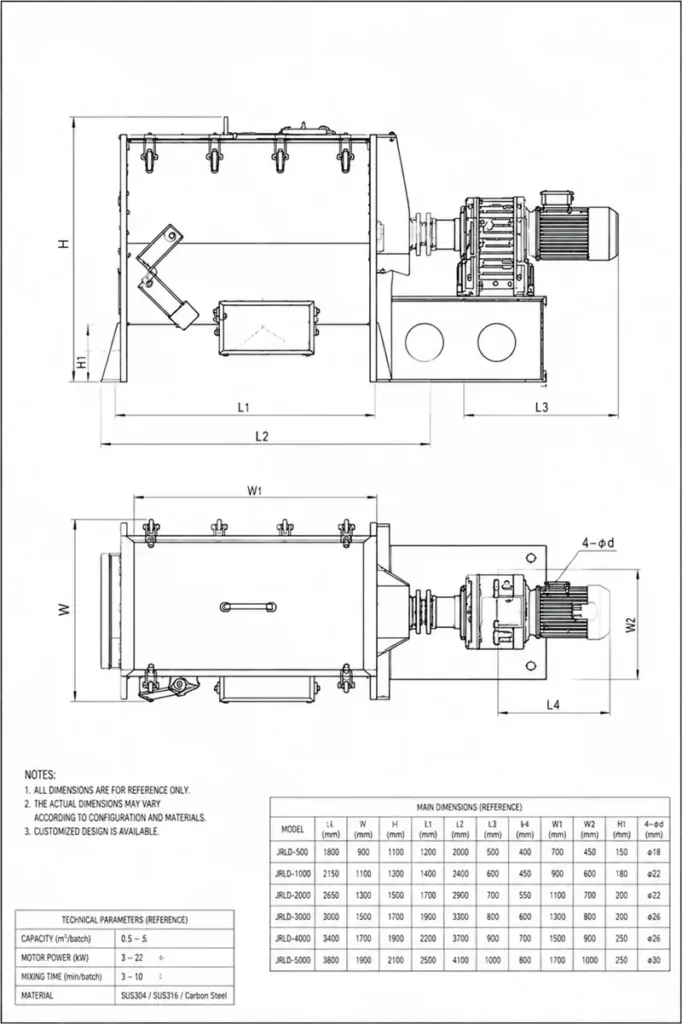
- Select the horizontal ribbon blender machines based on daily production volume. Since the processing time for each batch in a mixer is approximately 6 minutes, plus the time for discharging and feeding, each batch can be considered as taking 10 minutes. Thus, 6 batches can be processed per hour. If a mixer with a processing capacity of 100 kilograms per batch is chosen, it can process 600 kilograms per hour. Users can select a horizontal mixer according to their own needs.
- Based on the working principle of Horizontal ribbon blender machines, the ability of the dual screw ribbons used for mixing to push material in opposite directions should be basically consistent. Since the pitch of the inner screw ribbon should be smaller than that of the outer one, to achieve consistent pushing ability, the inner screw ribbon should have a smaller pitch but a greater width than the outer one; otherwise, the material will tend to concentrate in one direction. Therefore, this point should be noted when selecting a horizontal mixer.
- According to design principles, the gap between the screw ribbons and the shell in a screw ribbon mixer can be 4 millimeters to 10 millimeters, allowing all the material to participate in mixing through friction. However, due to differences in particle size and friction coefficients of the materials, various components of the material will participate in mixing at different times, leading to product non-uniformity.
- Some manufacturers have recognized this and improved their products. One improvement is to pay attention to machining accuracy, reducing the bottom gap to 1 millimeter to 2 millimeters. Another is to design the main shaft and shell in an adjustable position, allowing frequent adjustment of the gap between the screw ribbons and the shell based on wear. When selecting a mixer, products with these two forms should be the best choice.
Use and Maintenance
- When the equipment is in operation, hard foreign objects larger than 5mm must not enter the machine; otherwise, the machine should be stopped to remove them. If abnormal sounds such as metal collision or friction are detected during operation, the machine should be stopped promptly for inspection and elimination.
- When mixing solid-liquid materials, start the machine first, then spray the liquid. After spraying the liquid, continue to run and mix for another 3~5 minutes.
- The general mixing time for secondary materials is approximately 5~8 minutes. The mixing time for special materials needs to be determined by the user through testing.
- The particle size of the mixed materials is 20~1400 mesh; the liquid spray amount can be determined according to the adsorption performance of the materials and the production process requirements of the user.
- Lubricating oil for the reducer and bearings should be replaced regularly during use. The lubricant grade for the reducer should follow the requirements of the reducer manual. The main shaft bearings use composite lithium-based grease.
- The shaft end seal adopts packing seal. The sealing material is generally oil-soaked asbestos. If slight leakage is found during use, tighten the box cover pressing bolts to ensure a tight seal.