
What is a linear vibrating screen?
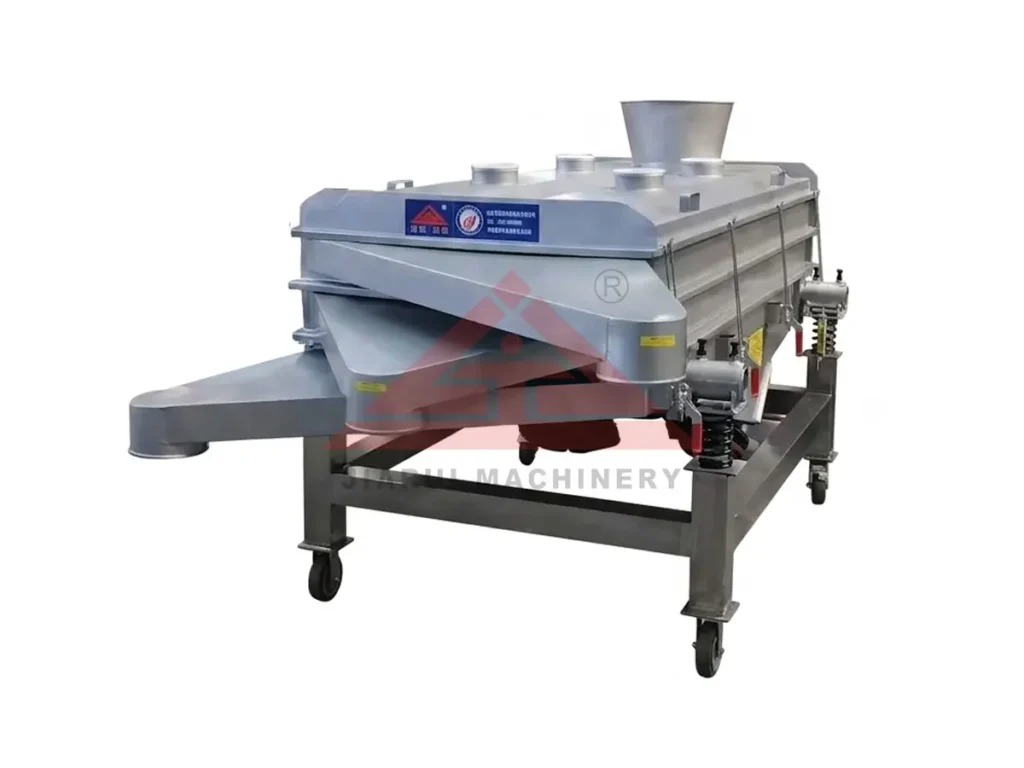
The linear vibrating screen uses a vibrating motor as the excitation source to drive the vibration, causing the material to be thrown up and move forward in a straight line. The material is evenly fed from the feeder into the screening machine, where it passes through multiple layers of screens to produce various grades of oversize and undersize materials, which are discharged separately from their respective outlets. It features low energy consumption, high output, simple structure, easy maintenance, a fully enclosed design, no dust dispersion, and automatic discharge, making it more suitable for continuous production lines.
What is the working principle of a linear vibrating screen?
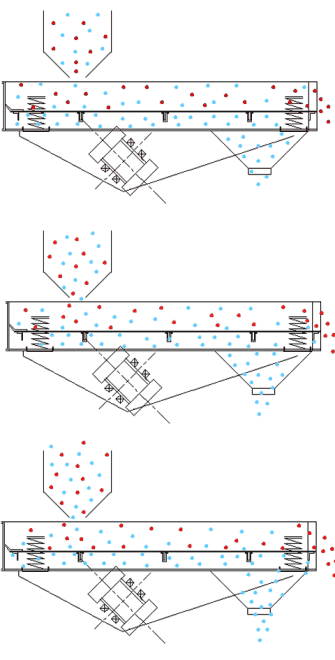
The linear vibrating screen is driven by dual exciters. When the two exciters rotate synchronously and in reverse, the excitation forces generated by their eccentric blocks cancel each other out in the direction parallel to the motor axis, and form a combined force in the direction perpendicular to the motor axis. Therefore, the motion trajectory of the screen machine is a straight line. The two motor shafts have an angle of inclination relative to the screen surface.
Under the combined forces of excitation and material self-gravity, the material is thrown up on the screen surface. It undergoes a jumping forward linear motion, thereby achieving the purpose of screening and grading the material. It can be used to automate operations on assembly lines. It has the characteristics of low energy consumption, high efficiency, simple structure, easy maintenance, and a fully enclosed structure without dust spillage. The maximum screening mesh is 400 mesh, which can screen out 7 different particle sizes.
Generation and Synthesis of Excitation Force
The power source for the sieve is generated by two vibrating motors that operate synchronously but rotate in opposite directions. Eccentric blocks are mounted on the motor shafts. As the machine operates and the motors rotate, they produce an exciting force that drives the linear sieve to perform screening operations. This force can be decomposed into the following two directions:
- Horizontal direction (parallel to the motor axis): The exciting forces from the two motors are equal in magnitude and opposite in direction in this direction.
- Vertical direction (perpendicular to the motor axis): The exciting forces from the two motors are in the same direction in this direction, combining to form a resultant force.
Core structure organization
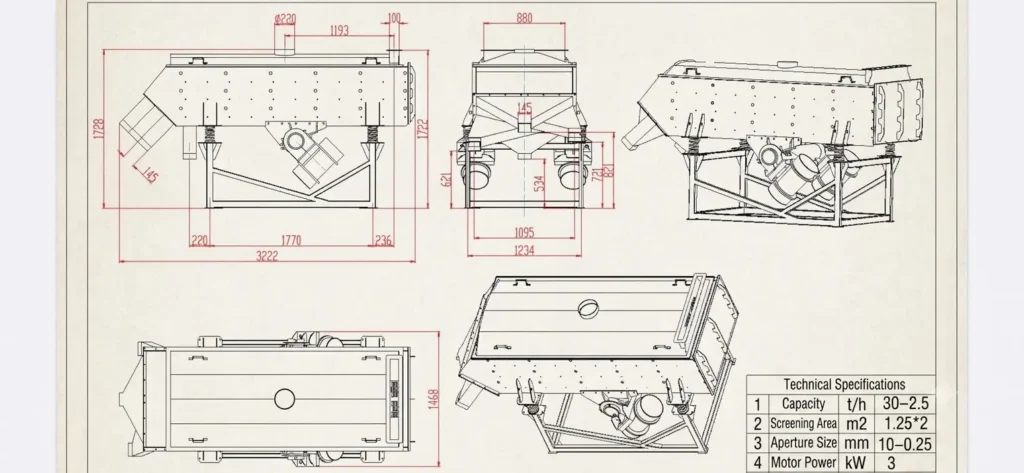
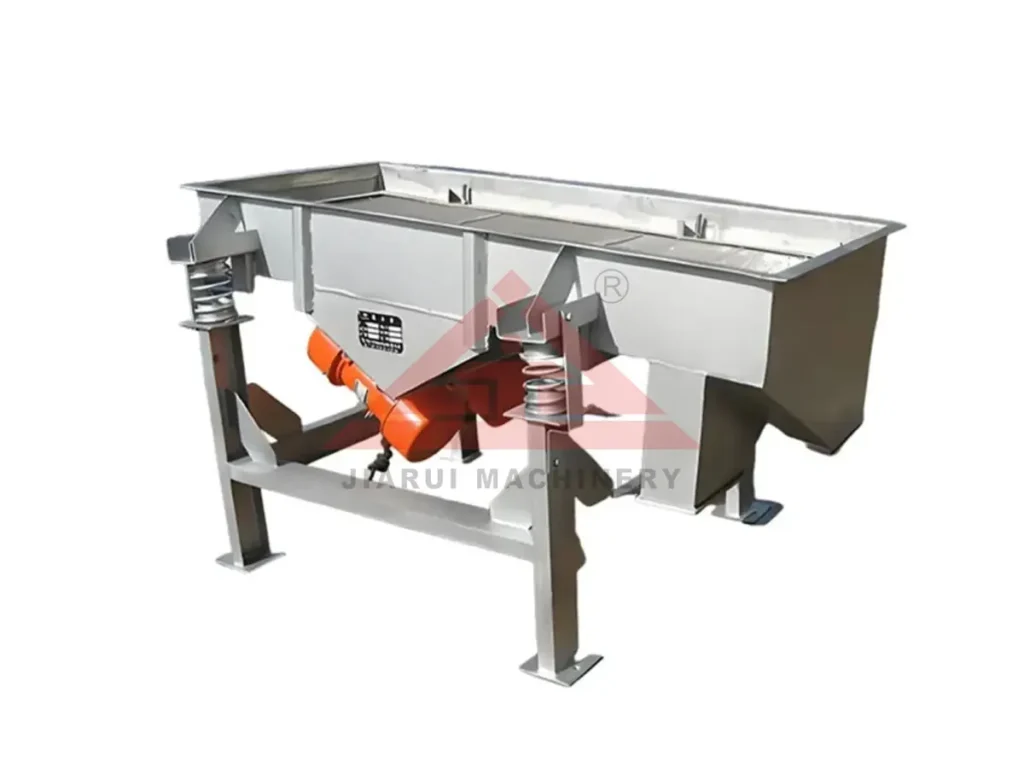
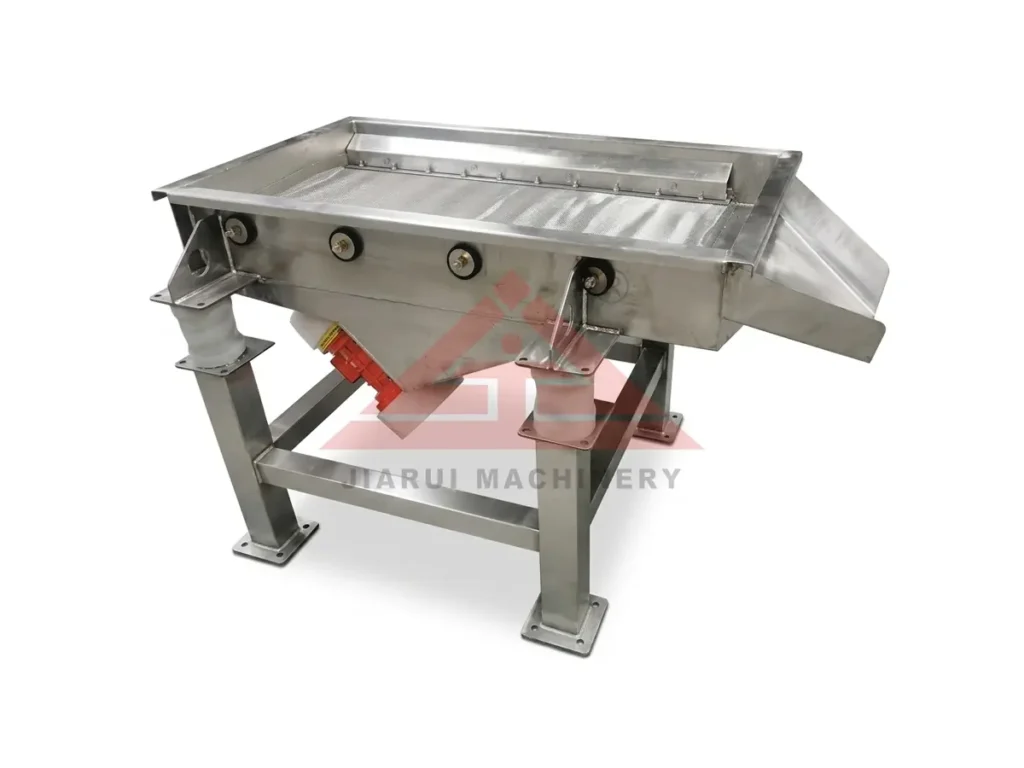
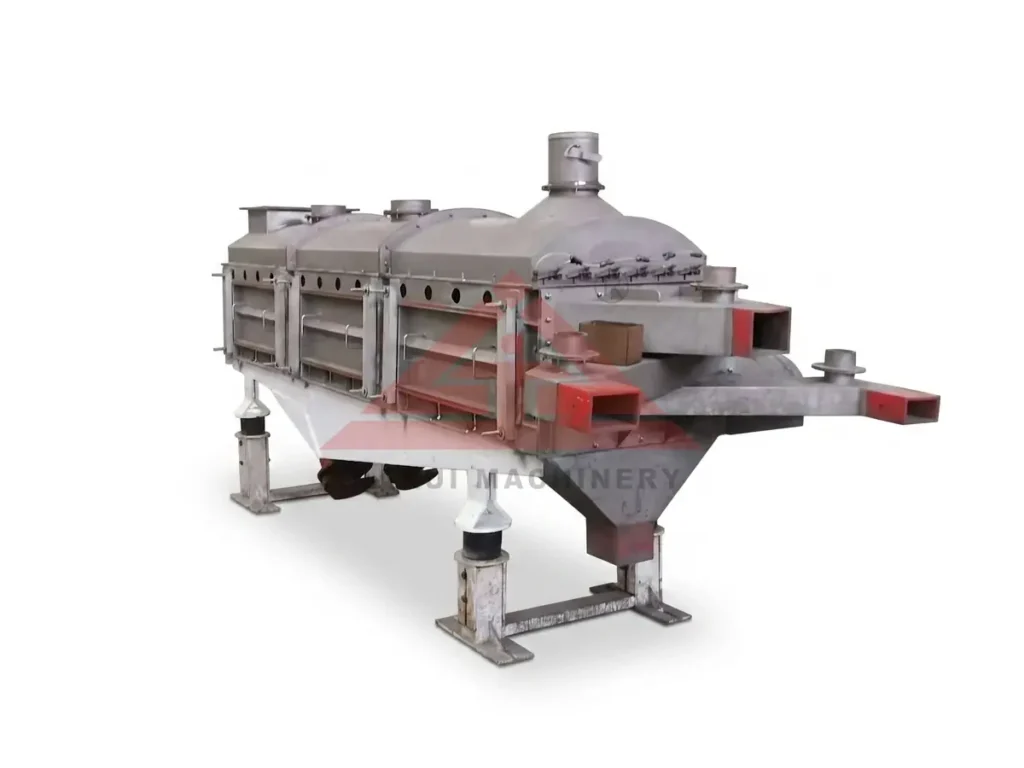
The linear vibrating screen is mainly composed of a sieve box, sieve frame, sieve mesh, vibrating motor, motor base, vibration-reducing springs, and supports, among other components.
- Screen Box: Fabricated by welding several steel plates of different thicknesses, it possesses certain strength and rigidity and is the main component of the screening machine.
- Screen Frame: Made from pine or wood with minimal deformation, its primary function is to keep the screen mesh flat to ensure normal screening.
- Screen Mesh: Available in several types including low-carbon steel, brass, bronze, and stainless steel wire mesh.
- Vibration Motor: (Usage and maintenance methods are detailed in the Vibration Motor User Manual).
- Motor Base: Used to install the vibration motor. Before use, the connecting screws must be tightened, especially during the first three days of trial operation of a new screening machine, which requires repeated tightening to prevent loosening and accidents.
- Vibration Damping Springs: Prevent vibration from being transmitted to the ground while supporting the entire weight of the screen box. When installing, the springs must be perpendicular to the ground.
- Support Frame: Composed of four pillars and two channel steels, it supports the screen box. During installation, the pillars must be vertical to the ground, and the channel steels under the two pillars should be parallel to each other.
The screening process of materials
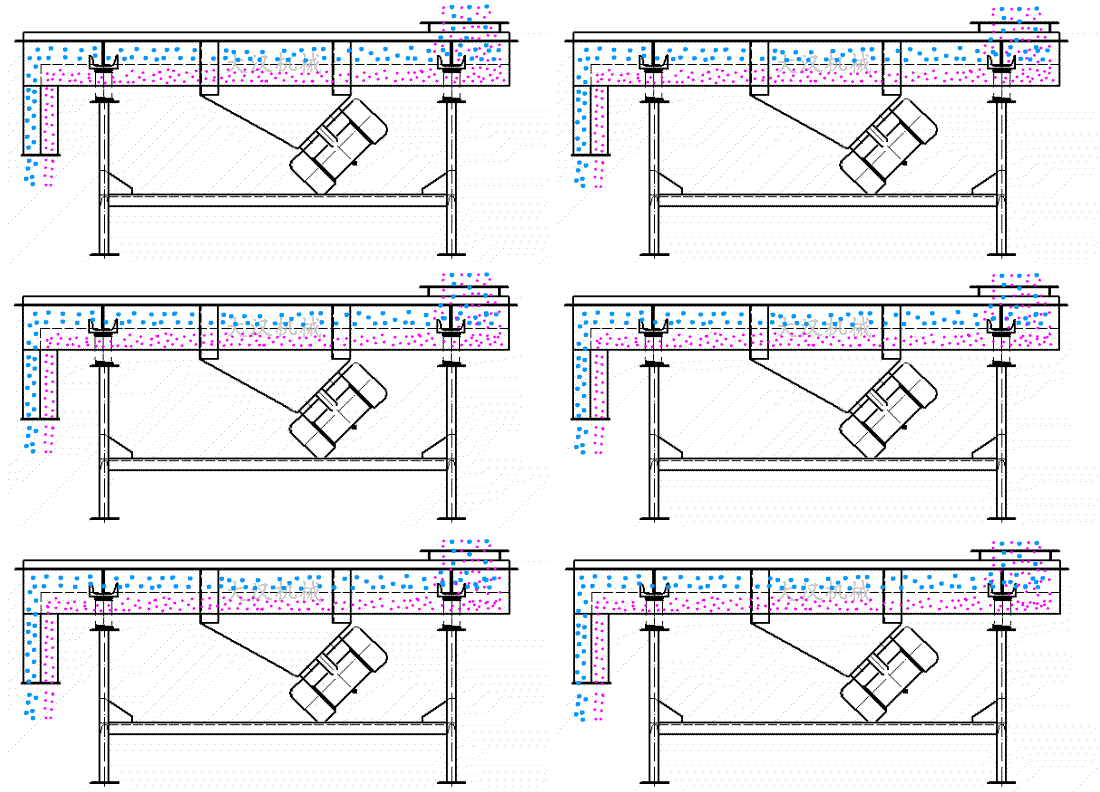
The screening process is a continuous stratification and permeation of materials on the sieve surface, which can be divided into the ‘stratification stage’ and the ‘permeation stage’. These two stages alternate cyclically to ultimately achieve the separation of materials with different particle sizes.
Stratification Stage: The process of separating materials by particle size
When the material first enters the screen surface, it is in a disordered pile with coarse and fine particles mixed. Under the action of vibration, the material layer becomes loose. Fine particles penetrate downward under the influence of gravity and vibration, while coarse particles are lifted upward, gradually forming a stratified structure of ‘coarse particles on top and fine particles at the bottom’.
The stratification speed depends on the vibration intensity (the ratio of excitation force to material weight): insufficient vibration intensity (<3) results in inadequate loosening of the material and slow stratification; excessive vibration intensity (>6) causes the material to jump too high, leading to disordered stratification. In industrial production, vibration intensity is typically controlled between 3 and 5. A mining enterprise increased its vibration intensity from 2.5 to 4.0, reducing the stratification time from 15 seconds to 8 seconds and improving screening efficiency by 15%.
Sieving Stage: The process through which fine particles pass through sieve holes
Fine particles in the lower layer move toward the screen apertures under vibration. When the particle size is less than 70% of the screen aperture size, they can pass through smoothly. When the particle size is between 70% and 100% of the screen aperture size, they require vibration to adjust their orientation to pass through, and these are referred to as ‘difficult-to-screen particles’. Particles larger than the screen aperture size remain on the screen surface and are eventually discharged from the discharge port.
Handling difficult-to-screen particles is key to improving efficiency: A building materials factory increased the vibration frequency (from 1800 r/min to 2200 r/min), raising the pass-through rate of difficult-to-screen particles from 30% to 65% and increasing screening efficiency by 22%. The shape of the screen apertures also affects pass-through: round apertures are suitable for spherical particles, while square apertures are suitable for flat particles. A food factory changed from round to square apertures, improving nut grading accuracy by 18%.
常见型号
As one of the common vibrating screens in the screening industry, the linear vibrating screen is summarized below with some commonly used models and their suitable applicable industries:
| Series | Common Models (Numbers Represent Diameter in mm) | Main Features / Notes |
| XZS Series | XZS-400, XZS-600, XZS-800, XZS-1000, XZS-1200, XZS-1500, XZS-1800, XZS-2000 | One of the most common series on the market, which is widely applied. |
| S49 Series | S49-400, S49-600, S49-800, S49-1000, S49-1200, S49-1500, S49-1800 | Another extremely common series belongs to the ‘Triangular Vibrating Sieve’. |
| JZ Series | JZ-400, JZ-600, JZ-800, JZ-1000, JZ-1200, JZ-1500, JZ-1800 | Another common series, similar to the XZS series. |
| WXZ Series | WXZ-400, WXZ-600, WXZ-800, WXZ-1000, WXZ-1200, WXZ-1500, WXZ-1800, WXZ-2000 | |
| Other Series | AK-600, HXS-1500, YC, JR | Models from other manufacturers or those with specific functions are less common than the above-mentioned ones. |
Debugging and Operation
Step1: No-load debugging
There should be no noise, smooth start-up, and no abnormal temperature. After running for 2-4 hours, shut down and retighten all bolts comprehensively (motor, screen frame, spring seat).
Step2: Load Debugging
First, feed a small and uniform amount of material, and observe that the material moves straight forward without deviation or accumulation.If there is a deviation, adjust the spring height or the motor’s exciting force.
Step3: Excitation force adjustment
Open the motor cover, loosen the eccentric block bolts, and rotate to adjust the angle in the same direction. The greater the angle, the greater the exciting force; the angles of the two motors must be consistent.
Step4: Full-load testing
Gradually add material until the rated output is reached, and check the screening accuracy, output, noise, and temperature. After continuous operation for 4-8 hours, if all parameters are stable, it is considered qualified.
Application industries
The linear vibrating screen has a wide range of applications and is compatible with the entire industry. It supports non-standard customization, material feeding, and trial operation, and is suitable for the food, pharmaceutical, chemical, metallurgical, and other industries.
| Industry Fields | Examples of Typical Materials | Key Requirements and Characteristics |
| Mining/Metallurgy | Iron ore, quartz sand, coal gangue, aluminum powder, copper powder, alloy powder, etc. | It has a large processing volume, with materials that are hard and have sharp edges, imposing extremely high requirements on the wear resistance of the equipment. |
| Chemical Industry | Fertilizers, resins, coatings, calcium carbonate, lithium battery materials, etc. | The material may be corrosive, prone to generating static electricity, or cause clogging of the screen mesh. |
| Food Industry | Flour, starch, white sugar, salt, milk powder, seasonings, etc. | It has extremely high requirements for hygiene standards, necessitating the prevention of material contamination and dust control. |
| Pharmaceutical Industry | Traditional Chinese medicine powders, granule pills, microbeads, and industrial pharmaceuticals | It also demands very high levels of cleanliness and precision to prevent cross-contamination. |
| Building Materials Industry | Mechanical sand, limestone, stone powder, activated carbon, kaolin, etc. | The material is typically in dry powder or granular form, and continuous and stable operation is required. |
| Plastics/Abrasives Industry | particles, plastic particles, abrasives, carbon materials, etc. | There is a certain requirement for screening accuracy, and there is a desire to extend the service life of the screen mesh. |
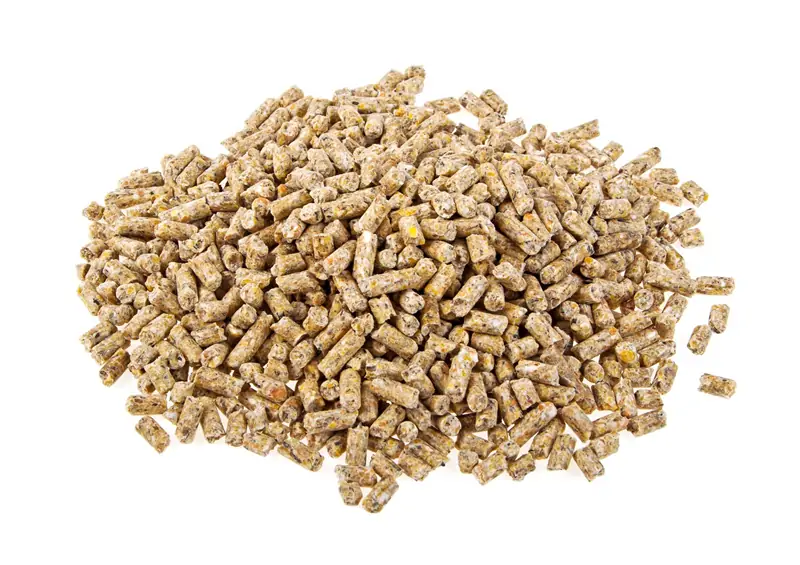 Animal Feed Pellets
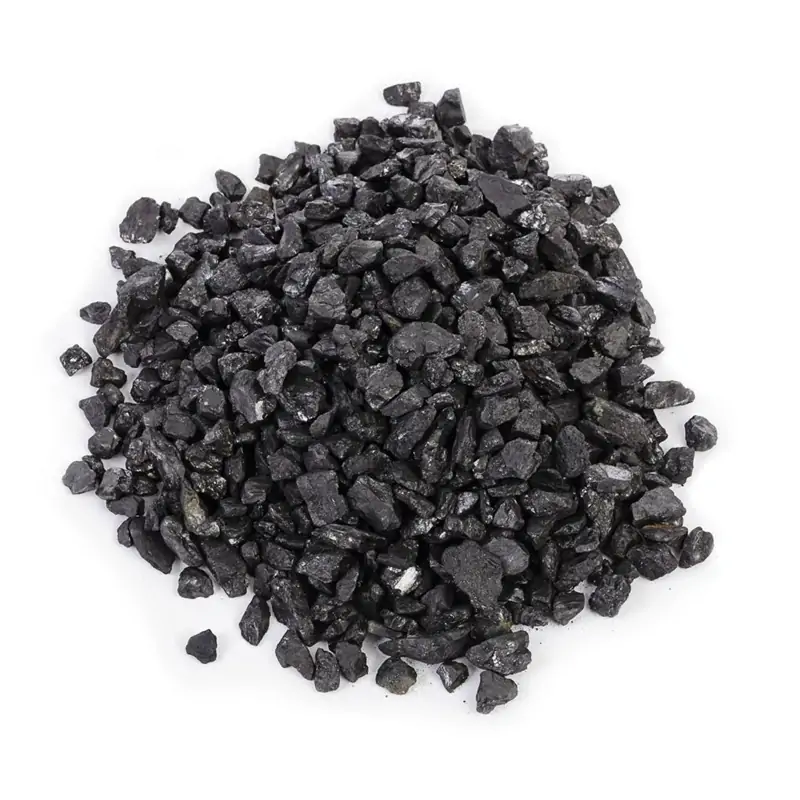 Coal
Coal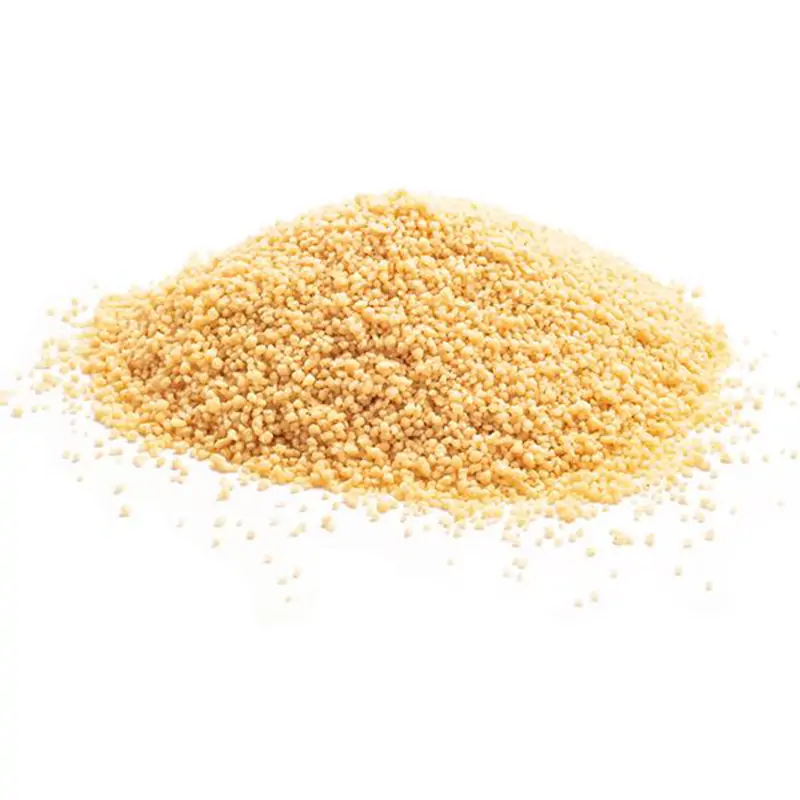 Grain Granules
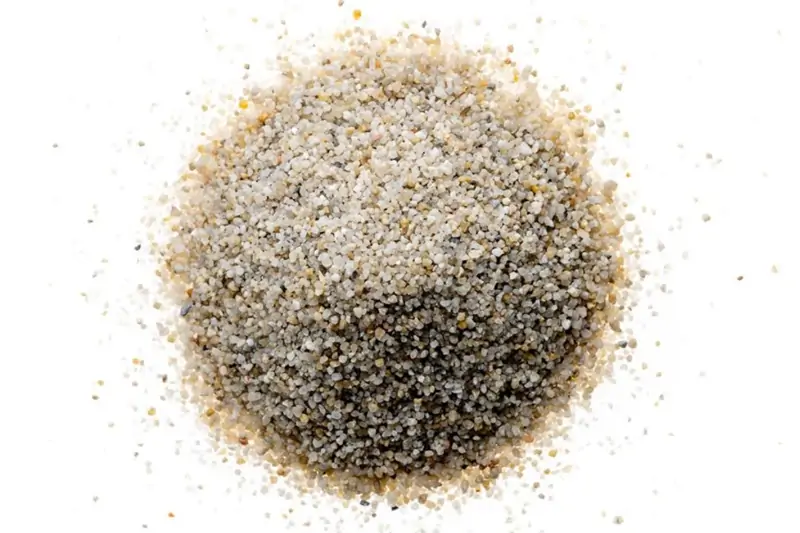 Quartz Sand
 Mixed Nuts
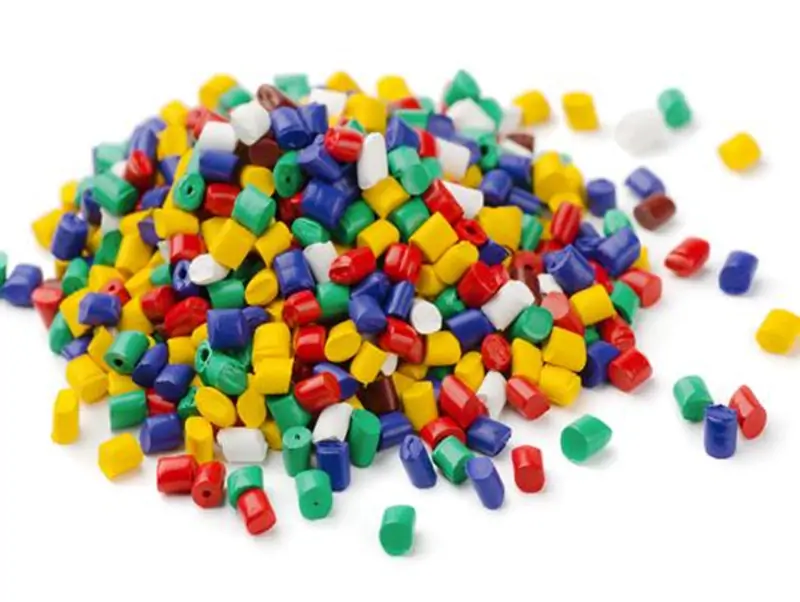 Plastic Pellets
Conclusion
The linear vibrating screen uses the vibration motor as the vibration source, causing the material to be thrown up on the sieve mesh while moving forward in a straight line. The material enters the feed port of the screening machine uniformly from the feeder, and through multiple layers of sieve meshes, produces several specifications of oversize and undersize materials, which are discharged separately from their respective outlets.