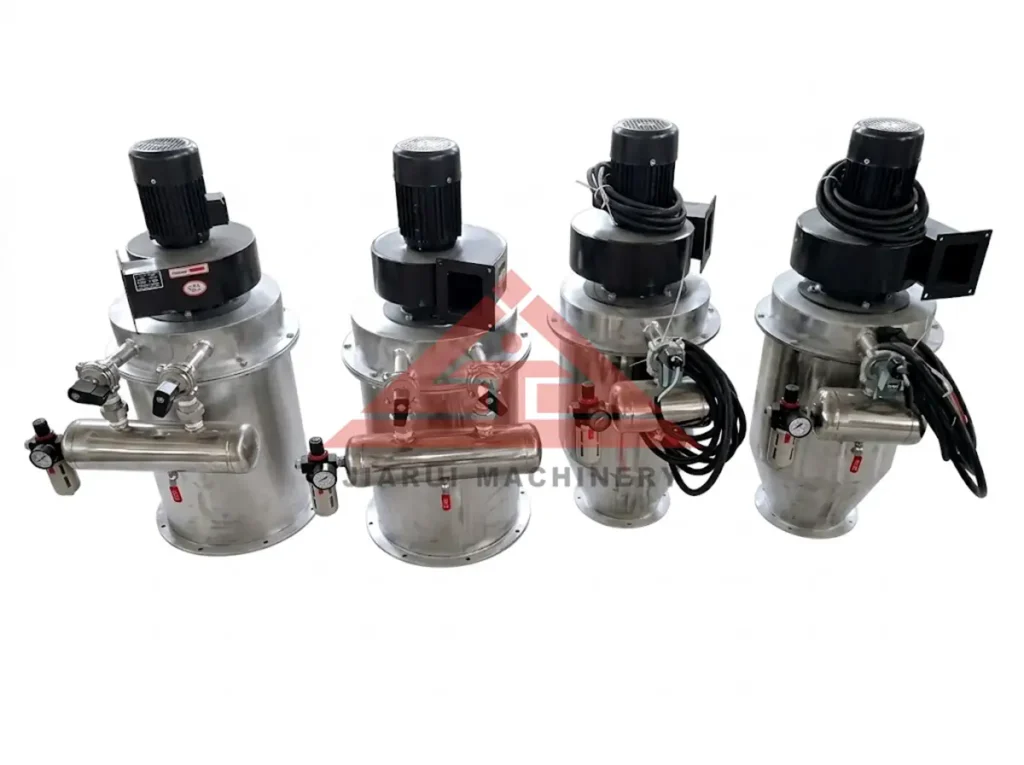
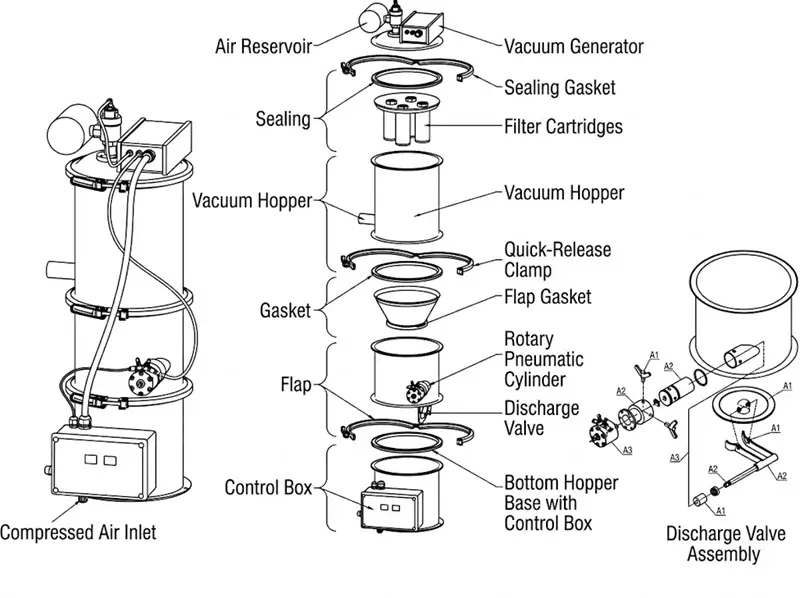
A vacuum conveyor, simply put, is a conveying device that uses negative pressure to “pull” powder or granular materials to a designated location. After the equipment starts, the vacuum source creates negative pressure inside the conveying pipeline. The material enters the pipeline under the action of the airflow and is conveyed to the receiving equipment.
Vacuum conveying is a type of pneumatic conveying. Unlike positive-pressure pneumatic conveying, which “pushes” material through the pipeline, vacuum conveying uses negative pressure to “pull” the material. It is commonly used for enclosed material transfer between hoppers, silos, mixers, packaging machines, extruders, and other equipment, and is suitable for powders and granular materials.
How Does a Vacuum Conveyor Work?
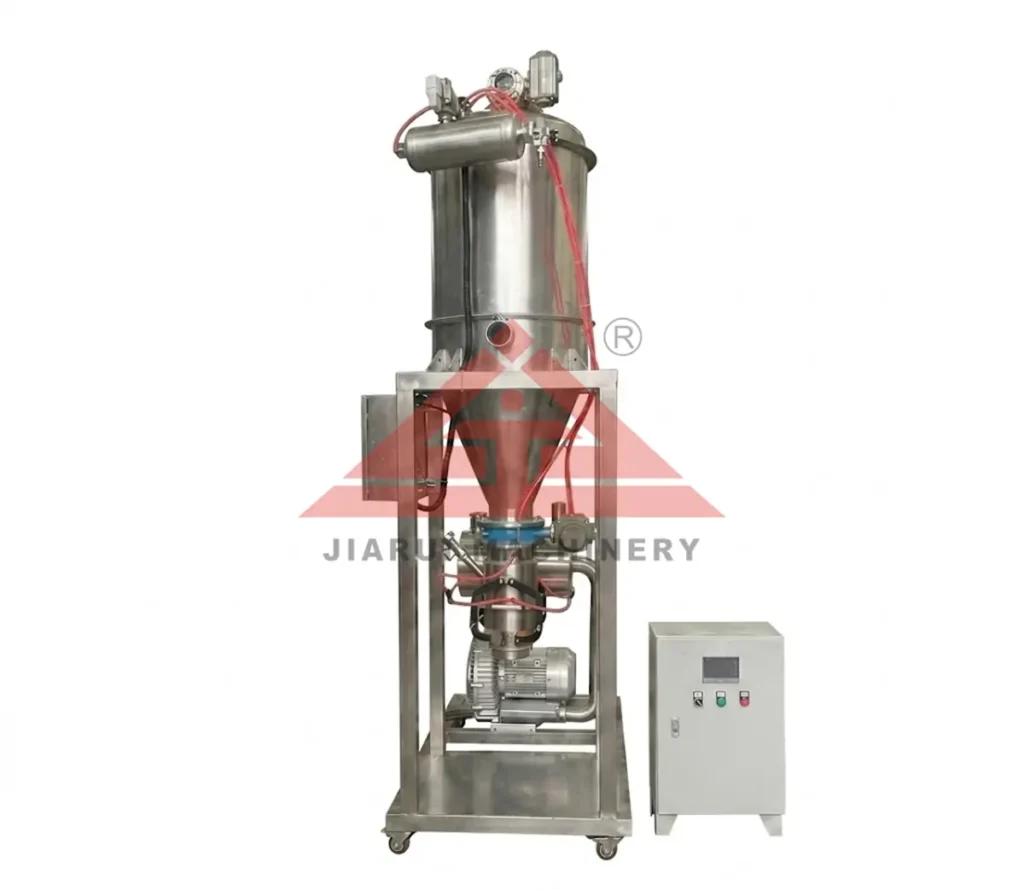
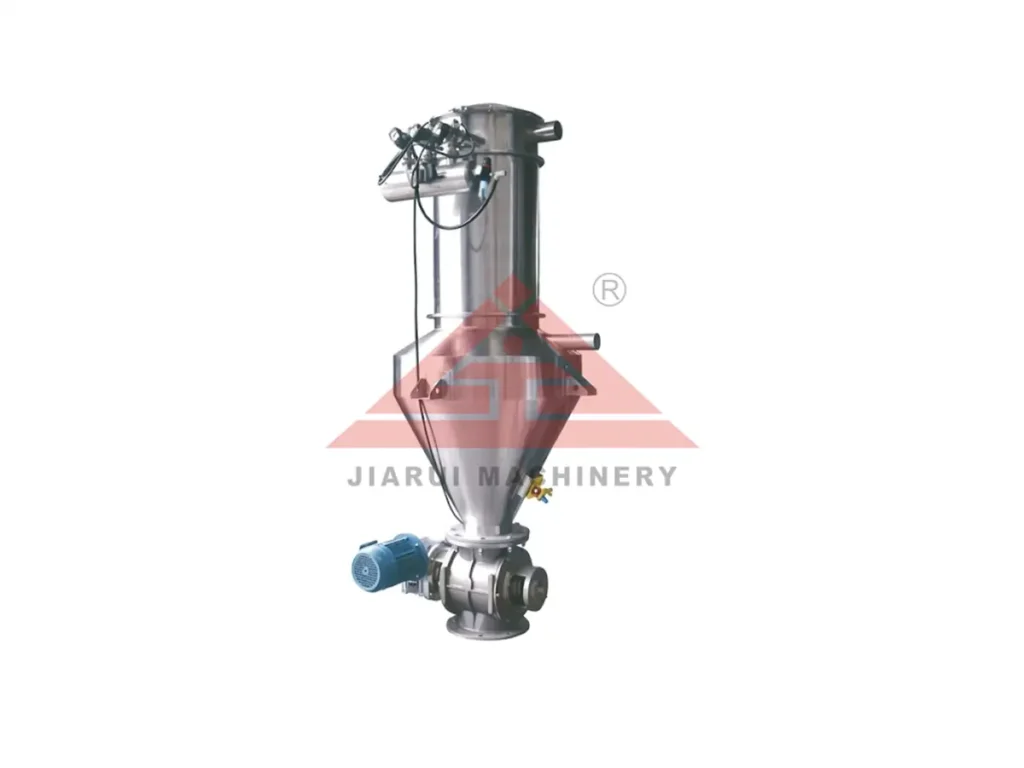
The working principle of a vacuum conveyor is relatively simple. After the vacuum source starts, it draws air out of the conveying system and creates negative pressure inside the pipeline. Because there is a pressure difference between the inside and outside of the pipeline, material enters the pipeline from a silo or hopper and is carried by the airflow to the receiving end. In the receiving hopper, the material is separated from the air and falls into the hopper, while the air passes through a filter before entering the vacuum system.The process can be understood in four steps:
- Create negative pressure:The vacuum source removes air from the conveying pipeline, making the pressure inside the pipeline lower than the surrounding pressure.
- Material enters the pipeline:Air is drawn into the pipeline through the feed inlet, carrying the powder or granular material forward.
- Separate the material from the air:After the material enters the receiving hopper, its velocity decreases and the material falls into the hopper. The filter captures fine powder in the airflow and prevents dust from entering the vacuum source.
- Discharge the material:The material is discharged from the hopper into the next piece of equipment. A conventional vacuum conveyor normally operates in cycles of suction, separation, and discharge, with the next conveying cycle starting after discharge is completed.
What Materials Are Suitable for Vacuum Conveying?
Vacuum conveyors are mainly used for powders, granules, and dry bulk materials. Whether a material is suitable depends not only on the material name, but also on its particle size, moisture content, flowability, and stickiness.

| Material Type | Common Materials | Suitable Conditions |
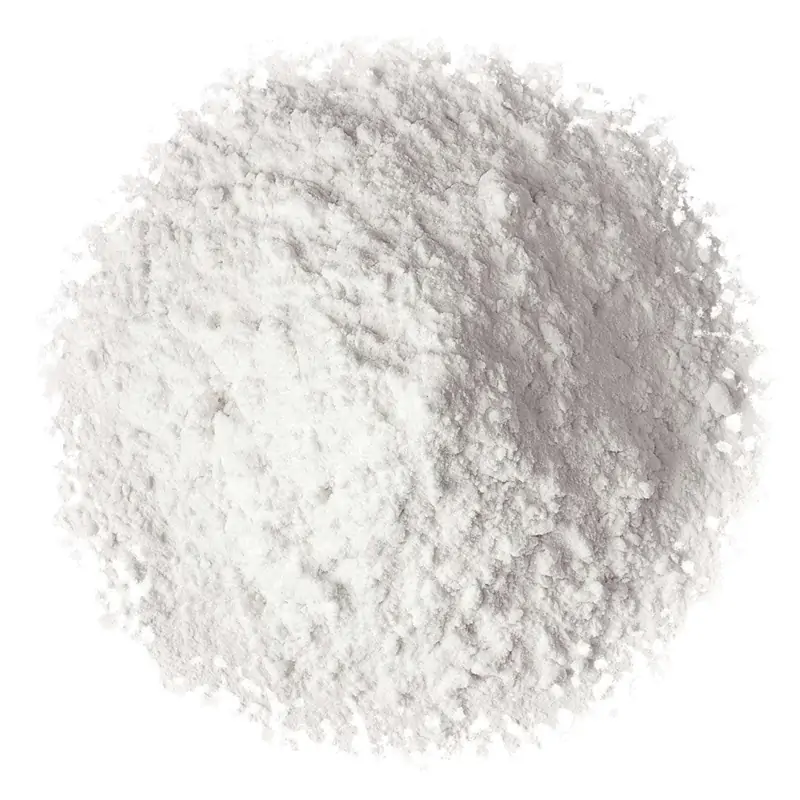
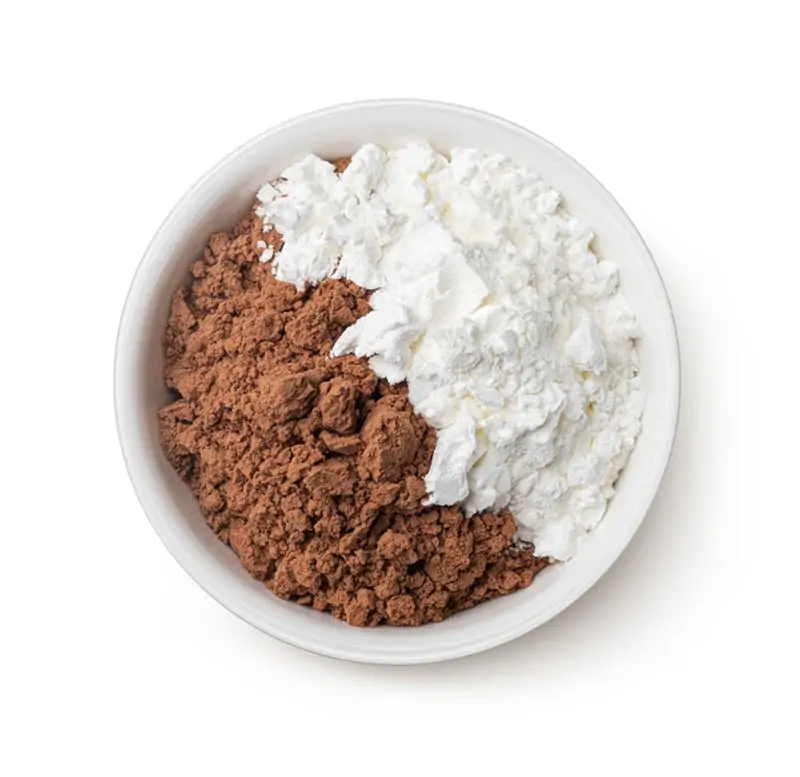
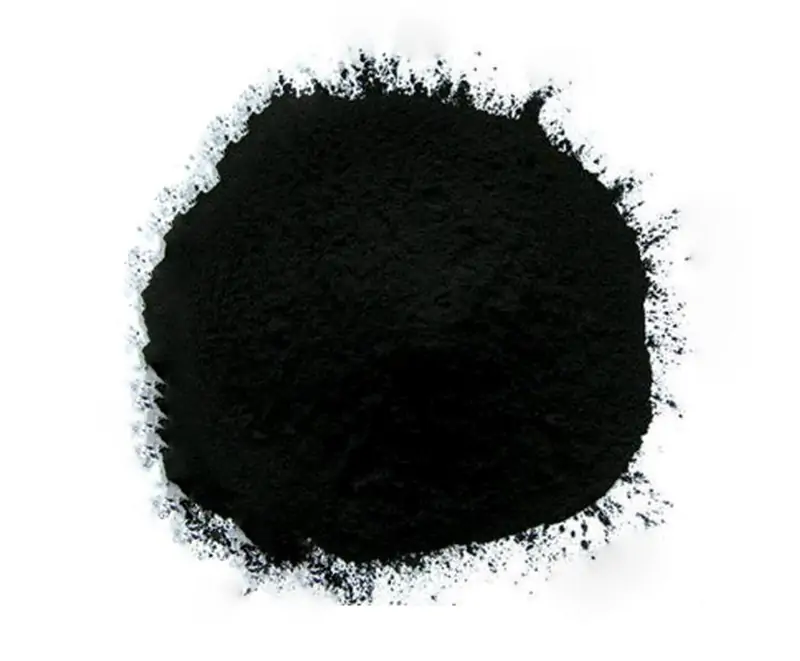
| Powders | Flour, starch, milk powder, graphite powder, chemical powders | Generally suitable for enclosed conveying |
| Granules | PE, PP, resin pellets, food granules | Suitable for automatic transfer between equipment |
| Fine bulk materials | Powders, fine particles, lightweight materials | Requires evaluation based on flowability and conveying capacity |
| High-moisture materials | Wet powders, wet granules | Prone to agglomeration and requires careful evaluation |
| Sticky materials | Powders that tend to stick to surfaces or build up on the walls | Pipeline and discharge conditions need to be considered |
| Large-particle or high-density materials | Large particles, high-density bulk materials | Particle size, density, and conveying distance need to be considered |
If the material absorbs moisture easily, forms lumps, tends to stick to surfaces, or has large particles or high bulk density, this does not necessarily mean that a vacuum conveyor cannot be used. The material condition and conveying requirements need to be evaluated further.
A simple rule of thumb: Dry powders and granules with good flowability are generally well suited to vacuum conveying. Materials that tend to agglomerate, stick, or have poor flowability require individual evaluation.
What Are Vacuum Conveyors Used For?
Vacuum conveying is mainly used for enclosed transfer of powders and granular materials between different pieces of equipment. The conveyor itself does not process the material; its main function is to automatically transfer material from one location to another. Common applications include:
| Application | Conveying Purpose |
| Silo → Mixer | Automatically feed raw materials into the mixing equipment and reduce manual loading |
| Silo → Packaging Machine | Automatically transfer powders or granules to the packaging equipment |
| Silo → Extruder | Convey plastic pellets, resin, and other materials while reducing manual handling |
| Silo → Screening Equipment | Enclosed transfer of material to vibrating screens, air classifiers, or other screening equipment |
| Equipment → Equipment | Connect different process stages and reduce manual material transfer and exposure |
If a production line requires enclosed conveying, automatic feeding, or transfer of powders and granular materials between equipment at different elevations, a vacuum conveyor can be considered as one conveying option.
Simply put, it can be understood as: Silo → Vacuum Conveyor → Next Piece of Equipment
The conveying pipeline completes the material transfer between the two points without repeated manual handling.
What Is the Difference Between Vacuum Conveying and Positive-Pressure Pneumatic Conveying?
Vacuum conveying is a type of pneumatic conveying. The main difference between vacuum conveying and positive-pressure pneumatic conveying is the pressure condition inside the conveying pipeline. Vacuum conveying uses negative pressure to “pull” the material, while positive-pressure pneumatic conveying uses positive pressure to “push” the material.
| Comparison Item | Vacuum Conveying | Positive-Pressure Pneumatic Conveying |
| Conveying method | Negative-pressure suction | Positive-pressure conveying |
| Material movement | Material is drawn toward the receiving end by airflow | Material is pushed toward the receiving end by airflow |
| Feeding method | Material is drawn from silos, hoppers, or other locations | A feeding device introduces material into the conveying pipeline |
| System layout | Suitable for drawing material from different locations and conveying it to receiving equipment | Suitable for conveying material downstream from a fixed feeding point |
| Selection considerations | Material characteristics, pickup location, conveying distance, receiving equipment | Material characteristics, feeding method, conveying distance, pipeline layout |
When to Choose Vacuum Conveying or Positive-Pressure Pneumatic Conveying?
If material needs to be drawn from one or more locations and conveyed to receiving equipment, vacuum conveying is usually a better fit. It is particularly suitable for enclosed conveying and automatic feeding of powders and granules. If material needs to be continuously conveyed from a fixed point to downstream equipment, positive-pressure pneumatic conveying is usually more suitable.
- Multiple pickup points → Vacuum conveying
- Fixed feeding point → Positive-pressure pneumatic conveying
Neither vacuum conveying nor positive-pressure pneumatic conveying is always the better choice. The right choice depends on the specific conveying conditions.
How Do You Select a Vacuum Conveyor?
If your material is a powder or granule and needs to be enclosed and automatically conveyed between a silo or hopper and a mixer, packaging machine, screening machine, extruder, or other equipment, a vacuum conveyor can generally be considered first.
| Production Requirement | Is Vacuum Conveying Suitable? |
| Powder or granular material | Generally suitable |
| Enclosed pipeline conveying | Suitable |
| Automatic pickup from a silo or hopper | Suitable |
| Material tends to agglomerate, stick, or absorb moisture | Requires further evaluation |
| Very high conveying capacity or very long conveying distance | Requires selection based on operating conditions |
| Downstream equipment requires continuous feeding | Continuous conveying configuration needs to be considered |
Once vacuum conveying has been selected, the key information to confirm includes material characteristics, conveying capacity, conveying distance, feed location, and discharge equipment. These factors largely determine the equipment configuration.
Quick check: Powder or granules + enclosed conveying + automatic feeding → Vacuum conveying can be considered first.
If these conditions are still unclear, that is not a problem. Tell Jiarui about your material and production line requirements, and we can help evaluate whether vacuum conveying is suitable before determining the specific solution.
FAQs
What materials can a vacuum conveyor convey?
Vacuum conveyors are mainly used for powders, granules, and dry bulk materials. Materials that tend to absorb moisture, agglomerate, or stick require further evaluation based on flowability, moisture content, and particle size.
How far can a vacuum conveyor convey material?
There is no single fixed conveying distance. The required distance depends on material characteristics, conveying capacity, pipeline length, the number of elbows, and conveying height. As the distance increases, the requirements for the vacuum source and conveying pipeline usually also increase.
Can a vacuum conveyor provide continuous conveying?
Yes, but the configuration needs to be selected according to the feeding requirements of the production line. Conventional vacuum conveyors normally operate in suction and discharge cycles. If the downstream equipment requires continuous feeding, a continuous vacuum feeding machine can be considered.
Does a vacuum conveyor generate dust during conveying?
Vacuum conveying uses an enclosed pipeline, which can reduce material exposure and dust release. The actual result also depends on equipment sealing, the filtration system, and the discharge structure, so it should not simply be understood as completely dust-free conveying. For materials that may form combustible dust, see the OSHA guidance on combustible dust for information on dust explosion hazards and control measures.
Which is better, a vacuum conveyor or a screw conveyor?
The two types of equipment use different conveying methods. Vacuum conveyors are suitable for enclosed transfer of powders and granules between different pieces of equipment, while screw conveyors are more suitable for continuous mechanical conveying along a fixed route. The choice depends on the material, conveying distance, and production line layout.
What information is needed to select a vacuum conveyor?
The main information required includes the material name, particle size, conveying capacity, conveying distance, conveying height, and feed and discharge equipment. If the material tends to absorb moisture, agglomerate, or stick, this should also be specified. Jiarui can use these operating conditions to help determine a suitable conveying method and equipment configuration.