
The JR series linear vibrating screen produced by Xinxiang Jiarui Electromechanical Manufacturing Co., Ltd. uses a vibrating motor as the excitation source, causing the material on the screen to be thrown up and move forward in a straight line. After the material is evenly fed into the feed port, it can be sieved through single- or multi-layer screens (1–6 layers) to separate materials by particle size. The oversize and undersize materials are discharged separately from their respective outlets. It has a large production capacity per unit, a simple structure, and is easy to maintain.
A dustproof cover can be added based on the material properties, and the fully enclosed structure prevents dust from escaping, creating a dust-free workshop. It can be connected with other equipment to form a production line. It is suitable for multiple industries such as food, pharmaceuticals, chemicals, building materials, and metallurgy, and we also provide non-standard customization services.
Proper linear vibrating screen operation is essential to maintain stable screening efficiency and extend equipment service life.
Let’s take a look at the operation and maintenance of the linear vibrating screen.
Linear Vibrating Screen Structure and Working Principle
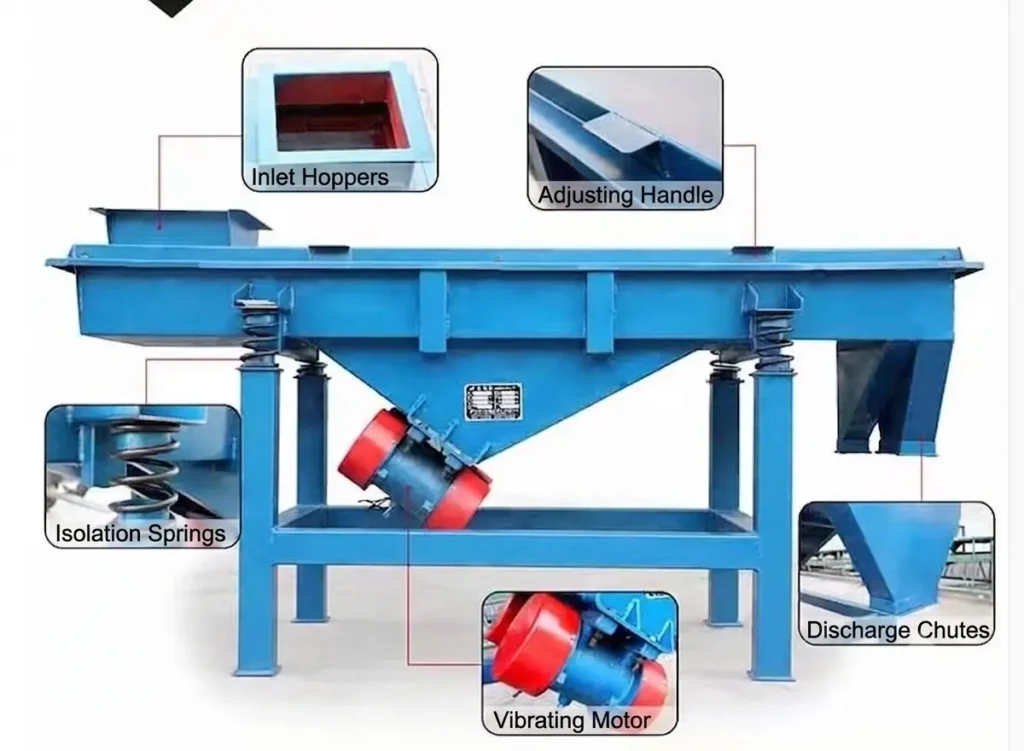
The Linear Vibrating Screen is composed of multiple parts, each of which has its corresponding function.
Below is a summary of some content:
| Component name | Material and Composition | Function Description |
| Vibrating sieve box | Welded together from several steel plates of different thicknesses | The main frame of the device must have sufficient strength and rigidity to support all components. |
| Sieve frame | It is usually made of wood with small deformation, such as pine. | Used to fix and support the sieve mesh, keep the sieve mesh flat, and ensure the sieving effect. |
| Sieve | A variety of materials are available, such as low-carbon steel, brass, and stainless steel wire, etc. | The critical working surface that comes into direct contact with the material to complete the classification operation. |
| Vibration Motor | Two symmetrically installed vibrating motors. | The core power source that generates exciting force. |
| Shock Absorbing Spring | Spiral springs or rubber springs. | Support the entire weight of the sieve box while isolating the transmission of vibration to the ground. When installing, the springs must be vertical to the ground. |
| stand | Composed of pillars and channel steel. | The base of the equipment, used to support the entire sieve machine body, with the pillars needing to be perpendicular to the ground during installation. |
Linear Vibrating Screen Operation
Step1:Linear Vibrating Screen Preparation Before Operation
Before performing screening operations, a systematic inspection of the vibrating screen is required. This is a critical step to ensure the equipment operates smoothly and safely during screening.
Pre-power-on basic installation check
- Remove the protective device: If the machine is being used for the first time, the support devices or protective frames used to secure the machine during transportation must be removed. Otherwise, the sieve machine may be damaged and its service life reduced.
- Check the machine position and sieve: Check if the machine is placed horizontally and stable without shaking; ensure that both foot bolts on either side are tightened securely to prevent the machine from moving randomly, which could affect its operation and safety. Inspect the screen mesh for any damage or protrusions, as these would impact the screening accuracy and prevent guaranteed precision in screening.
- Check the net cleaning device: Before starting the machine, residual materials on the screen surface and discharge port should be cleaned promptly to prevent accuracy from decreasing and inaccurate material screening caused by clogging. Check the de-clogging devices such as the spring balls in a timely manner to ensure they are intact and not missing, guaranteeing the normal operation of the de-clogging devices. This reduces the phenomenon of repeated shutdowns due to clogging and improves screening efficiency.
- Confirm the motor rotation direction: Check if the vibration motor angles are synchronized and consistent, and ensure that parts such as the power interface are in good contact with no damage to prevent machine damage.
- Check the airtightness of the inlet and outlet ports: If there is a need to integrate the production line, it is essential to carefully inspect whether the discharge port has already been properly sealed in contact with upstream and downstream equipment to prevent leakage or mixing of materials, thereby ensuring the quality of the materials.
Step2: Startup and Operating Procedures
Before Starting Operation
Before feeding materials, the machine should be run idle first to check if all aspects of its operation are normal, so as to avoid delaying the running schedule for this reason.
- Start without loading material first. Start the equipment first without pouring any material into it, run it for about 3 minutes, check if the vibration motor inside the machine vibrates synchronously and if the operating direction is correct, ensuring there are no abnormal noises or significant shaking of the machine.
- When the machine starts up, it operates normally. The material is then fed into it. The material needs to be evenly fed back and forth across the screen surface according to its width to avoid uneven force distribution on the screen when feeding from one side only. This prevents the material from deviating on the screen surface, which would otherwise affect screening efficiency and accuracy.
During Operation
After running the no-load test and confirming there are no abnormalities in all aspects, you can proceed with feeding material for the trial run, entering the normal screening phase.
- When the machine starts up, it operates normally. The material is then fed into it. The material needs to be evenly fed back and forth across the screen surface according to its width to avoid uneven force distribution on the screen when feeding from one side only. This prevents the material from deviating on the screen surface, which would otherwise affect screening efficiency and accuracy.
- When feeding materials, we should supply them evenly and continuously, and should not throw them from a height into the screen. This is to prevent damage to the screen caused by intense impact forces.
- During the operation of the screening machine, it is necessary to continuously monitor various aspects of its operating condition, such as whether there are abnormal noises, vibrations, or excessively high motor temperatures.
Step3: Shutdown Procedure After Operation
Power must be turned off and the machine shut down only after all material on the screen has been emptied. If connected to a production line, upstream feeding equipment should be stopped first to extend the screen’s lifespan.
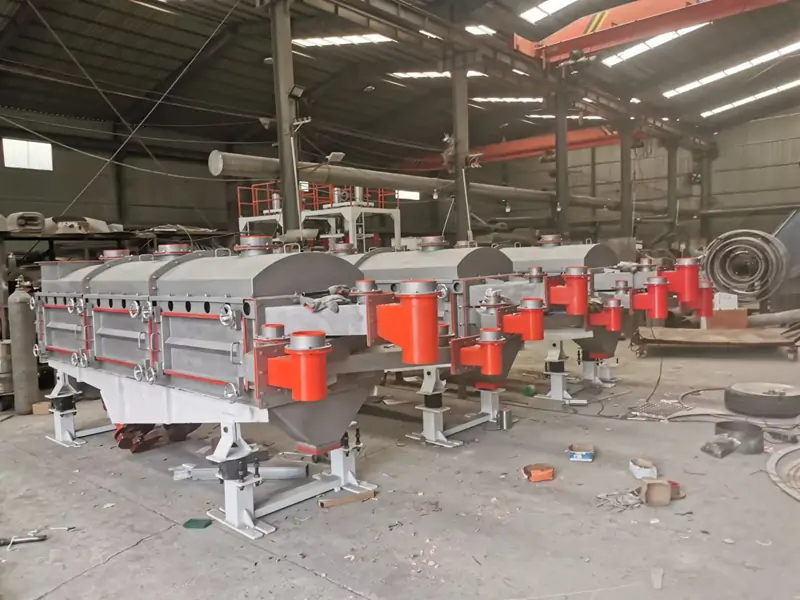
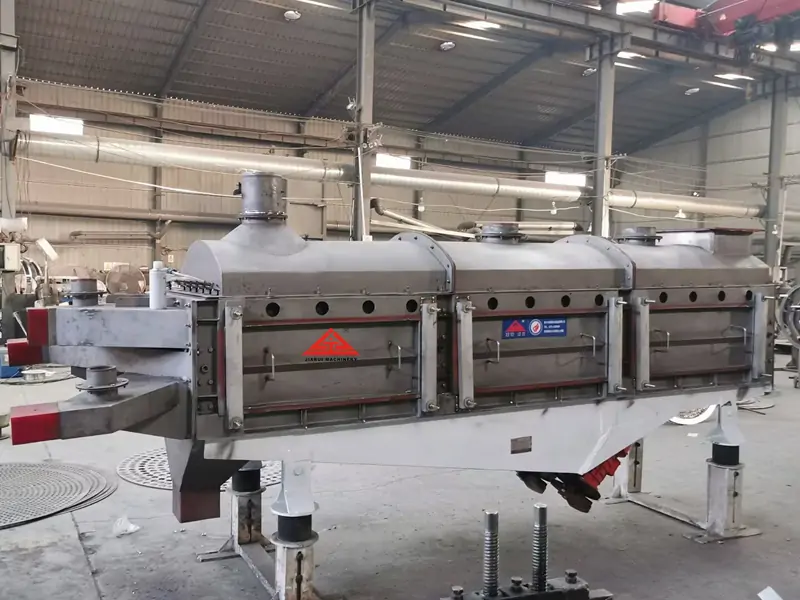
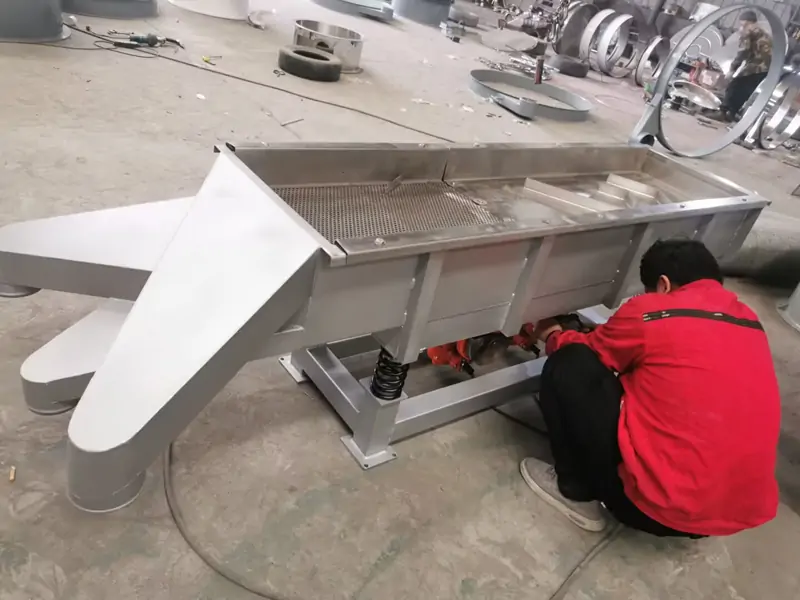
Linear Vibrating Screen Maintenance Tips
Properly maintaining machines is a key step in extending their lifespan.
- Daily maintenance: After the machine stops, the sieve mesh and sieve box need to be cleaned promptly to prevent residual material buildup, which could affect the accuracy and efficiency of subsequent material sieving.
- Check if the screen mesh is damaged or bulging, and ensure the cleaning device is intact to guarantee the machine’s screening efficiency.
- Check if the motor is overheating and if there is any material leakage; the spring and other accessories remain intact with no signs of breakage.
- Regularly clean the machine, check for aging of wiring and various components, tighten screws and bolts, and prevent equipment failures and shutdowns.
Common Linear Vibrating Screen Problems and Solutions
Here are some common faults of the Linear Vibrating Screen and their corresponding solutions.
| Fault Phenomenon | Possible Causes | Troubleshooting and Handling Steps |
|---|---|---|
| Materials not moving or deviating from the screening path | 1. The two motors rotate in the same direction. 2. Unbalanced excitation force (inconsistent eccentric block angles). 2. Unbalanced excitation force (inconsistent eccentric block angles). | 1. Adjust the motor wiring to ensure opposite rotation directions. 2. Adjust the eccentric block angles to make them consistent. 3. Check and replace the spring sets with the same height. |
| Bearing overheating (>75°C) | 1. Excessive or insufficient grease lubrication. 2. Bearing wear or damage. 3. Motor overload. | 1. Add or remove grease to maintain an appropriate amount. 2. Inspect and replace the damaged bearings. 2. Inspect and replace the damaged bearings. |
| Abnormal noise | 1. Loose bolts. 2. Bearing damage. 3. Broken springs or spring collision. | 1. Stop the machine immediately and tighten all bolts. 2. Inspect and replace the bearings. 3. Check the springs and replace them as a complete set if necessary. |
| Low screening efficiency | 1. Screen mesh blockage. 2. Excessive feeding rate or overly thick material layer. 3. Insufficient vibration amplitude. | 1. Stop the machine and clean the screen mesh. 2. Adjust the feeding gate to control the feed rate. 3. Adjust the eccentric block counterweight to increase the vibration force. |
Conclusion
The Jiarui linear vibrating screen delivers stable and efficient material separation performance across multiple industries. By following proper installation, operation, and maintenance procedures, users can significantly enhance equipment reliability and maximize production efficiency.
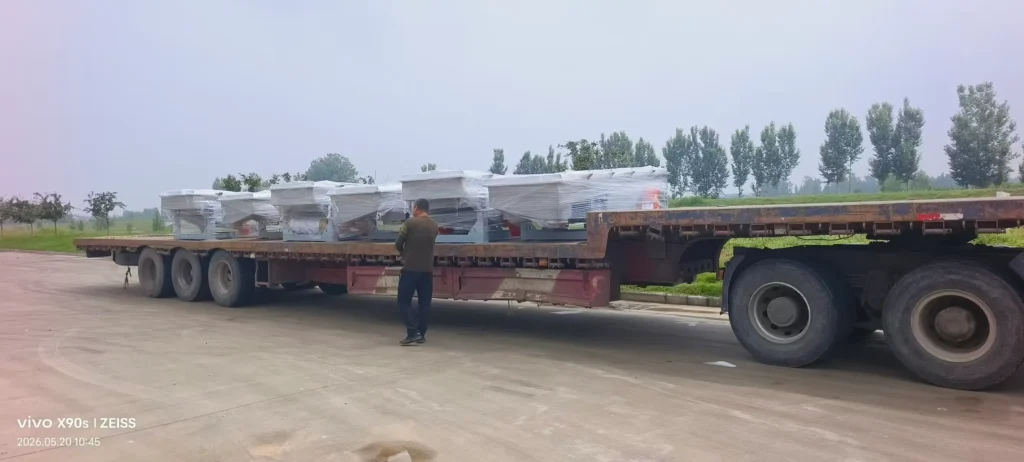
Regular inspection, timely lubrication, and immediate replacement of worn components are essential to ensure long-term stable operation.