
Le crible vibrant linéaire de la série JR fabriqué par Xinxiang Jiarui Electromechanical Manufacturing Co., Ltd. utilise un moteur vibrant comme source d'excitation, ce qui fait que le matériau sur le tamis est projeté vers le haut et avance en ligne droite. Après que le matériau est introduit uniformément dans l'orifice d'alimentation, il peut être tamisé à travers des tamis simples ou multicouches (1 à 6 couches) pour séparer les matériaux par taille de particules. Les matériaux refusés et passants sont déchargés séparément par leurs sorties respectives. Il offre une grande capacité de production par unité, une structure simple et est facile à entretenir.
Un couvercle anti-poussière peut être ajouté en fonction des propriétés du matériau, et la structure entièrement fermée empêche la poussière de s'échapper, créant ainsi un atelier sans poussière. Il peut être connecté à d'autres équipements pour former une ligne de production. Il convient à plusieurs industries telles que l'alimentation, les produits pharmaceutiques, les produits chimiques, les matériaux de construction et la métallurgie, et nous fournissons également des services de personnalisation non standard.
Un fonctionnement correct du crible vibrant linéaire est essentiel pour maintenir une efficacité de tamisage stable et prolonger la durée de vie de l'équipement.
Examinons le fonctionnement et la maintenance du crible vibrant linéaire.
Structure et principe de fonctionnement du crible vibrant linéaire
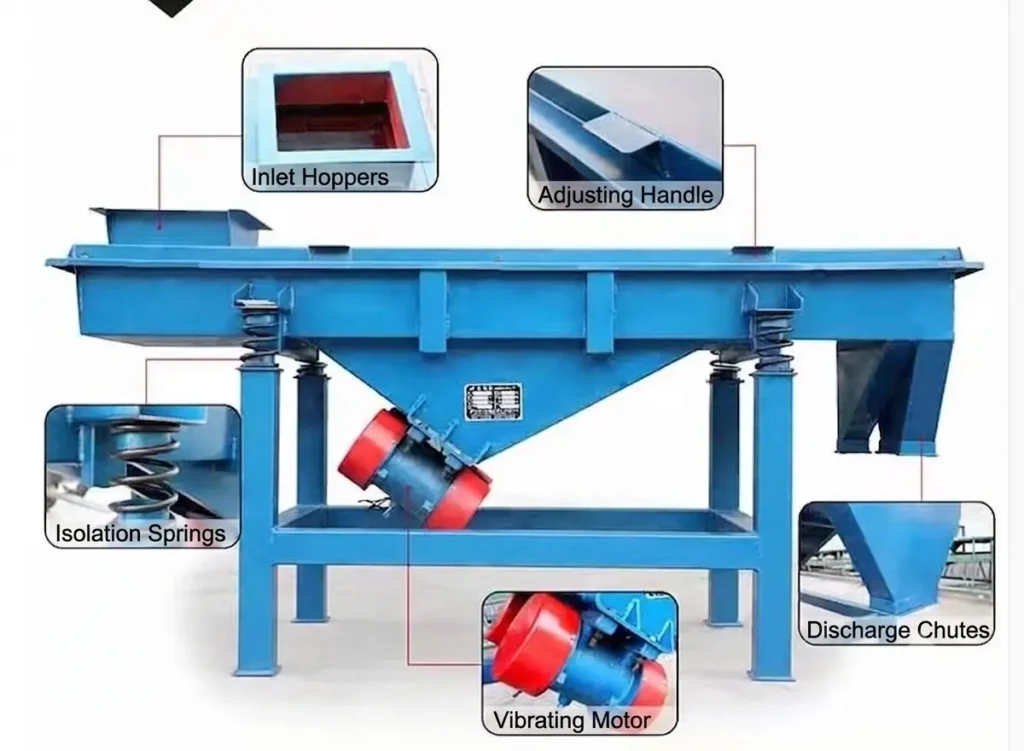
Le crible vibrant linéaire est composé de plusieurs pièces, chacune ayant sa fonction correspondante.
Voici un résumé de certains contenus :
| Nom du composant | Matériau et composition | Description de la fonction |
| Caisse de criblage vibrante | Soudée à partir de plusieurs plaques d'acier d'épaisseurs différentes | Le châssis principal de l'équipement doit avoir une résistance et une rigidité suffisantes pour supporter tous les composants. |
| Cadre du tamis | Il est généralement fabriqué en bois avec une faible déformation, comme le pin. | Utilisé pour fixer et soutenir la toile de criblage, maintenir la toile de criblage plane et garantir l'efficacité du tamisage. |
| Toile de criblage | Une variété de matériaux sont disponibles, tels que l'acier à faible teneur en carbone, le laiton et le fil en acier inoxydable, etc. | La surface de travail critique qui entre en contact direct avec le matériau pour effectuer l'opération de classification. |
| Moteur vibrant | Deux moteurs vibrants installés symétriquement. | La source d'alimentation principale qui génère la force d'excitation. |
| Ressort amortisseur | Ressorts hélicoïdaux ou ressorts en caoutchouc. | Supporte le poids total de la caisse de criblage tout en isolant la transmission des vibrations au sol. Lors de l'installation, les ressorts doivent être verticaux par rapport au sol. |
| Support | Composé de piliers et de profilés en U. | La base de l'équipement, utilisée pour soutenir l'ensemble du corps de la cribleuse, les piliers devant être perpendiculaires au sol lors de l'installation. |
Utilisation du crible vibrant linéaire
Étape 1 : Préparation du crible vibrant linéaire avant le fonctionnement
Avant d'effectuer les opérations de tamisage, une inspection systématique du crible vibrant est requise. C'est une étape critique pour garantir que l'équipement fonctionne de manière fluide et sûre pendant le tamisage.
Vérification d'installation de base avant la mise sous tension
- Retirer le dispositif de protection : Si la machine est utilisée pour la première fois, les dispositifs de support ou les cadres de protection utilisés pour sécuriser la machine pendant le transport doivent être retirés. Sinon, la cribleuse pourrait être endommagée et sa durée de vie réduite.
- Vérifier la position de la machine et le crible: Vérifier si la machine est placée horizontalement et stable sans vaciller ; s'assurer que les deux boulons de pied de chaque côté sont serrés correctement pour empêcher la machine de bouger de manière aléatoire, ce qui pourrait affecter son fonctionnement et sa sécurité. Inspecter la toile du tamis pour détecter tout dommage ou protubérance, car ceux-ci affecteraient la précision du tamisage et empêcheraient une précision garantie du tamisage.
- Vérifier le dispositif de nettoyage de la toile : Avant de démarrer la machine, les matériaux résiduels sur la surface du tamis et à l'orifice de décharge doivent être nettoyés rapidement pour éviter une diminution de la précision et un tamisage inexact des matériaux causé par le colmatage. Vérifier les dispositifs de décolmatage tels que les billes à ressort en temps opportun pour s'assurer qu'ils sont intacts et non manquants, garantissant le fonctionnement normal des dispositifs de décolmatage. Cela réduit le phénomène d'arrêts répétés dus au colmatage et améliore l'efficacité du tamisage.
- Confirmer le sens de rotation du moteur : Vérifier si les angles du moteur vibrant sont synchronisés et cohérents, et s'assurer que des pièces telles que l'interface d'alimentation sont en bon contact sans dommage pour éviter tout dommage à la machine.
- Vérifier l'étanchéité des orifices d'entrée et de sortie : S'il est nécessaire d'intégrer la ligne de production, il est essentiel d'inspecter soigneusement si l'orifice de décharge a déjà été correctement scellé en contact avec les équipements en amont et en aval pour éviter les fuites ou le mélange des matériaux, garantissant ainsi la qualité des matériaux.
Étape 2 : Procédures de démarrage et de fonctionnement
Avant de commencer le fonctionnement
Avant d'introduire les matériaux, la machine doit d'abord fonctionner à vide pour vérifier si tous les aspects de son fonctionnement sont normaux, afin d'éviter de retarder le calendrier de fonctionnement pour cette raison.
- Démarrer sans charger de matériau d'abord. Démarrer l'équipement d'abord sans verser de matériau, le faire fonctionner pendant environ 3 minutes, vérifier si le moteur vibrant à l'intérieur de la machine vibre de manière synchrone et si la direction de fonctionnement est correcte, en s'assurant qu'il n'y a pas de bruits anormaux ou de secousses importantes de la machine.
- Lorsque la machine démarre, elle fonctionne normalement. Le matériau est ensuite introduit. Le matériau doit être alimenté uniformément d'avant en arrière sur la surface du tamis en fonction de sa largeur pour éviter une répartition inégale des forces sur le tamis lors de l'alimentation d'un seul côté. Cela empêche le matériau de dévier sur la surface du tamis, ce qui affecterait autrement l'efficacité et la précision du tamisage.
Pendant le fonctionnement
Après avoir effectué l'essai à vide et confirmé qu'il n'y a aucune anomalie à tous les niveaux, vous pouvez procéder à l'alimentation en matériau pour l'essai de fonctionnement, en entrant dans la phase normale de criblage.
- Lorsque la machine démarre, elle fonctionne normalement. Le matériau est ensuite introduit. Le matériau doit être alimenté uniformément d'avant en arrière sur la surface du tamis en fonction de sa largeur pour éviter une répartition inégale des forces sur le tamis lors de l'alimentation d'un seul côté. Cela empêche le matériau de dévier sur la surface du tamis, ce qui affecterait autrement l'efficacité et la précision du tamisage.
- Lors de l'alimentation des matériaux, nous devons les fournir uniformément et en continu, et ne pas les jeter d'une hauteur dans la toile. Cela permet d'éviter les dommages à la toile causés par des forces d'impact intenses.
- Pendant le fonctionnement de la machine de criblage, il est nécessaire de surveiller en continu divers aspects de son état de fonctionnement, tels que la présence de bruits anormaux, de vibrations ou de températures de moteur excessivement élevées.
Étape 3 : Procédure d'arrêt après le fonctionnement
L'alimentation doit être coupée et la machine arrêtée uniquement après que tout le matériau sur le tamis a été vidé. Si elle est connectée à une ligne de production, l'équipement d'alimentation en amont doit être arrêté en premier pour prolonger la durée de vie du tamis.
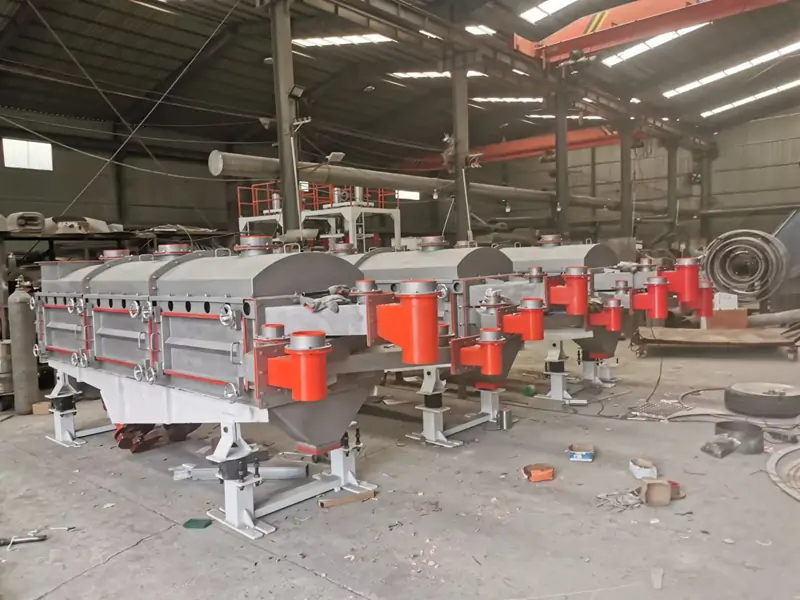
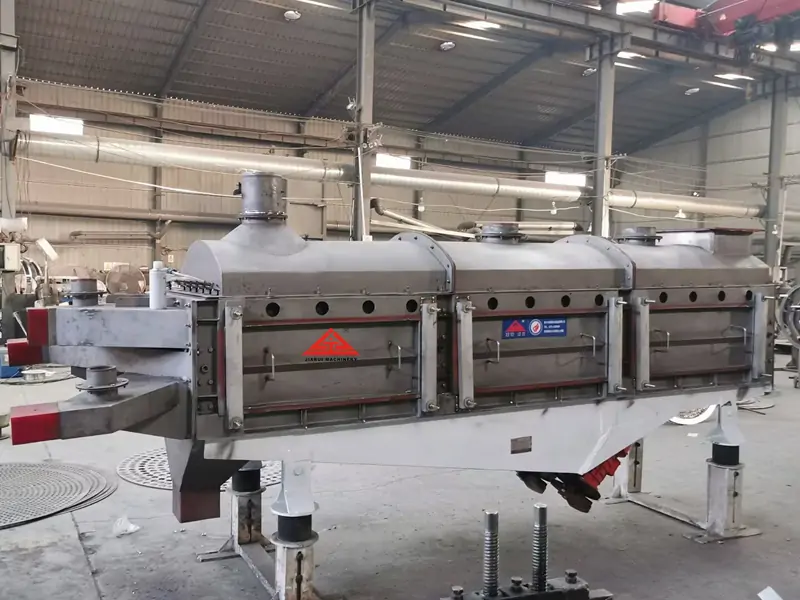
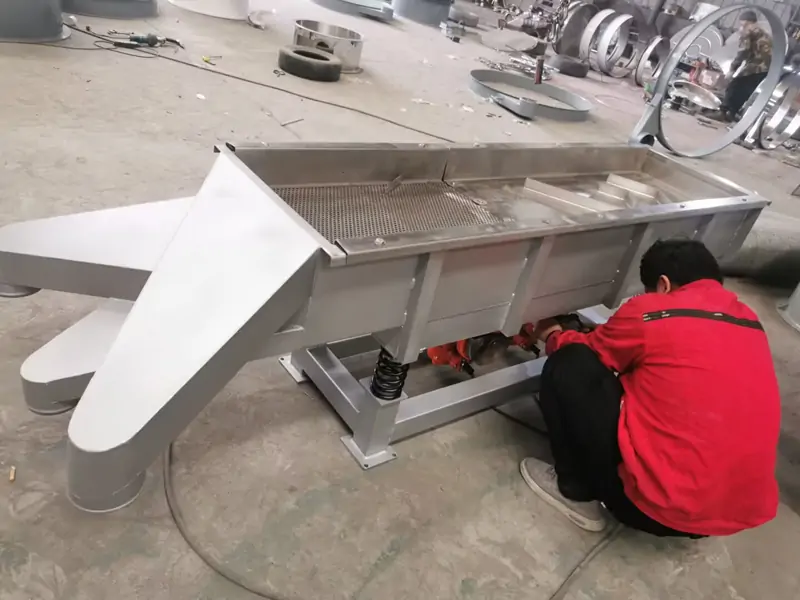
Conseils de maintenance du crible vibrant linéaire
Entretenir correctement les machines est une étape clé pour prolonger leur durée de vie.
- Maintenance quotidienne : après l'arrêt de la machine, la toile du tamis et la caisse de tamisage doivent être nettoyées rapidement pour éviter l'accumulation de matériaux résiduels, ce qui pourrait affecter la précision et l'efficacité du tamisage des matériaux suivants.
- Vérifier si la toile du tamis est endommagée ou bombée, et s'assurer que le dispositif de nettoyage est intact pour garantir l'efficacité de tamisage de la machine.
- Vérifier si le moteur surchauffe et s'il y a des fuites de matériaux ; le ressort et les autres accessoires restent intacts sans signes de rupture.
- Nettoyer régulièrement la machine, vérifier le vieillissement du câblage et des divers composants, serrer les vis et les boulons, et prévenir les pannes d'équipement et les arrêts.
Problèmes courants du crible vibrant linéaire et solutions
Voici quelques pannes courantes du crible vibrant linéaire et leurs solutions correspondantes.
| Phénomène de panne | Causes possibles | Étapes de dépannage et de traitement |
|---|---|---|
| Matériaux ne se déplaçant pas ou déviant du chemin de tamisage | Les deux moteurs tournent dans le même sens. Force d'excitation déséquilibrée (angles des blocs excentriques incohérents). Force d'excitation déséquilibrée (angles des blocs excentriques incohérents). | Ajuster le câblage du moteur pour garantir des sens de rotation opposés. Ajuster les angles des blocs excentriques pour les rendre cohérents. Vérifier et remplacer les ensembles de ressorts avec la même hauteur. |
| Surchauffe des roulements (>75°C) | Lubrification à la graisse excessive ou insuffisante. Usure ou dommage des roulements. Surcharge du moteur. | Ajouter ou retirer de la graisse pour maintenir une quantité appropriée. Inspecter et remplacer les roulements endommagés. Inspecter et remplacer les roulements endommagés. |
| Bruit anormal | Boulons desserrés. Dommage des roulements. Ressorts cassés ou collision des ressorts. | Arrêter la machine immédiatement et serrer tous les boulons. Inspecter et remplacer les roulements. Vérifier les ressorts et les remplacer en jeu complet si nécessaire. |
| Faible efficacité de criblage | Colmatage de la maille de tamis. Débit d'alimentation excessif ou couche de matière trop épaisse. Amplitude de vibration insuffisante. | Arrêter la machine et nettoyer la maille de tamis. Ajuster la porte d'alimentation pour contrôler le débit d'alimentation. Ajuster le contrepoids du bloc excentrique pour augmenter la force de vibration. |
Conclusion
Le Jiarui Le crible vibrant linéaire offre des performances de séparation de matériaux stables et efficaces dans de multiples industries. En suivant les procédures appropriées d'installation, d'exploitation et de maintenance, les utilisateurs peuvent considérablement améliorer la fiabilité de l'équipement et maximiser l'efficacité de production.
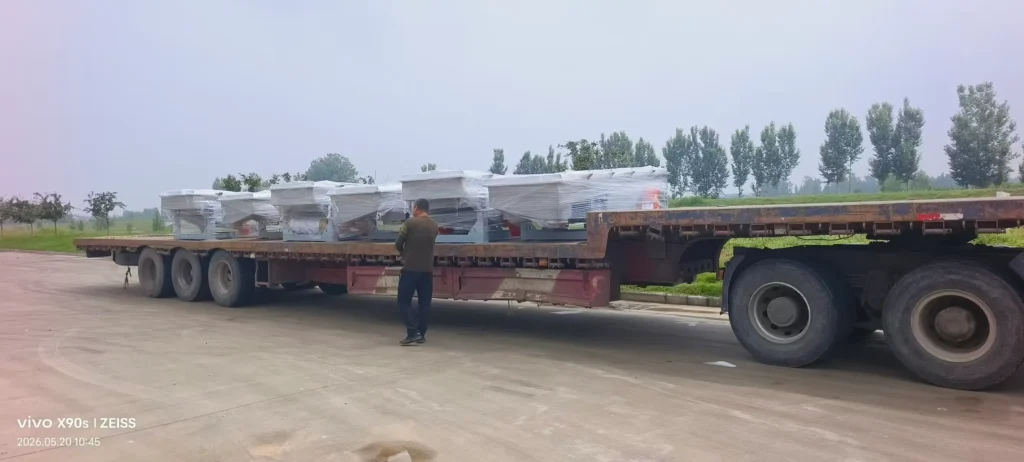
Une inspection régulière, une lubrification en temps opportun et un remplacement immédiat des composants usés sont essentiels pour garantir un fonctionnement stable à long terme.