
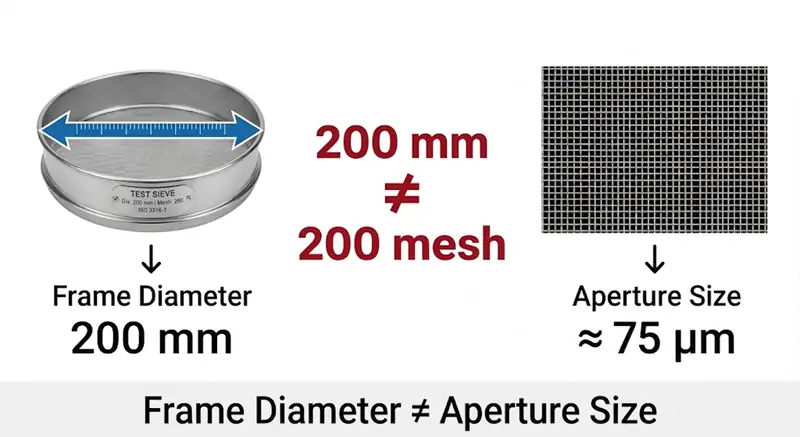
Standard sieve sizes are often described using numbers such as 200 mm, 75 μm, and 200 mesh. These numbers do not refer to the same thing. 200 mm refers to the diameter of the sieve frame, 75 μm refers to the sieve aperture size, and 200 mesh is another common way of specifying the sieve opening.
It is important to note that 200 mm and 200 mesh are not the same: 200 mm refers to the sieve frame size, while 200 mesh refers to the sieve opening size.
What are the common standard sieve sizes?
Standard sieve sizes are usually described first by the sieve frame diameter. Common diameters include 75 mm, 100 mm, 200 mm, 300 mm, and 450 mm. For example, a 200 mm test sieve means that the sieve frame has a diameter of approximately 200 mm. It does not mean that the sieve has a 200-mesh opening.For a broader explanation of the differences between sieve frame diameter, sieve opening size, and mesh count, see our guide to Different Sieve Sizes.
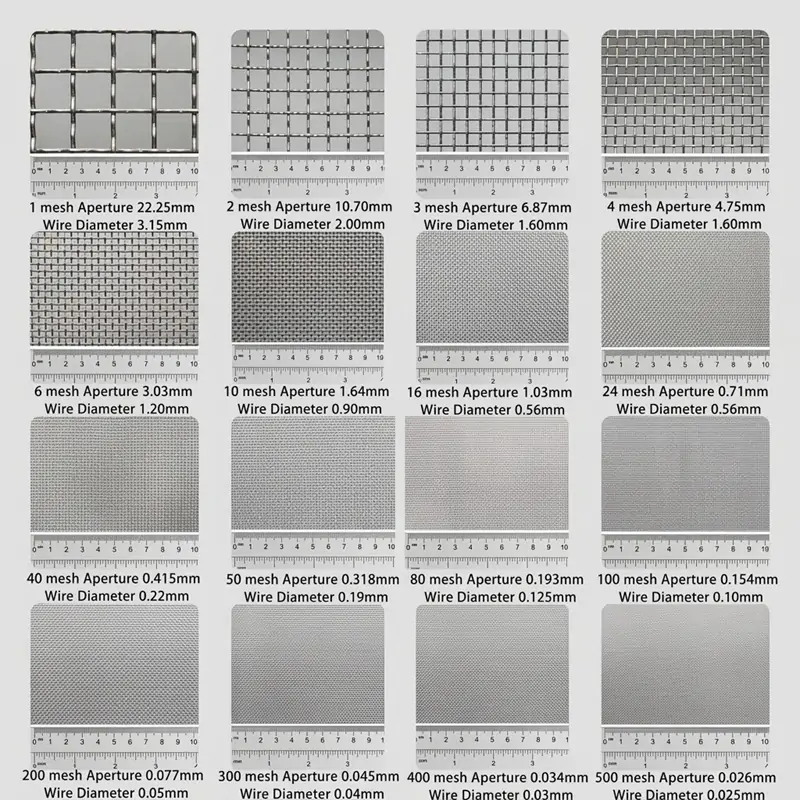
After the frame diameter is determined, the appropriate sieve opening size can be selected based on the required screening size.
Common Sieve Aperture and Mesh Size Conversion
The aperture size of a standard test sieve is commonly expressed in micrometers (μm), millimeters (mm), or mesh.
| Mesh | Aperture Size (μm) | Aperture Size (mm) |
|---|---|---|
| 20 mesh | Approx. 850 | 0.850 |
| 40 mesh | Approx. 425 | 0.425 |
| 60 mesh | Approx. 250 | 0.250 |
| 80 mesh | Approx. 180 | 0.180 |
| 100 mesh | Approx. 150 | 0.150 |
| 120 mesh | Approx. 125 | 0.125 |
| 140 mesh | Approx. 106 | 0.106 |
| 170 mesh | Approx. 90 | 0.090 |
| 200 mesh | Approx. 75 | 0.075 |
| 230 mesh | Approx. 63 | 0.063 |
| 270 mesh | Approx. 53 | 0.053 |
| 325 mesh | Approx. 45 | 0.045 |
| 400 mesh | Approx. 38 | 0.038 |
For example, a 200-mesh test sieve has an aperture of approximately 75 μm, or 0.075 mm. These values are commonly used for describing test sieve openings; the exact designation and tolerance should be confirmed against the applicable standard. For a broader reference, see our Vibrating Screen Mesh Size and Aperture Comparison Table.
The correspondence between mesh and aperture size can vary between standards. When placing an order, it is better to confirm the exact aperture size and applicable standard rather than providing only a mesh number such as 200 mesh.
What Is the Difference Between Sieve Aperture Size and Sieve Frame Diameter?
The aperture size determines the particle size that can pass through the sieve, while the frame diameter determines the overall size of the sieve. For example, two test sieves can both have a 75 μm aperture, with one having a 100 mm diameter and the other having a 200 mm diameter. They have the same aperture size, but different screening areas.
Therefore, when selecting a test sieve, the aperture size and frame diameter need to be specified separately.If you also need to understand the difference between a sieve and a complete sifting machine, see our Sieve vs Sifter guide.
What Are Different Sieve Aperture Sizes Used For?
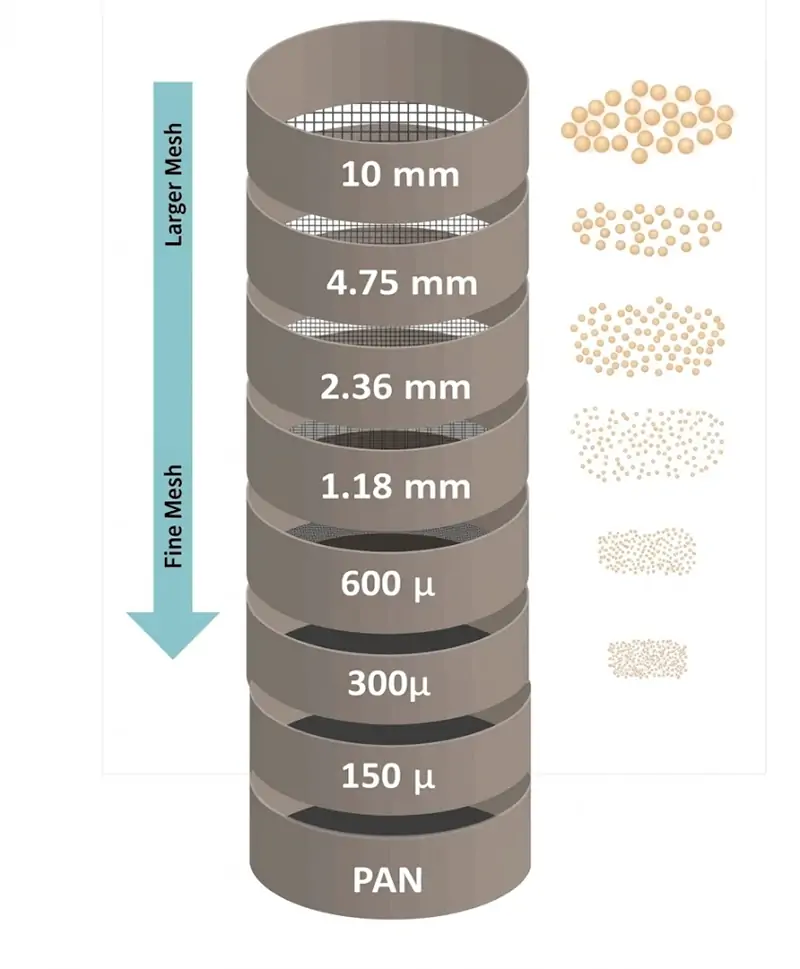
The aperture size mainly depends on the particle size you need to separate or test. Sieve analysis can help show how the material is distributed across different particle size ranges.
| Aperture Size | Common Use |
| Above 2 mm | Larger particles, sand, aggregates, etc. |
| 850–425 μm | Coarser powders and particles |
| 250–150 μm | Medium-sized powders and particles |
| 125–75 μm | Fine powders and particles |
| 53–38 μm | Finer powder testing |
These are only common ranges. The specific aperture size still depends on particle size and testing requirements.For continuous industrial screening of very fine powders, an Ultrasonic Vibrating Screen can be considered when fine mesh screening is required.
For example, if you want to separate larger particles around 1 mm, you should not use a 75 μm aperture because the opening is too small. On the other hand, if you need to test particles around 75 μm, you can select a sieve with an aperture close to this size.
Therefore, when choosing a standard test sieve, do not first ask “Which mesh size is best?” First determine the particle size that needs to be separated or tested, and then select the appropriate aperture size.
How Do You Choose the Right Standard Test Sieve?
- When selecting standard sieve sizes, first look at the particle size that needs to be screened or tested and determine the required aperture size.
- Then determine the sieve frame diameter. Common diameters include 75 mm, 100 mm, 200 mm, 300 mm, and 450 mm.
- If the sieve is used for laboratory testing, also confirm the applicable standard, such as ASTM E11 or ISO 3310-1, as well as the sieve cloth material. ASTM E11 covers the construction and requirements of woven wire test sieves, while ISO 3310-1 specifies technical requirements and testing methods for metal wire cloth test sieves.
When ordering, you can provide:
- Sieve frame diameter
- Aperture size
- Applicable standard
- Sieve cloth material
For example: 200 mm diameter, 75 μm aperture, ASTM E11, stainless steel.
If you are not sure which size to choose, you can provide the material, target aperture size, and applicable standard to Jiarui, and we can help confirm the suitable test sieve specification.
FAQs
What does a 200 mm test sieve mean?
200 mm refers to the sieve frame diameter, not the aperture size. In other words, a 200 mm test sieve has a sieve frame with a diameter of approximately 200 mm. The specific aperture size needs to be specified separately.
What is 200 mesh in microns?
200 mesh is approximately 75 μm, or 0.075 mm. However, when ordering, it is better to confirm the exact aperture size and applicable standard.
What is the difference between 100 mesh and 200 mesh?
The main difference is the aperture size. A 100-mesh sieve has an aperture of approximately 150 μm, while a 200-mesh sieve has an aperture of approximately 75 μm. Therefore, the 200-mesh sieve has smaller openings.
Are a 200 mm test sieve and a 200-mesh test sieve the same?
No. 200 mm refers to the sieve frame diameter, while 200 mesh refers to the aperture specification. A test sieve can be both 200 mm in diameter and 200 mesh, meaning it has an approximately 200 mm diameter frame and a 75 μm aperture.
How do you determine the aperture size of a standard test sieve?
First determine the particle size that needs to be screened or tested, and then select the corresponding aperture size. If the test method specifies an aperture size, the sieve should be selected according to that standard rather than based only on the mesh number.
Can standard test sieves be customized?
Yes. If standard sizes do not meet your requirements, you can provide the sieve frame diameter, aperture size, applicable standard, and sieve cloth material. Jiarui can customize test sieves based on these specifications.