What is a double cone mixer?
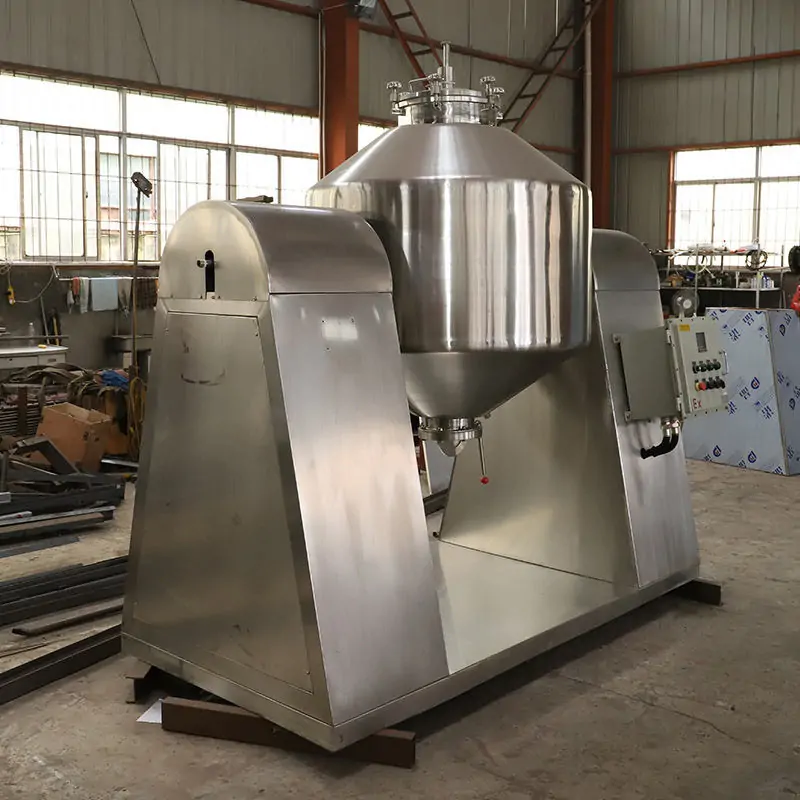
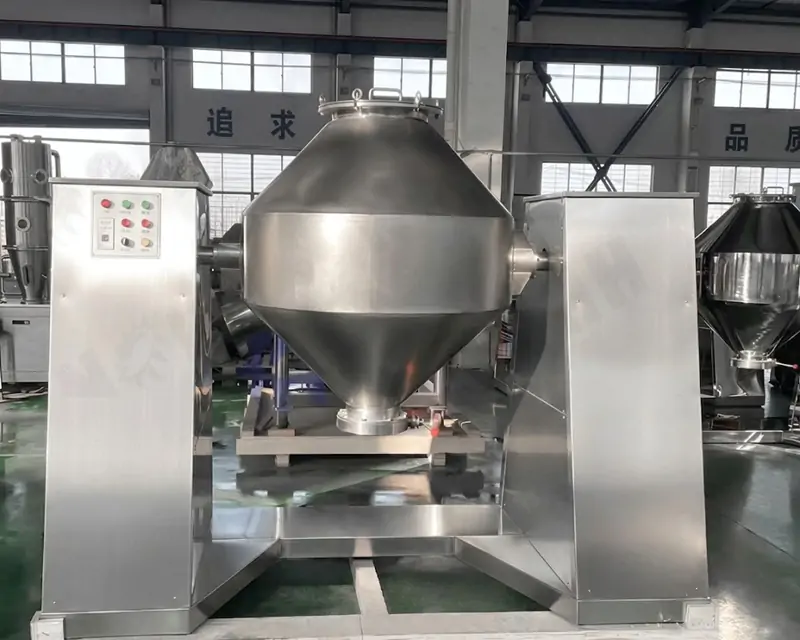
A double cone mixer is a mechanical device that feeds powder or granular materials into a double-cone container via vacuum conveying or manual loading. As the container continuously rotates, the materials undergo complex impact movements within it, achieving uniform mixing. The double cone mixer is used to achieve standardized solid-solid mixing. Mixing is a common step in the product assembly process, for example, in the plastic, fertilizer, cosmetic, chemical, detergent, healthcare, and food industries.
Core Advantages
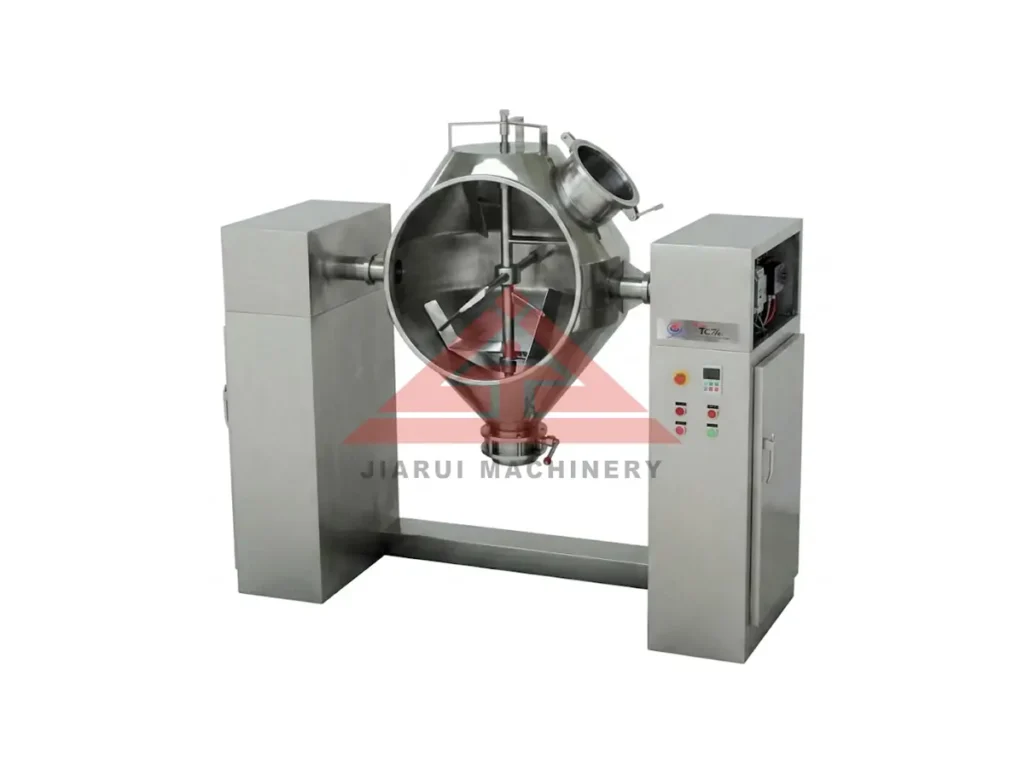
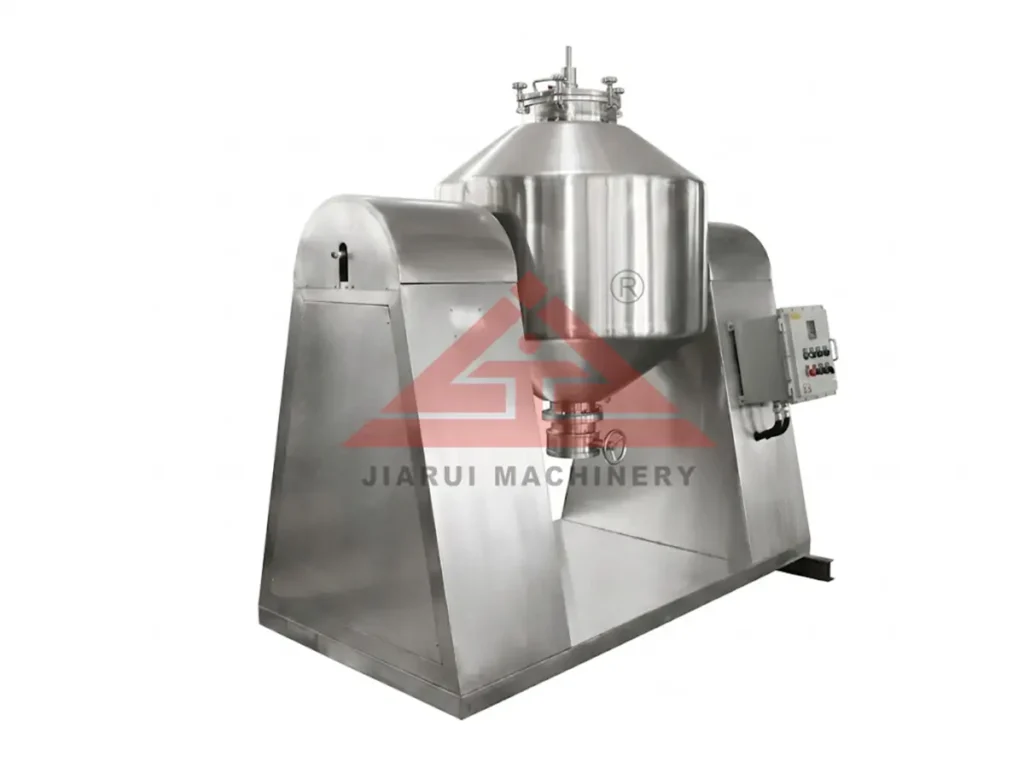
- The conical design at both ends facilitates uniform mixing and easy discharge.
- The cone is statically balanced to avoid excessive load on the gearbox and motor.
- Powder can be loaded into the cone through a larger opening and discharged via a butterfly valve or slide gate.
- Depending on the product, paddle baffles can be mounted on the shaft for better mixing within the cone.
- Contact parts are made of 304 stainless steel or 316 stainless steel.
- Magnetic-shielded motors are available as an optional accessory.
- Capacity ranges from 20 liters to 3000 liters.
- Based on the product, working capacity can be adjusted to 80% of total capacity through validated studies.
- Sloped design (with an eccentric double-cone mixer available as an alternative).
Working principle
A double cone mixer can have a jacket added around the mixing cylinder according to process requirements. Cooling or heating of the material is achieved by injecting cold or hot media into the jacket. Typically, industrial water is pumped in for cooling, while steam or electrically heated heat transfer oil is used for heating.
Inside the mixing cylinder, two asymmetric screws rotate self-rotatively to lift the material upward while the rotating arms move slowly in a planetary motion. This causes the material outside the screws to enter the screw columns to varying degrees, resulting in continuous renewal and diffusion of the material across the entire circumference. The two streams of material lifted to the top then converge into a central depression, forming a downward-flowing stream that replenishes the bottom void, creating a convection circulation for a triple mixing effect.
Standard double cone mixers have two mixing screws. In practical applications, depending on the equipment size, they can be configured with a single (one long screw), double (two asymmetric screws of different lengths), or triple (two short and one long symmetrically arranged) screws. Theoretically, the more mixing screws, the better the mixing effect. The equipment generally uses a plum blossom-shaped ‘misalignment valve’ that fits tightly against the bottom of the long screw, effectively reducing mixing dead zones. Drive options include manual and pneumatic. According to user needs, butterfly valves, ball valves, star discharge devices, and side discharge ports can also be added.
What problems can the double cone mixer solve for you?
- Achieve high uniformity mixing: It can effectively address the problem of uneven material mixing, and its unique rolling motion ensures that materials can be fully exchanged in different dimensions.
- Protective Material Properties: It can address the damage issues of fragile materials. Unlike ordinary forced-mixing mixers, it generates almost no heat during the mixing process, thus reducing the risk of material damage.
- Prevent cross-contamination: Its internal stirring has no dead corners, effectively solving problems such as difficult cleaning and material residue, thus reducing the risk of contamination.
How are materials mixed?
Several materials to be mixed are fed into the double cone mixer via vacuum conveying or manual loading. The cylinder cover is then secured, and the equipment is started. The double-cone cylinder and mixing blades rotate simultaneously. The rotating double cone causes the materials inside to tumble and mix in a chaotic manner, while the high-speed rotating mixing blades break up clumped materials, enabling rapid mixing within the cylinder. The double-cone mixer operates without dead corners or material buildup, allowing the mixed materials to quickly achieve a uniform and consistent result.
What are the core components?
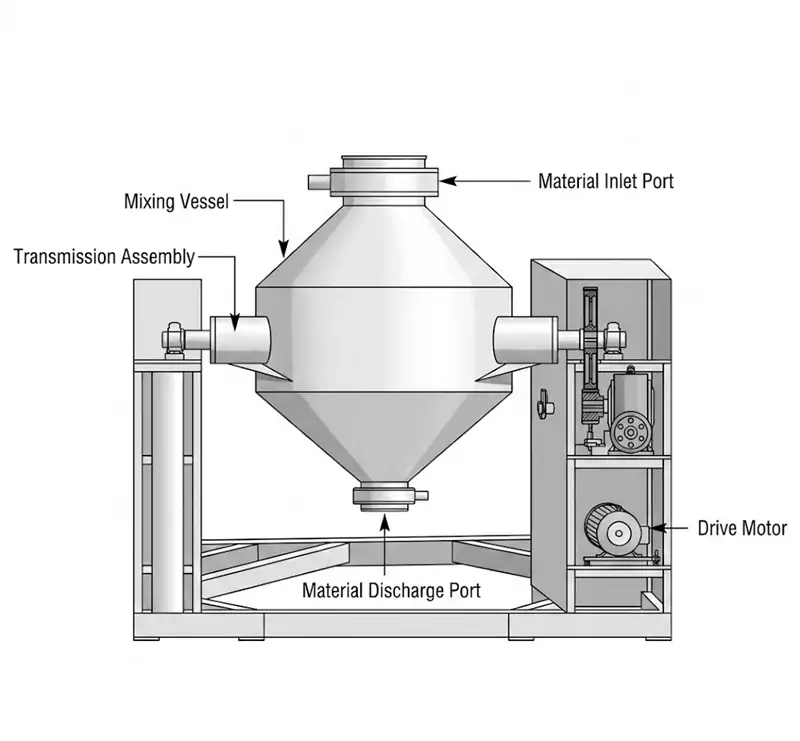
A double cone mixer consists of a double cone cylinder, mechanical seal, frame, speed reduction transmission, and stirring blades.
Double Cone Mixer VS Other Mixers
Classified by working principle
| Comparison Items | Double Cone Mixer | V-Type Mixer | Three-Dimensional Mixer | Horizontal Ribbon Mixer |
| Blending Principle | Gravity dispersion, | Gravity diffusion | Gravity diffusion | Forced stirring |
| Internal Structure | No agitator blades | No agitator blades | No agitator blades | With screw ribbon/agitator blades |
| Blending Action | Container rotation causes material to roll naturally | The container rotates to split and merge the material | The container undergoes multi-dimensional swinging, resulting in more intense agitation. | The screw ribbon forcibly promotes material convection and shear. |
By key performance
| Comparison Items | Double Cone Mixer | V-Type Mixer | Three-Dimensional Mixer | Horizontal Ribbon Mixer |
| Uniformity of Mixing | Higher | High | Highest | High |
| Mixing Time | Longer | Faster | Faster | Fastest |
| Material Damage | None | Mild | Available | Yes (with strong shear force) |
| Residual Amount | Extremely Low (Almost No Residue) | Possible residue | Possible residue | Higher (with dead corners) |
| Loading Rate | 50%-80% | 30%-40% | ≤60% | 60%-85% |
| Cleaning Difficulty | Easy | General | General | Difficult |
Categorized by usage scenarios
| Comparison Items | Double Cone Blender | V-Type Mixer | Three-Dimensional Mixer | Horizontal Screw Ribbon Mixer |
| Most Suitable | Fragile, heat-sensitive, and expensive materials requiring frequent product changeovers | Free-flowing homogeneous powder | Fine powders with extremely high uniformity requirements: Large batches of fixed-formula ordinary materials | Large batches of fixed-formula ordinary materials |
| Typical Industries | Pharmaceuticals, Food, Powder Metallurgy | Pharmaceuticals, food | Pharmaceuticals, fine chemical industry. | Chemical industry, building materials, feed |
What core value will it bring us?
- Enhance Production Efficiency and Quality: The equipment is highly efficient, capable of seamlessly integrating products from different batches to ensure product quality. It is easy to operate and has low maintenance costs.
- Provide Process Flexibility: Materials can be selected based on material properties to adapt to different operating conditions.
- Reduce Comprehensive Costs: The equipment has low energy consumption, a relatively high filling rate, and large batch processing capacity, which can effectively increase output.
Scenarios where it may not be suitable
Although the double-cone mixer has obvious advantages, it also has some limitations, and we should carefully judge whether it is suitable for us.
- For materials with very poor flowability or a tendency to clump: Mixing primarily relies on gravity-induced rolling, which may result in suboptimal mixing effects and require longer mixing times.
- A process requiring rapid and high-intensity mixing: the mixing time of materials in the mixer is relatively long, leading to low efficiency for scenarios demanding high-efficiency mixing.
- Processing large quantities of highly viscous paste or dough-like materials: Such materials are difficult to freely tumble within containers, leading to low efficiency and unsatisfactory mixing results.