Conical Twin Screw Mixer
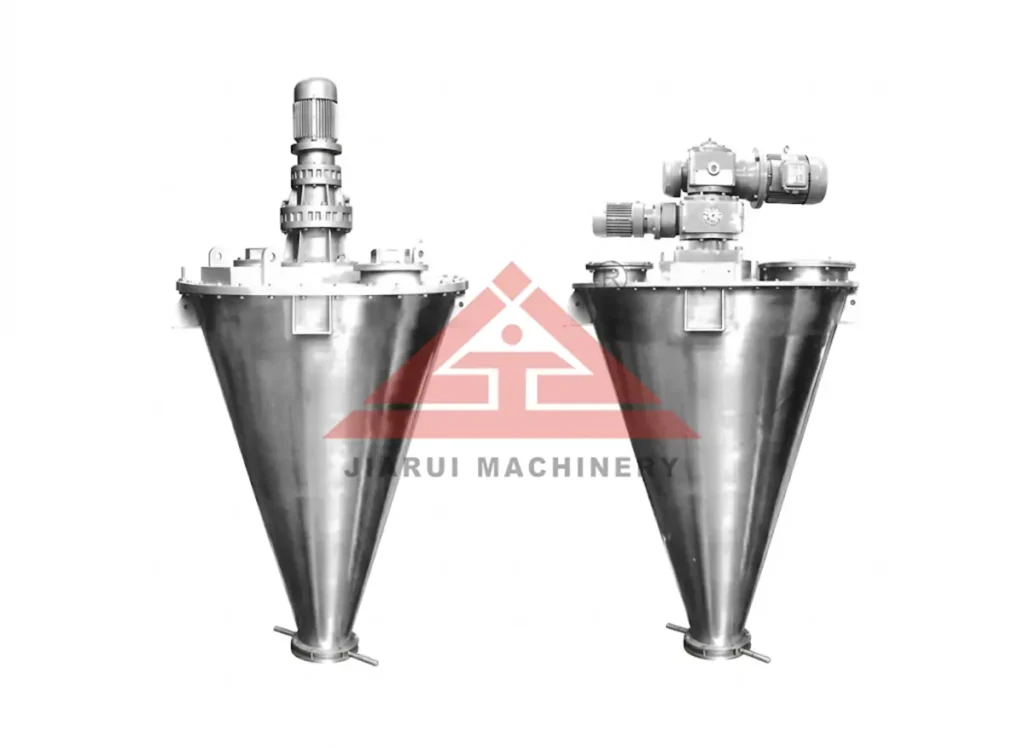
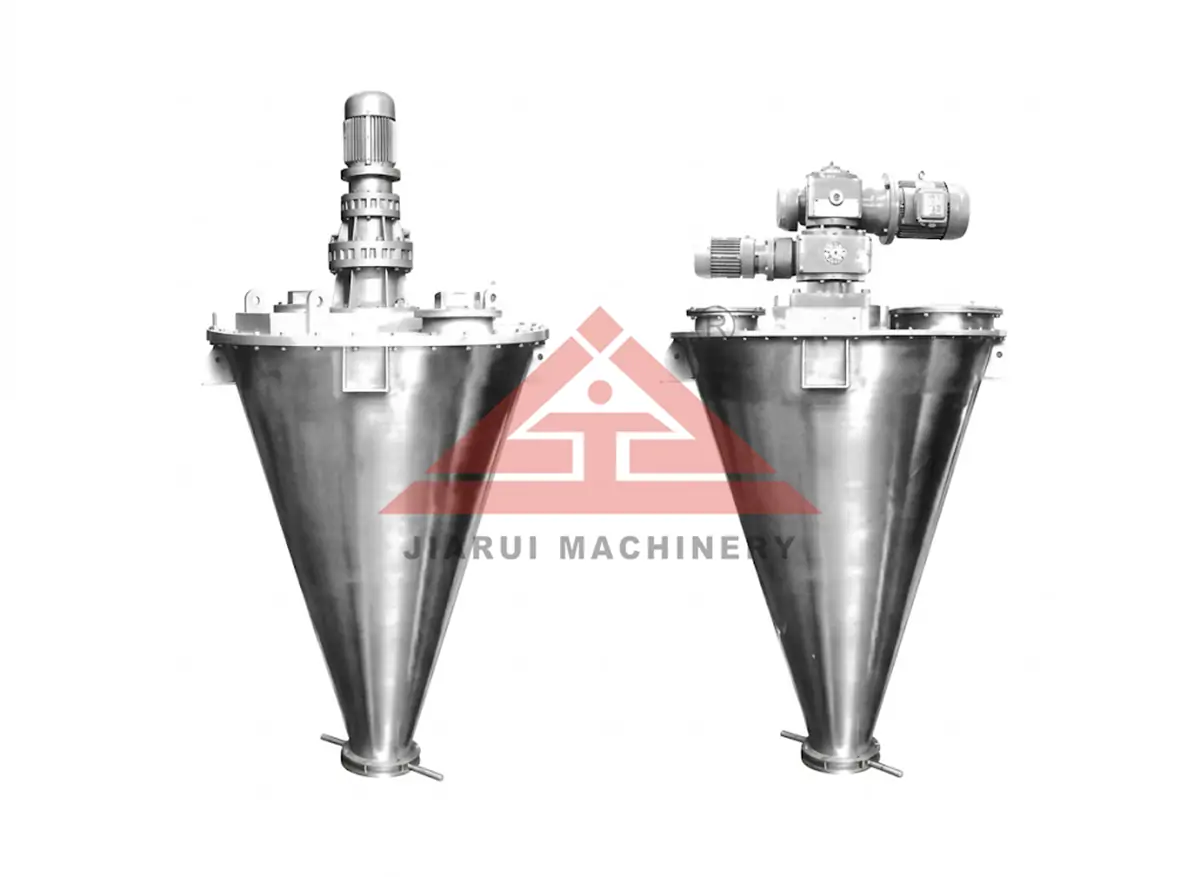
The Conical Twin Screw Mixer is mainly used for mixing powders, granules, and formulation materials composed of multiple raw materials. For mixing processes involving base powders, additives, or materials with different properties, the equipment uses a twin screw circulation movement to continuously exchange materials in different areas, reducing segregation caused by density differences and improving mixing consistency.
- Equipment Name: Conical Twin Screw Mixer
- Mixing Materials: Powders, granules, and formulation materials
- Mixing Method: Twin screw planetary rotation and self-rotation circulation mixing
- Equipment Volume: Customized according to production requirements
- Contact Material: SUS304 / SUS316L stainless steel available
- Drive System: Motor + gearbox drive
- Applicable Industries: Chemical, food, pharmaceutical, new materials, and feed industries
- Customization: Volume, material, structure, and auxiliary function configurations
- Manufacturer: Jiarui Machinery
Working Principle
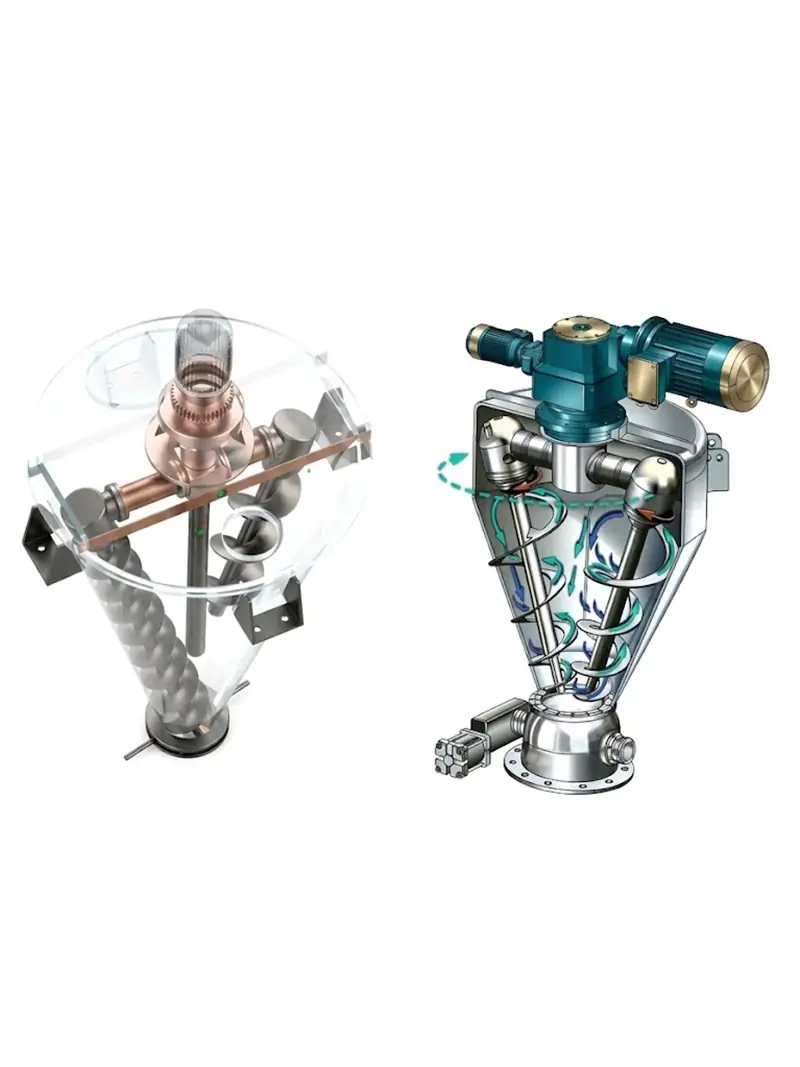
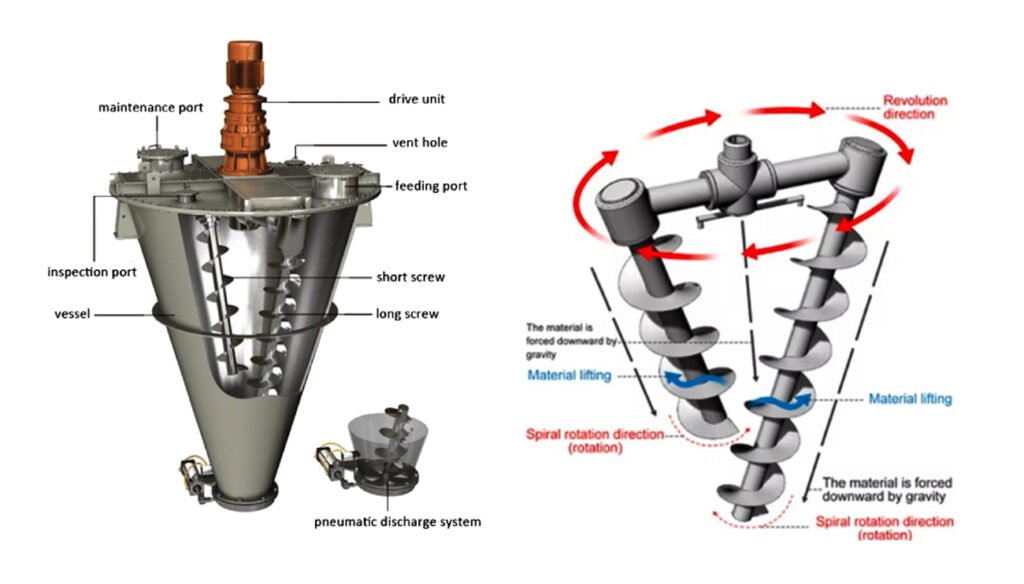
The Conical Twin Screw Mixer completes continuous material mixing through the planetary rotation and self-rotation movement of the screw assembly inside the conical vessel. During operation, the screws rotate around the center of the vessel while moving the material as a whole. At the same time, the screws rotate around their own axis to continuously lift the material from the bottom to the upper area. The material at the top falls back under gravity and exchanges position with the rising material, forming a combined movement of axial lifting and radial diffusion to improve mixing uniformity between different components.
Step 1: Material Feeding into the Vessel.The powder, granules, or formulation materials to be mixed are loaded into the conical vessel. The loading amount should be adjusted according to material characteristics, density, and equipment specifications to ensure stable circulation during screw operation.
Step 2: Screw Planetary Rotation and Self-Rotation.After the equipment starts, the motor drives the twin screw mixing assembly through the transmission system. The screws rotate around the vessel center while rotating around their own axis, continuously lifting the material from the bottom to the upper area and allowing materials in different positions to participate in the circulation process.
Step 3: Material Circulation and Exchange.The material lifted to the upper area gradually falls under gravity, while materials in different areas inside the vessel continuously exchange positions. Through vertical circulation and radial diffusion, different raw materials are gradually distributed evenly, reducing segregation caused by density differences.
Step 4: Mixing Completion and Discharge.After reaching the preset mixing time, the material is discharged through the bottom discharge structure. The equipment can be connected with packaging equipment, screw conveyors, or other downstream production equipment according to production line requirements.
Core Structure
The Conical Twin Screw Mixer mainly uses the combination of the twin screw mixing assembly and conical vessel to create an upward and downward material circulation. The mixing performance of the equipment is directly related to the screw structure, vessel design, and transmission configuration.
- Twin Screw Mixing Assembly:The twin screw mixing assembly is the core component for achieving material circulation and blending. During operation, the screws continuously move the material from the bottom upward, allowing materials at different heights to exchange positions and improving the mixing uniformity of powders, granules, and multi-component materials.
- Conical Mixing Vessel:The conical vessel provides the space required for material circulation. The smaller bottom section helps concentrate materials into the screw working area and allows easier discharge after mixing, reducing material residue inside the equipment.
- Twin Screw Drive System:The motor and gearbox provide power for screw operation. The transmission configuration needs to be matched according to equipment volume, material load, and operating conditions. The discharge structure can be configured according to production requirements. For food and pharmaceutical applications, stainless steel contact parts and corresponding surface treatments can be selected.
Applicable Materials
The Conical Twin Screw Mixer is mainly suitable for mixing powders, granules, and formulation materials composed of multiple raw materials. Through the combined planetary rotation and self-rotation movement of the twin screws, the equipment creates continuous vertical circulation, allowing materials in different positions to exchange continuously. It is suitable for production processes involving complex formulations, significant density differences, and high requirements for mixing uniformity.
Corn Starch 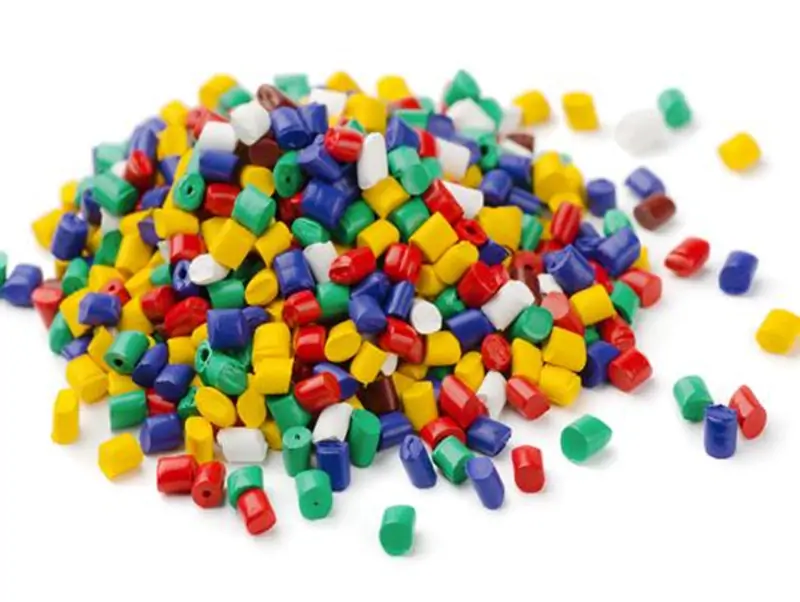
Plastic Granules 
Powder Coatings 
Resin Powder
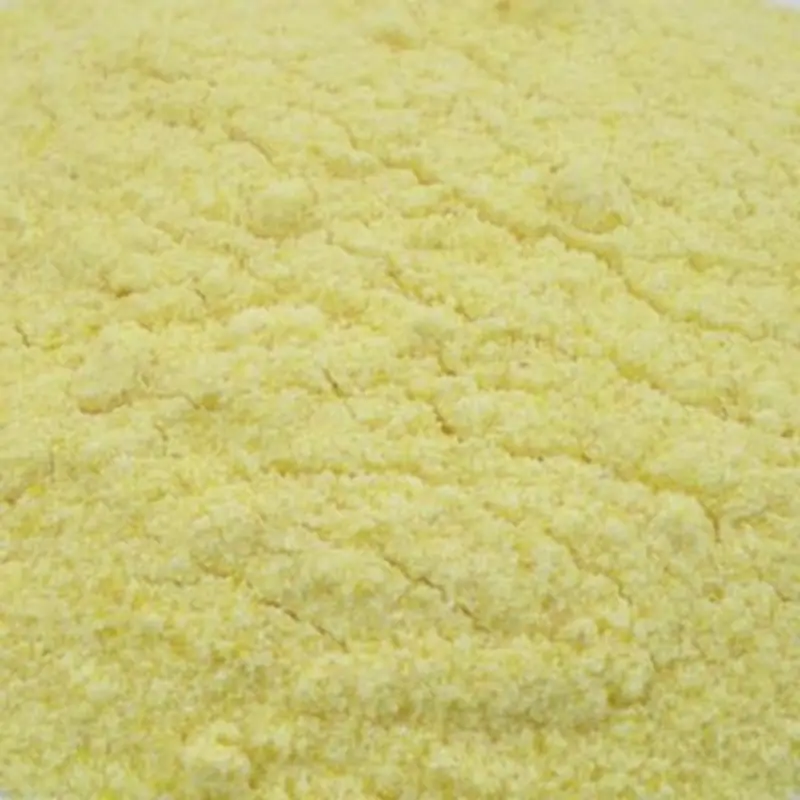
Food Powders and Additives:Suitable for starch, seasoning powder, nutritional powder, food additives, and other powder materials. Food formulations usually contain basic ingredients and small amounts of functional additives, which require uniform distribution of minor components. Through continuous circulation, the Conical Twin Screw Mixer allows different components to fully contact and reduces local uneven distribution caused by different addition ratios.
Chemical Powders and New Materials:Suitable for resin powder, pigment powder, coating powder, plastic modification materials, and other chemical and new material products. These materials usually have differences in particle size, density, and flow characteristics, which may cause segregation or unstable mixing with conventional mixing methods. The equipment uses screw lifting and circulation diffusion to maintain continuous material exchange and improve mixing consistency.
Pharmaceutical and Fine Powders:Suitable for pharmaceutical excipients, health supplement powders, and fine powders requiring higher cleanliness standards. These applications usually have strict requirements for equipment cleaning, material residue, and contact materials to comply with relevant GMP (Good Manufacturing Practice) requirements. According to production requirements, material contact parts can be made of SUS304 or SUS316L stainless steel, with structural designs that reduce residue and facilitate batch changeover and equipment cleaning.
Granules and Powder-Granule Mixtures:Suitable for plastic granules, composite granules, and powder-granule mixtures. For production processes requiring particle integrity, the equipment completes mixing through screw circulation and avoids significant particle damage caused by high shear forces, making it suitable for formulation mixing processes where particle shape needs to be maintained.
Conical Twin Screw Mixer vs Common Mixing Equipment
Different mixing equipment uses different material movement methods and is suitable for different production conditions. The Conical Twin Screw Mixer mainly uses screw revolution and rotation to create vertical circulation and continuous material exchange. It is more suitable for formulation materials with multiple components, significant density differences, and high requirements for mixing uniformity.
| Comparison Item | Conical Twin Screw Mixer | V-Type Mixer | Horizontal Ribbon Mixer |
| Mixing Method | Twin screw revolution and rotation create vertical circulation and radial material exchange | Vessel rotation causes materials to separate, merge, and tumble continuously | Ribbon agitator pushes materials to circulate along the vessel direction |
| Material Movement Characteristics | The screw lifts bottom materials upward, while upper materials fall naturally to form continuous circulation | Mixing is achieved through gravity and vessel rotation | Inner and outer ribbons drive materials to create convection mixing |
| Suitable Materials | Various powders, granules, and formulation materials | Powders and granules with good flowability | Powders, granules, and materials requiring stronger mixing action |
| Common Applications | Production processes with complex formulations, obvious density differences, and high mixing uniformity requirements | Mixing processes requiring particle protection, low shear, and high cleanliness | Large batch production, high efficiency requirements, or processes involving powder-liquid mixing |
| Structural Features | Conical vessel + twin screw mixing assembly | V-shaped rotating vessel structure | Horizontal vessel + ribbon mixing structure |
How to Select the Right Mixer According to Mixing Requirements
- Multiple powder materials need to be mixed, and the materials have obvious density differences:The Conical Twin Screw Mixer can be considered first. The screw circulation method enhances vertical material exchange, reduces the risk of segregation caused by density differences, and is suitable for formulation materials with complex compositions.
- Particle integrity needs to be maintained and the material is sensitive to shear force:A V-Type Mixer can be considered. The equipment mainly relies on vessel rotation to tumble materials. The mixing process is relatively gentle and suitable for dry powders and granules with good flowability.
- Large batch processing capacity is required, or the production process involves powder mixing with a small amount of liquid:A Horizontal Ribbon Mixer can be considered. The horizontal structure provides a larger mixing space and can be equipped with auxiliary functions such as liquid spraying, heating, and cooling according to process requirements.
- Food, pharmaceutical, and other applications with high requirements for hygiene and cleaning:The material contact surface, internal surface treatment, and discharge structure should be carefully considered. SUS304 or SUS316L stainless steel can be selected according to production requirements, together with structures designed for easier cleaning and batch changeover.

Equipment Selection
The selection of a Conical Twin Screw Mixer mainly depends on material characteristics, batch processing capacity, and mixing requirements. Different materials may have problems such as segregation, uneven mixing, or particle damage during the mixing process. The equipment size and structural configuration should be selected according to actual production conditions.
- Complex formulations containing multiple powders or additives:
If the production process requires mixing multiple powder materials or adding a small amount of additives, attention should be paid to whether different components can be evenly distributed. For example, when the main material accounts for a large proportion while certain additives are added in small quantities, uneven additive distribution may occur in different areas. The Vertical Screw Mixer uses screw circulation to continuously exchange material positions, allowing different components to gradually disperse evenly. - Different material densities causing segregation:
When lightweight powders and heavier particles are mixed together, segregation may occur due to density differences. For example, lightweight materials may accumulate in the upper area while heavier materials settle at the bottom. In this situation, the equipment needs to continuously circulate materials vertically. The conical twin screw structure lifts materials through screw movement and allows them to fall naturally, creating continuous material exchange. - Plastic granules and other materials requiring reduced particle damage:
For plastic granules, composite granules, and similar materials, excessive mixing force may cause particle breakage or generate excessive powder. The Conical Screw Blender mainly relies on screw movement to complete material circulation and is suitable for mixing processes requiring particle integrity.
Selecting Equipment Size According to Production Capacity
Equipment size should be determined according to batch mixing quantity, material density, and production cycle requirements. Equipment that is too small may not meet production requirements, while oversized equipment may affect material circulation efficiency. Therefore, the suitable vessel volume should be selected according to actual production conditions.The Conical Twin Screw Mixer is generally suitable for applications with the following requirements:
- Additives are added in small quantities but require uniform distribution after mixing;
- A relatively gentle mixing method is required to reduce particle damage.
- Multiple powders or granules need to be mixed according to fixed ratios;
- Different materials have obvious density differences and are prone to segregation;
Technical Parameters
The specifications of the Conical Twin Screw Mixer are mainly selected according to equipment volume, batch capacity, and material requirements. Under different operating conditions, equipment configurations may vary. The following parameters are common reference configurations, and customized designs can be provided according to actual requirements.
Common Specification Parameters
| Model | Total Volume (m3) | Filling Coefficient | Batch Processing Capacity (kg) | Motor Power (kW) |
| DSH-0.3 | 0.3 | 0.4-0.6 | 120-200 | 2.2 |
| DSH-0.5 | 0.5 | 0.4-0.6 | 200-350 | 3 |
| DSH-1 | 1 | 0.4-0.6 | 400-700 | 4 |
| DSH-2 | 2 | 0.4-0.6 | 800-1400 | 5.5 |
| DSH-3 | 3 | 0.4-0.6 | 1200-2000 | 7.5 |
| DSH-5 | 5 | 0.4-0.6 | 2000-3500 | 11–15 |
| DSH-10 | 10 | 0.4-0.6 | 4000-6000 | 18.5-22 |
Main Configuration Parameters
| Parameter Item | Configuration Description |
| Equipment Structure | Conical vessel + twin screw mixing assembly |
| Mixing Method | Screw revolution and rotation combined movement |
| Screw Movement Type | Revolution lifting + rotation dispersion circulation |
| Drive System | Motor + reducer drive |
| Mixing Speed | Configured according to equipment specifications and material conditions |
| Mixing Time | Determined according to material properties and mixing requirements |
| Applicable Materials | Powders, granules, and powder-granule mixed materials |
| Contact Material | SUS304 / SUS316L stainless steel optional |
| Discharge Method | Manual, pneumatic, or electric discharge optional |
| Auxiliary Functions | Liquid spraying, jacket heating, cooling, explosion-proof configuration optional |
Note: The above parameters are reference configurations for common equipment. The actual processing capacity may vary depending on material characteristics and production requirements. For special materials, capacity requirements, or functional configurations, Jiarui can design equipment solutions according to actual application conditions.
Customization Plan
The Conical Twin Screw Mixer cannot be configured only according to equipment volume like a standard machine. Different materials behave differently during mixing. For example, some powders are prone to segregation, some granules require reduced particle damage, and some formulations contain small amounts of additives. These factors will affect the selection of screw structure, equipment volume, and drive configuration.
Before designing the equipment, Jiarui first understands the customer’s actual production conditions and then determines the suitable configuration according to material characteristics and mixing requirements. To provide a more accurate equipment design, please provide the following key information:
- Mixing materials: Provide the material name and specify whether the material is powder, granule, or powder-granule mixture. If the material has issues such as segregation, agglomeration, or particle breakage, please provide details in advance.
- Batch mixing quantity: Provide the batch capacity or daily production capacity to determine the equipment volume and motor configuration.
- Material characteristics: Include material density, ratio of different components, and whether liquid or other additives need to be added.
- Operating requirements: Specify whether stainless steel material, explosion-proof configuration, heating and cooling functions, or connection with existing conveying and packaging equipment are required.
Jiarui Manufacturing
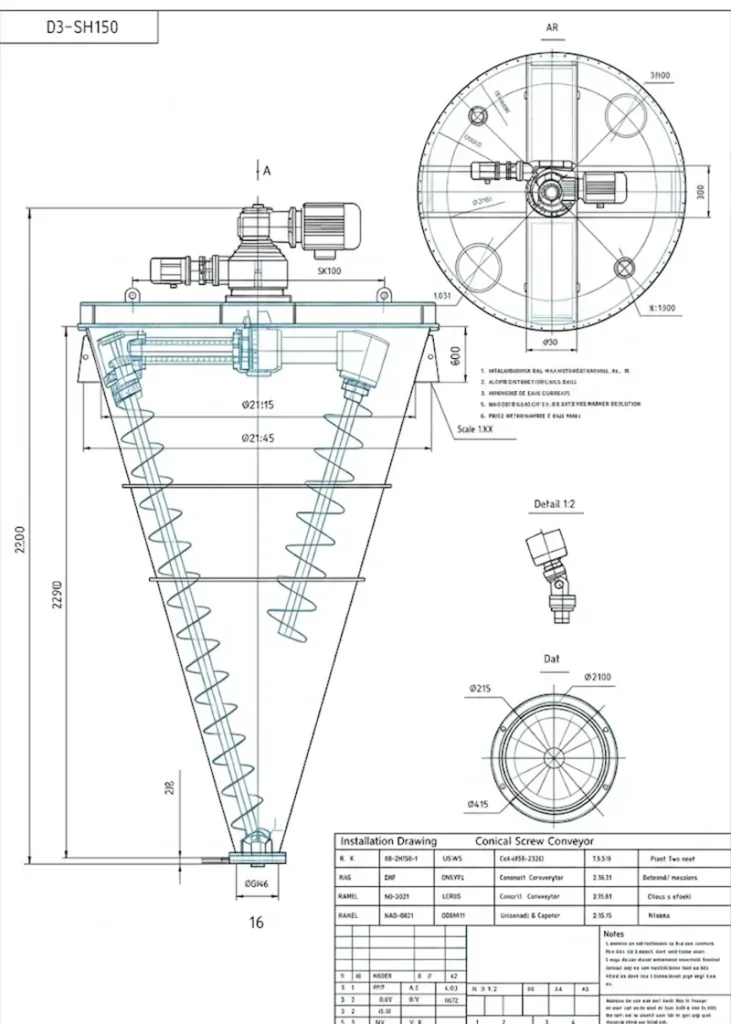
The manufacturing quality of the Conical Twin Screw Mixer mainly depends on the coordination between the twin screw assembly, conical vessel, and transmission system. During operation, the screws need to complete both revolution and rotation movements to continuously lift, disperse, and circulate materials. Therefore, the machining quality and assembly accuracy of core components directly affect mixing performance and operating stability.
Jiarui designs and manufactures equipment according to customer material characteristics, production capacity, and operating requirements. From vessel fabrication and screw assembly processing to complete machine testing, each manufacturing stage focuses on actual equipment operation to ensure stable performance after installation.
Step 1: Conical Vessel Fabrication.The vessel dimensions are determined according to equipment volume and mixing requirements. A suitable conical structure helps materials form proper circulation inside the mixer while facilitating discharge and equipment cleaning.
Step 2: Twin Screw Assembly Processing.The twin screw assembly is the core component for material circulation and mixing. During manufacturing, screw dimensions and installation positions need to be accurately controlled to ensure smooth material lifting and exchange, reducing unstable operation conditions.
Step 3: Transmission System Installation.The equipment uses a motor and reducer to drive the screws for revolution and rotation movement. During installation, transmission components are adjusted and matched to ensure stable equipment startup and continuous operation.
Step 4: Complete Machine Testing.After assembly, the equipment is inspected for screw operation, transmission performance, and discharge structure to confirm that all components operate normally before delivery.
FAQs
Get a Free Consultation
Fill out the form below to connect with our experts and receive personalized recommendations for your application.