锥形双螺旋混合机
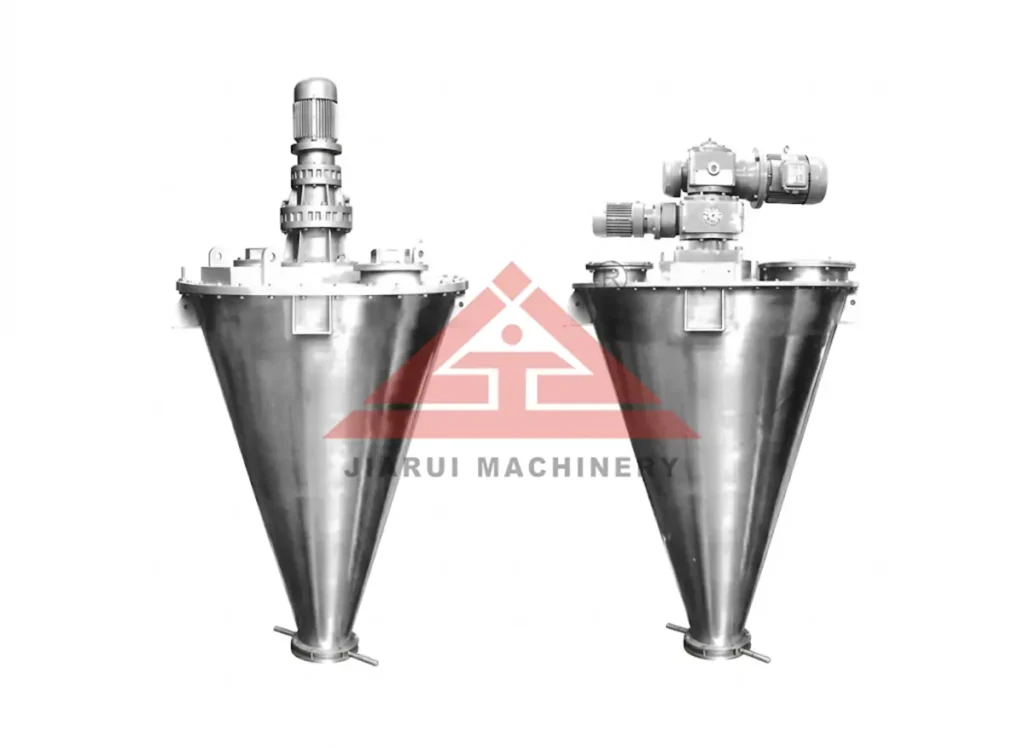
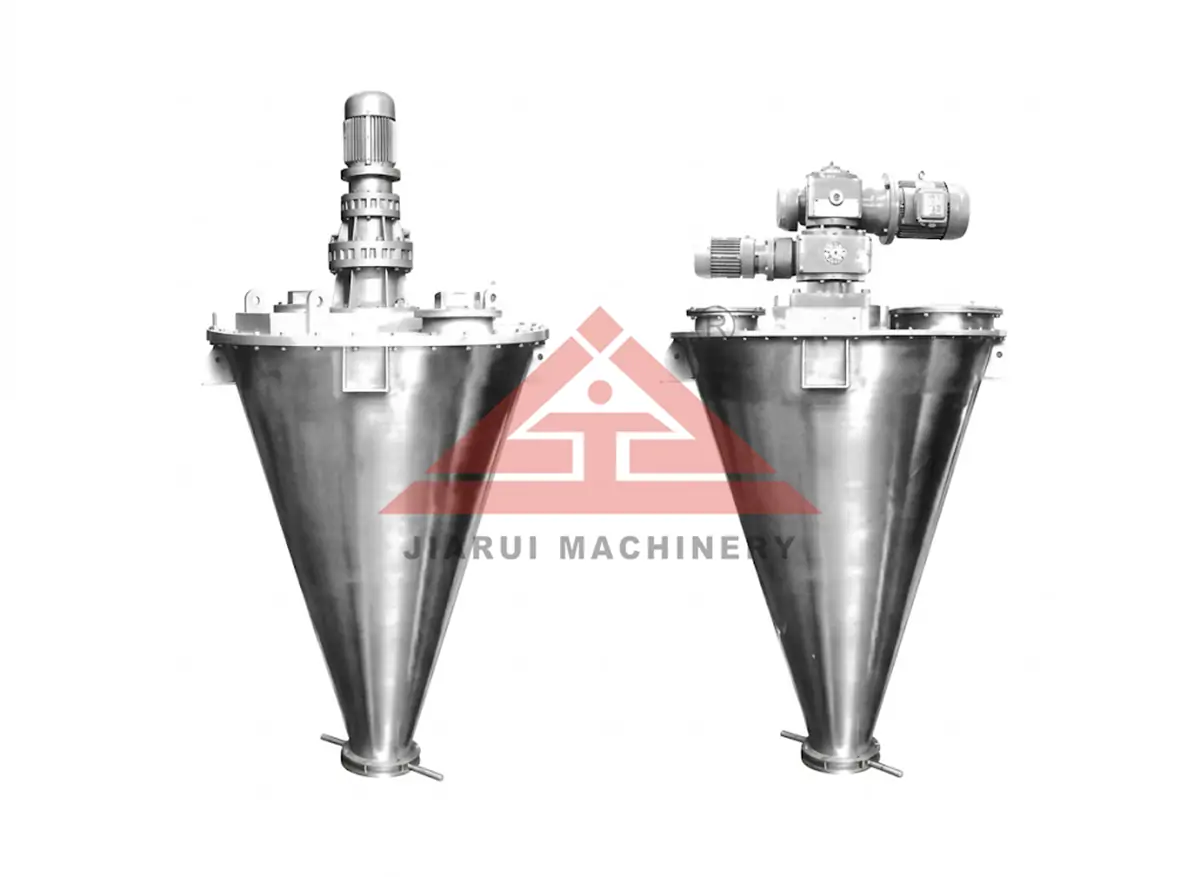
锥形双螺旋混合机主要用于混合粉末、颗粒及由多种原料组成的配方物料。对于涉及基础粉料、添加剂或不同性质物料的混合工艺,该设备通过双螺旋循环运动使不同区域的物料持续交换,减少因密度差异引起的偏析,提高混合均匀度。.
- 设备名称: 锥形双螺旋混合机
- 混合物料: 粉末、颗粒及配方物料
- 混合方式: 双螺旋行星公转与自转循环混合
- 设备容积: 可根据生产需求定制
- 接触物料材质: 可选SUS304 / SUS316L不锈钢
- 驱动系统: 电机+减速机驱动
- 适用行业: 化工、食品、制药、新材料及饲料行业
- 定制化: 容积、材质、结构及辅助功能配置
- 制造商: 嘉瑞机械
工作原理
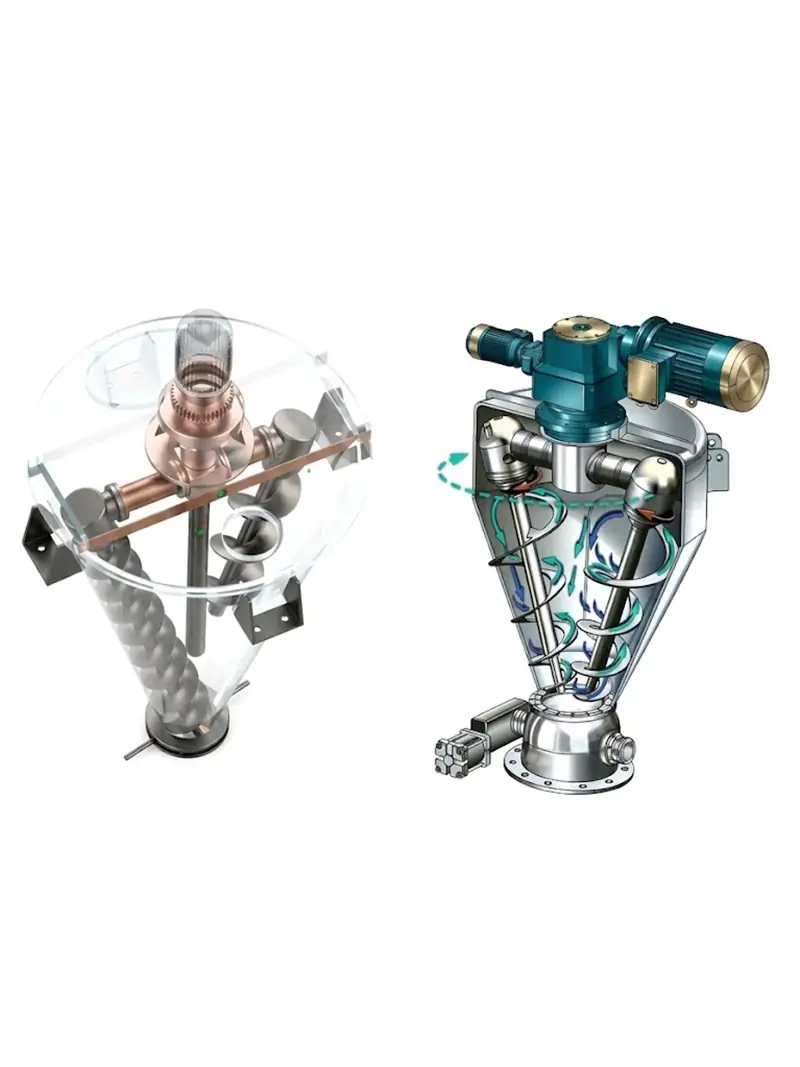
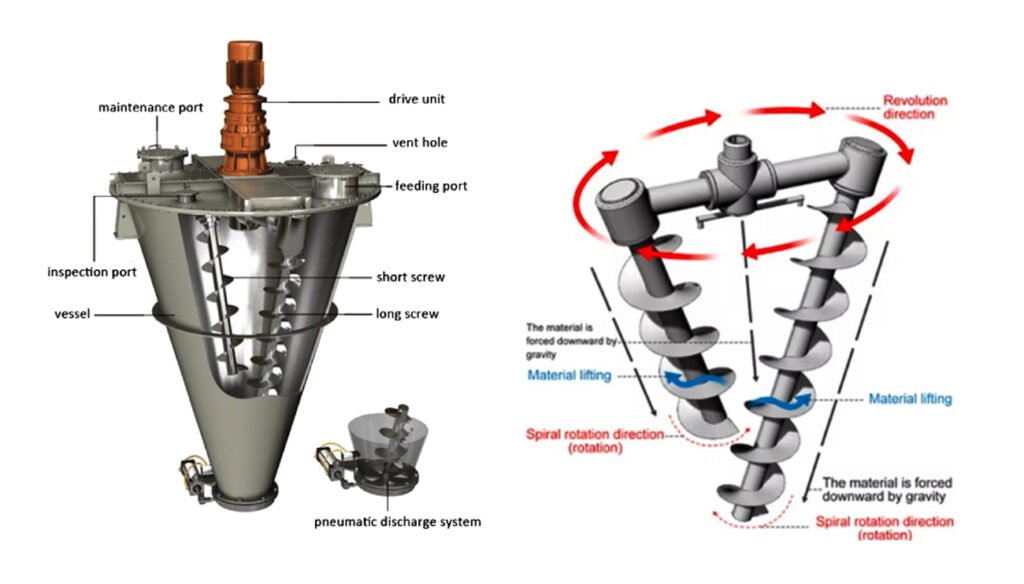
锥形双螺旋混合机通过锥形筒体内螺旋组件的行星公转与自转运动完成物料的连续混合。运行过程中,螺旋围绕筒体中心旋转,同时带动物料整体运动。与此同时,螺旋绕自身轴线旋转,持续将物料从底部提升至上部区域。顶部物料在重力作用下回落,与上升物料交换位置,形成轴向提升与径向扩散的复合运动,以提高不同组分之间的混合均匀度。.
第一步:物料投入筒体。.待混合的粉末、颗粒或配方物料装入锥形筒体内。装料量应根据物料特性、密度及设备规格进行调整,以确保螺旋运行过程中物料循环稳定。.
第二步:螺旋行星公转与自转。.设备启动后,电机通过传动系统驱动双螺旋混合组件。螺旋围绕筒体中心旋转,同时绕自身轴线旋转,持续将物料从底部提升至上部区域,使不同位置的物料参与循环过程。.
第三步:物料循环与交换。.被提升至上部区域的物料在重力作用下逐渐下落,同时筒体内不同区域的物料持续交换位置。通过垂直循环与径向扩散,不同原料逐渐分布均匀,减少因密度差异引起的偏析。.
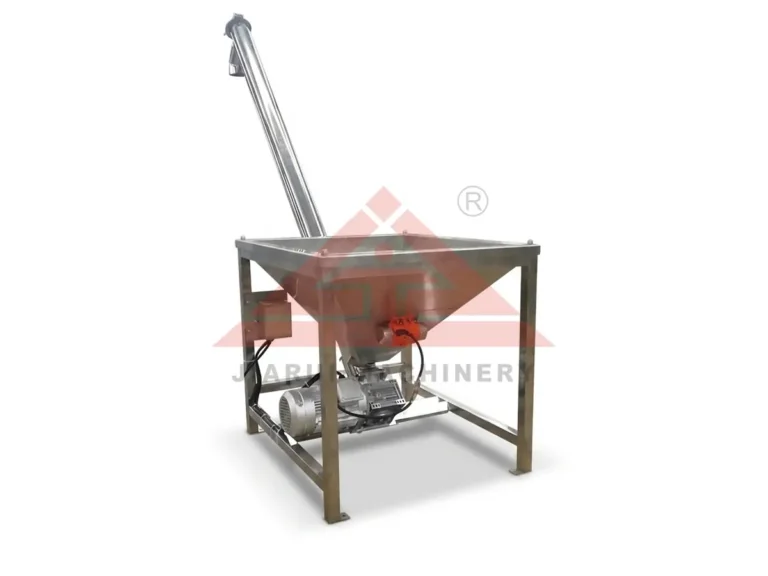
第四步:混合完成与出料。.After reaching the preset mixing time, the material is discharged through the bottom discharge structure. The equipment can be connected with packaging equipment, screw conveyors, or other downstream production equipment according to production line requirements.
核心结构
锥形双螺旋混合机主要利用双螺旋混合组件与锥形筒体的组合,形成物料上下循环运动。设备的混合性能与螺旋结构、筒体设计及传动配置直接相关。.
- 双螺旋混合组件:双螺旋混合组件是实现物料循环与混合的核心部件。运行过程中,螺旋持续将物料从底部向上输送,使不同高度的物料交换位置,提高粉末、颗粒及多组分物料的混合均匀度。.
- 锥形混合筒体:锥形筒体提供物料循环所需的空间。底部较小的截面有助于将物料集中至螺旋工作区域,并便于混合后出料,减少设备内部物料残留。.
- 双螺旋驱动系统:电机与减速机为螺旋运行提供动力。传动配置需根据设备容积、物料负载及运行工况进行匹配。出料结构可根据生产需求配置。对于食品和制药应用,可选择不锈钢接触部件及相应的表面处理。.
适用物料
锥形双螺旋混合机主要适用于混合粉末、颗粒及由多种原料组成的配方物料。通过双螺旋行星公转与自转的复合运动,设备形成连续的垂直循环,使不同位置的物料持续交换。适用于涉及复杂配方、密度差异显著及对混合均匀度要求较高的生产工艺。.
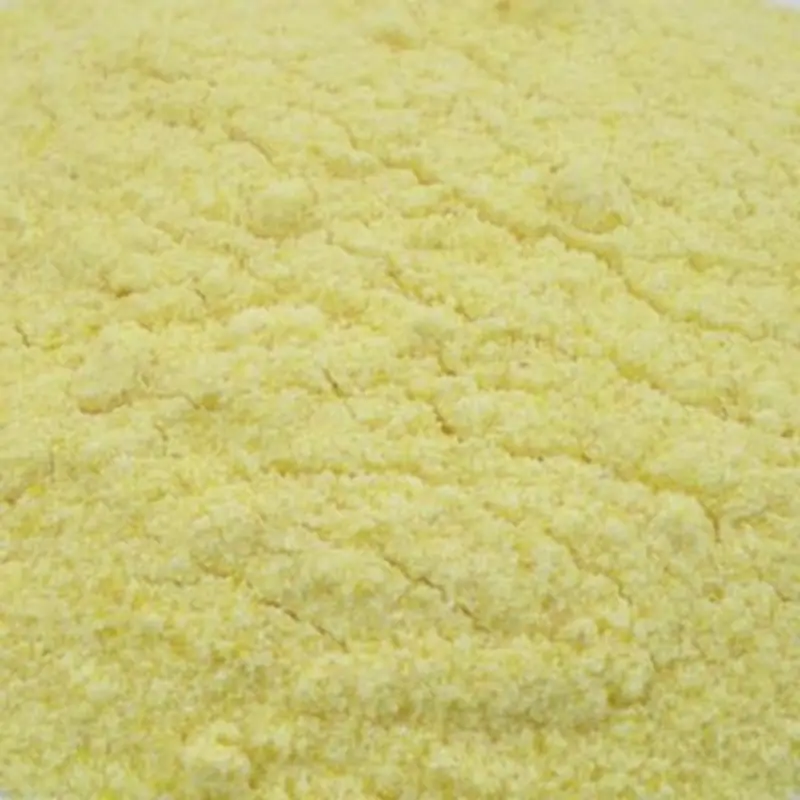
玉米淀粉 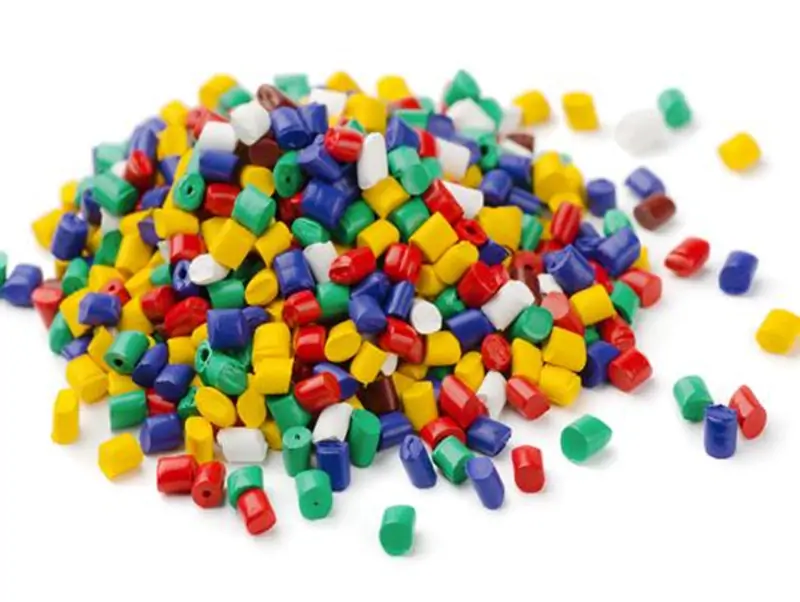
塑料颗粒 
粉末涂料 
树脂粉
食品粉末及添加剂:适用于淀粉、调味粉、营养粉、食品添加剂等粉体物料。食品配方通常含有基础成分和少量功能性添加剂,需要微量组分均匀分布。通过连续循环,锥形双螺旋混合机使不同组分充分接触,减少因添加比例不同而造成的局部分布不均。.
化工粉末及新材料:适用于树脂粉、颜料粉、涂料粉、塑料改性材料等化工及新材料产品。这些物料通常在粒径、密度和流动性方面存在差异,使用常规混合方式可能导致偏析或混合不稳定。该设备通过螺旋提升与循环扩散保持物料持续交换,提高混合一致性。.
制药及精细粉末:Suitable for pharmaceutical excipients, health supplement powders, and fine powders requiring higher cleanliness standards. These applications usually have strict requirements for equipment cleaning, material residue, and contact materials to comply with relevant GMP (Good Manufacturing Practice) requirements. According to production requirements, material contact parts can be made of SUS304 or SUS316L stainless steel, with structural designs that reduce residue and facilitate batch changeover and equipment cleaning.
颗粒及粉粒混合物:适用于塑料颗粒、复合颗粒及粉粒混合物。对于需要保持颗粒完整性的生产工艺,设备通过螺旋循环完成混合,避免高剪切力造成的颗粒明显破损,适用于需保持颗粒形态的配方混合工艺。.
Conical Twin Screw Mixer vs Common Mixing Equipment
Different mixing equipment uses different material movement methods and is suitable for different production conditions. The Conical Twin Screw Mixer mainly uses screw revolution and rotation to create vertical circulation and continuous material exchange. It is more suitable for formulation materials with multiple components, significant density differences, and high requirements for mixing uniformity.
| 对比项目 | 锥形双螺旋混合机 | V-Type Mixer | 卧式螺带混合机 |
| Mixing Method | Twin screw revolution and rotation create vertical circulation and radial material exchange | Vessel rotation causes materials to separate, merge, and tumble continuously | Ribbon agitator pushes materials to circulate along the vessel direction |
| Material Movement Characteristics | The screw lifts bottom materials upward, while upper materials fall naturally to form continuous circulation | Mixing is achieved through gravity and vessel rotation | Inner and outer ribbons drive materials to create convection mixing |
| 适用物料 | Various powders, granules, and formulation materials | Powders and granules with good flowability | Powders, granules, and materials requiring stronger mixing action |
| 常见应用 | Production processes with complex formulations, obvious density differences, and high mixing uniformity requirements | Mixing processes requiring particle protection, low shear, and high cleanliness | Large batch production, high efficiency requirements, or processes involving powder-liquid mixing |
| 结构特点 | Conical vessel + twin screw mixing assembly | V-shaped rotating vessel structure | Horizontal vessel + ribbon mixing structure |
How to Select the Right Mixer According to Mixing Requirements
- Multiple powder materials need to be mixed, and the materials have obvious density differences:The Conical Twin Screw Mixer can be considered first. The screw circulation method enhances vertical material exchange, reduces the risk of segregation caused by density differences, and is suitable for formulation materials with complex compositions.
- Particle integrity needs to be maintained and the material is sensitive to shear force:A V-Type Mixer can be considered. The equipment mainly relies on vessel rotation to tumble materials. The mixing process is relatively gentle and suitable for dry powders and granules with good flowability.
- Large batch processing capacity is required, or the production process involves powder mixing with a small amount of liquid:A Horizontal Ribbon Mixer can be considered. The horizontal structure provides a larger mixing space and can be equipped with auxiliary functions such as liquid spraying, heating, and cooling according to process requirements.
- Food, pharmaceutical, and other applications with high requirements for hygiene and cleaning:The material contact surface, internal surface treatment, and discharge structure should be carefully considered. SUS304 or SUS316L stainless steel can be selected according to production requirements, together with structures designed for easier cleaning and batch changeover.

设备选型
The selection of a Conical Twin Screw Mixer mainly depends on material characteristics, batch processing capacity, and mixing requirements. Different materials may have problems such as segregation, uneven mixing, or particle damage during the mixing process. The equipment size and structural configuration should be selected according to actual production conditions.
- Complex formulations containing multiple powders or additives:
If the production process requires mixing multiple powder materials or adding a small amount of additives, attention should be paid to whether different components can be evenly distributed. For example, when the main material accounts for a large proportion while certain additives are added in small quantities, uneven additive distribution may occur in different areas. The Vertical Screw Mixer uses screw circulation to continuously exchange material positions, allowing different components to gradually disperse evenly. - Different material densities causing segregation:
When lightweight powders and heavier particles are mixed together, segregation may occur due to density differences. For example, lightweight materials may accumulate in the upper area while heavier materials settle at the bottom. In this situation, the equipment needs to continuously circulate materials vertically. The conical twin screw structure lifts materials through screw movement and allows them to fall naturally, creating continuous material exchange. - Plastic granules and other materials requiring reduced particle damage:
For plastic granules, composite granules, and similar materials, excessive mixing force may cause particle breakage or generate excessive powder. The Conical Screw Blender mainly relies on screw movement to complete material circulation and is suitable for mixing processes requiring particle integrity.
Selecting Equipment Size According to Production Capacity
Equipment size should be determined according to batch mixing quantity, material density, and production cycle requirements. Equipment that is too small may not meet production requirements, while oversized equipment may affect material circulation efficiency. Therefore, the suitable vessel volume should be selected according to actual production conditions.The Conical Twin Screw Mixer is generally suitable for applications with the following requirements:
- Additives are added in small quantities but require uniform distribution after mixing;
- A relatively gentle mixing method is required to reduce particle damage.
- Multiple powders or granules need to be mixed according to fixed ratios;
- Different materials have obvious density differences and are prone to segregation;
技术参数
The specifications of the Conical Twin Screw Mixer are mainly selected according to equipment volume, batch capacity, and material requirements. Under different operating conditions, equipment configurations may vary. The following parameters are common reference configurations, and customized designs can be provided according to actual requirements.
Common Specification Parameters
| 型号 | Total Volume (m3) | Filling Coefficient | Batch Processing Capacity (kg) | 电机功率(千瓦) |
| DSH-0.3 | 0.3 | 0.4-0.6 | 120-200 | 2.2 |
| DSH-0.5 | 0.5 | 0.4-0.6 | 200-350 | 3 |
| DSH-1 | 1 | 0.4-0.6 | 400-700 | 4 |
| DSH-2 | 2 | 0.4-0.6 | 800-1400 | 5.5 |
| DSH-3 | 3 | 0.4-0.6 | 1200-2000 | 7.5 |
| DSH-5 | 5 | 0.4-0.6 | 2000-3500 | 11–15 |
| DSH-10 | 10 | 0.4-0.6 | 4000-6000 | 18.5-22 |
Main Configuration Parameters
| Parameter Item | Configuration Description |
| Equipment Structure | Conical vessel + twin screw mixing assembly |
| Mixing Method | Screw revolution and rotation combined movement |
| Screw Movement Type | Revolution lifting + rotation dispersion circulation |
| 驱动系统 | Motor + reducer drive |
| Mixing Speed | Configured according to equipment specifications and material conditions |
| Mixing Time | Determined according to material properties and mixing requirements |
| 适用物料 | Powders, granules, and powder-granule mixed materials |
| 接触物料材质 | SUS304 / SUS316L stainless steel optional |
| Discharge Method | Manual, pneumatic, or electric discharge optional |
| Auxiliary Functions | Liquid spraying, jacket heating, cooling, explosion-proof configuration optional |
Note: The above parameters are reference configurations for common equipment. The actual processing capacity may vary depending on material characteristics and production requirements. For special materials, capacity requirements, or functional configurations, Jiarui can design equipment solutions according to actual application conditions.
Customization Plan
The Conical Twin Screw Mixer cannot be configured only according to equipment volume like a standard machine. Different materials behave differently during mixing. For example, some powders are prone to segregation, some granules require reduced particle damage, and some formulations contain small amounts of additives. These factors will affect the selection of screw structure, equipment volume, and drive configuration.
Before designing the equipment, Jiarui first understands the customer’s actual production conditions and then determines the suitable configuration according to material characteristics and mixing requirements. To provide a more accurate equipment design, please provide the following key information:
- Mixing materials: Provide the material name and specify whether the material is powder, granule, or powder-granule mixture. If the material has issues such as segregation, agglomeration, or particle breakage, please provide details in advance.
- Batch mixing quantity: Provide the batch capacity or daily production capacity to determine the equipment volume and motor configuration.
- Material characteristics: Include material density, ratio of different components, and whether liquid or other additives need to be added.
- Operating requirements: Specify whether stainless steel material, explosion-proof configuration, heating and cooling functions, or connection with existing conveying and packaging equipment are required.
佳锐制造
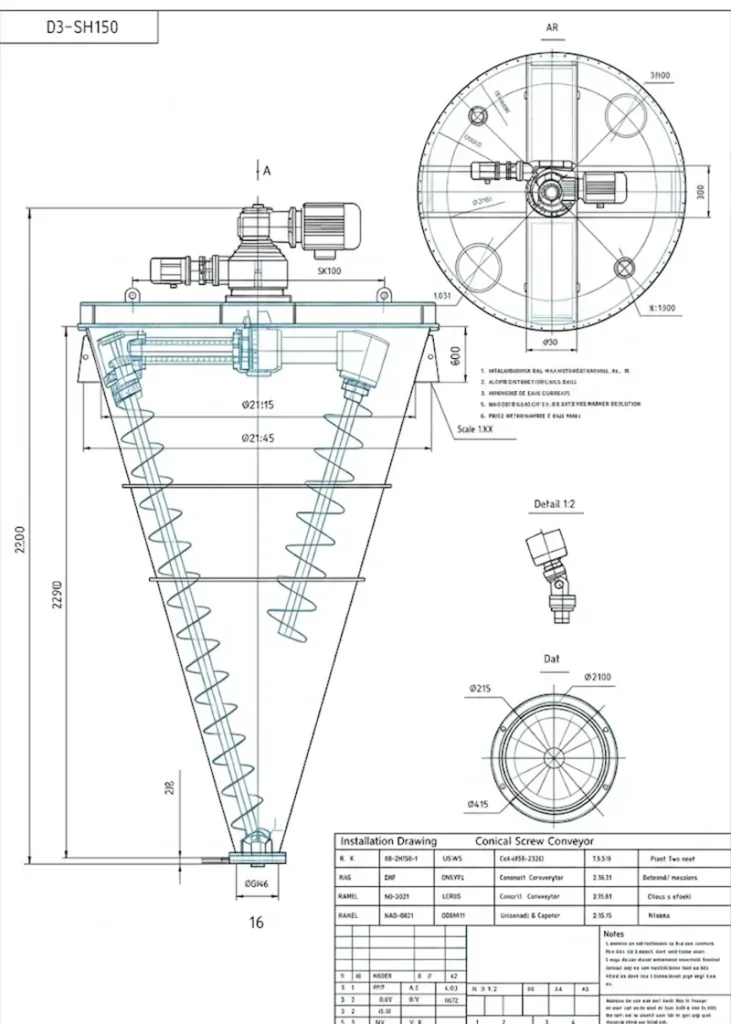
The manufacturing quality of the Conical Twin Screw Mixer mainly depends on the coordination between the twin screw assembly, conical vessel, and transmission system. During operation, the screws need to complete both revolution and rotation movements to continuously lift, disperse, and circulate materials. Therefore, the machining quality and assembly accuracy of core components directly affect mixing performance and operating stability.
Jiarui designs and manufactures equipment according to customer material characteristics, production capacity, and operating requirements. From vessel fabrication and screw assembly processing to complete machine testing, each manufacturing stage focuses on actual equipment operation to ensure stable performance after installation.
Step 1: Conical Vessel Fabrication.The vessel dimensions are determined according to equipment volume and mixing requirements. A suitable conical structure helps materials form proper circulation inside the mixer while facilitating discharge and equipment cleaning.
Step 2: Twin Screw Assembly Processing.The twin screw assembly is the core component for material circulation and mixing. During manufacturing, screw dimensions and installation positions need to be accurately controlled to ensure smooth material lifting and exchange, reducing unstable operation conditions.
Step 3: Transmission System Installation.The equipment uses a motor and reducer to drive the screws for revolution and rotation movement. During installation, transmission components are adjusted and matched to ensure stable equipment startup and continuous operation.
Step 4: Complete Machine Testing.After assembly, the equipment is inspected for screw operation, transmission performance, and discharge structure to confirm that all components operate normally before delivery.
常见问题
获取免费咨询
填写以下表格,与我们的专家联系,获取针对您应用需求的个性化推荐。.