什么是振动管式输送机?
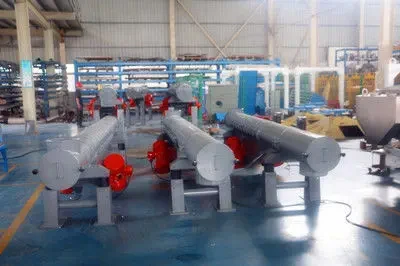
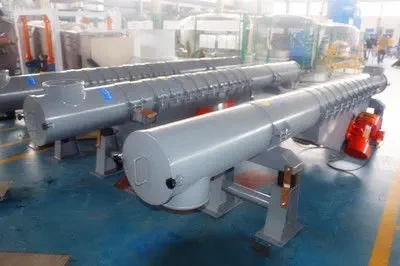
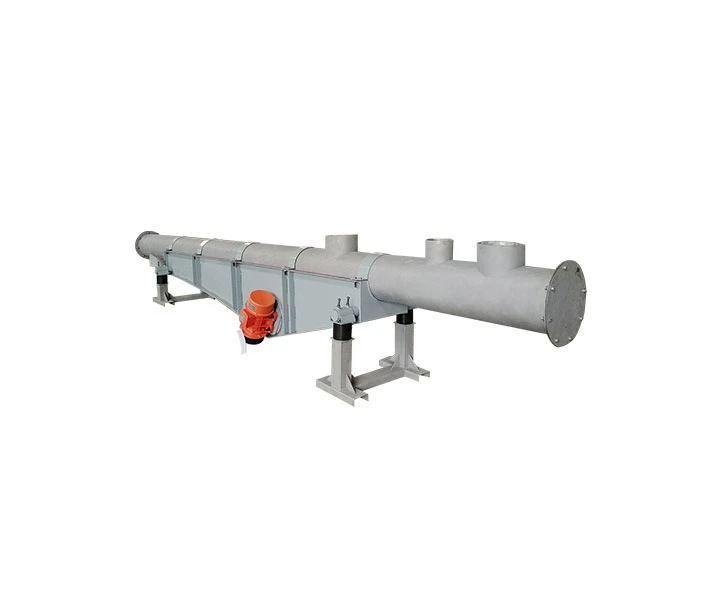
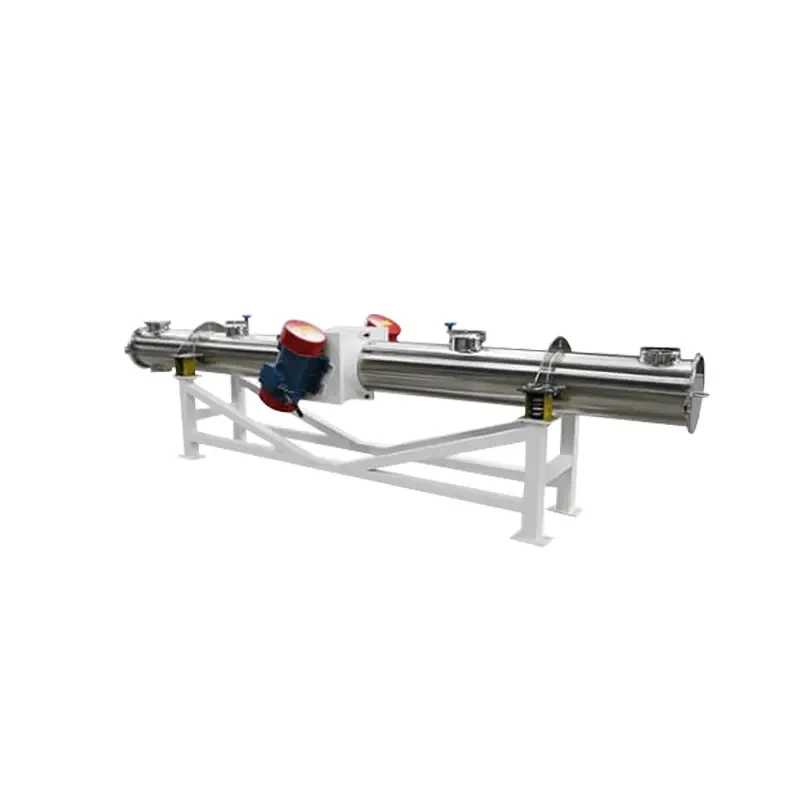
振动管式输送机 主要用于混凝土搅拌站中水泥和粉煤灰物料的输送,也适用于化工、冶金、粮仓加工、储存等场所。该输送机具有螺旋直径小、转速高、输送量大、精度高、输送条件优良等特点。驱动单元采用齿轮减速机,扭矩大、噪音低、无漏油、使用寿命长。输送壳体采用优质无缝钢管,法兰连接。设备整体刚性好,承载能力大。输送过程中,无论是水平输送还是大倾角输送,均可实现连续输送。可任意选择工作位置和工作状态,拆装维护方便,运行安全可靠。.
输送原理
振动管式输送机的基本工作原理如下:设备启动后,两台型号规格相同的振动电机或激振器对称布置,反向同步运转。其产生的激振力通过振动体——电机或激振器底座——传递给整个振动体——给料槽。使料槽产生周期性振动,从而使槽内物料以定向跳跃方式向出料端移动,最终完成物料 输送 作业。.
核心结构与组成
振动管式输送机是一种直线振动惯性 输送装置. 。其基本结构和组成主要包括动力单元(两台型号规格相同的振动电机或激振器)、振动体(给料槽)、隔振装置(隔振弹簧)、承载底座(钢结构框架或其他预制平台)及相关附件。.
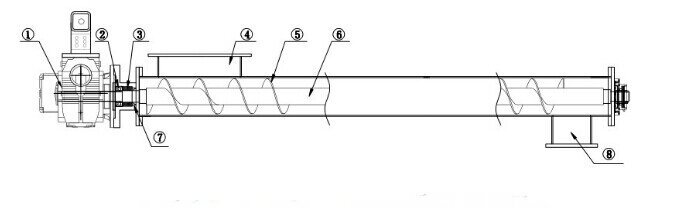
| 部件名称 | 功能及材料要求 |
| 输送管道 | 物料输送通道,通常为圆管,可选材料包括碳钢(耐磨型)、不锈钢(食品/制药应用)或陶瓷内衬(高磨损工况),常用管径范围为Φ100至Φ600 mm。. |
| 振动发生器 | 核心动力源,如振动电机、电磁铁或偏心轴组件,直接决定设备性能。. |
| 隔振装置 | 通常为金属螺旋弹簧或橡胶弹簧,安装于管体与机架之间,用于隔离振动传递并保护结构基础。. |
| 机架与支架 | 整个设备由焊接结构钢支撑,需具备足够的刚度和强度。. |
| 进料口与出料口 | 可根据工艺要求设计多点进料和多点出料,并配备闸门或密封装置。. |
| 控制系统 | 包括变频器(用于调节振动频率)、PLC控制器(用于自动化联锁控制)及传感器(用于料位监测)。. |
它能为您解决哪些问题?
振动管式输送机采用全封闭管状结构,有效防止车间粉尘飞扬,避免外部污染。可满足化工、食品加工、制药等行业高洁净度环节的要求。它继承了振动给料机的全部优点,同时通过封闭结构解决了环保和污染问题。.
型号参数
作为 输送 行业中常见的给料设备,振动管式给料机为大家总结了常见型号及其对应技术参数:
| 输送型号规格 | 管径(mm) | 电机功率(千瓦) | 倾角(°) | 输送距离(mm) |
| 273-2000 | Φ273 | 0.25 | 0~5 | 2000 |
| 273-2500 | Φ273 | 0.25 | 0~5 | 2500 |
| 273-3000 | Φ273 | 0.37 | 0~5 | 3000 |
| 356-3000 | φ356 | 0.37 | 0~5 | 3000 |
| 356-3500 | φ356 | 0.37 | 0~5 | 3500 |
| 356-4000 | φ356 | 0.55 | 0~5 | 4000 |
| 356-4500 | φ356 | 0.55 | 0~5 | 4500 |
| 356-5000 | φ356 | 0.75 | 0~5 | 5000 |
| 356-5500 | φ356 | 0.75 | 0~5 | 5500 |
核心优势
- 高效物料输送: 采用新型悬挂式中间轴承架,增大物料输送空间,降低物流阻力。结合小直径、高转速、变螺距等设计,确保物料流动平稳、快速、均匀。.
- 灵活布局: 壳体采用优质无缝钢管,通过法兰连接为整体结构。可水平或大倾角连续输送物料。可直接与设备连接固定,无需基础,充分利用空间,便于移动和拆卸。.
- 多样化连接方式: 进料口和出料口均可采用法兰连接、布袋连接、吊袋连接、万向节连接等多种连接形式。.
- 密封可靠: 壳体管连接处设有防水装置,工艺孔经过精心改进,防止雨水渗入导致管内水泥结块堵塞,避免卡机事故。.
- 无需添加润滑剂: 由于采用创新的中间轴承材料,具有减摩、耐磨、自润滑特性,长期使用后也无需添加润滑油。避免润滑脂与水泥混合对轴套和轴产生不良影响。.
两种类型
按振动源分类
| 振动源 | 频率 | 振幅 | 典型应用场景 | 振动源 |
| 惯性式 | 偏心块旋转离心力 | Intermediate frequency (16~50 Hz) | Medium (1~5 mm) | The most widely applied and suitable for conveying most bulk materials |
| Electromagnetic type | Electromagnetic periodic attractive force | High frequency (50~100 Hz) | Small (0.5~2 mm) | Accurate feeding, quantitative control, fine powder material |
| Elastic link type | Eccentric shaft + connecting rod mechanical transmission | Low frequency (6~15 Hz) | Large (5~15 mm) | Heavy materials, large ore chunks, impact-resistant applications |
Based on their core working principles
| 产品特点 | 振动管式输送机 | Screw Tube Conveyor |
| 优势 | Environmentally friendly with no leakage; capable of large inclination (up to 30°) and three-dimensional spatial bending; conveyor belt does not deviate; suitable for long-distance, high-capacity conveying. | Simple and compact structure; good sealing performance; capable of loading and unloading at multiple points; lower cost; good rigidity. |
| Limitations | Simple and compact structure; good sealing performance; capable of loading and unloading at multiple points; lower cost; good rigidity. | The mechanical parts are severely worn; the conveying capacity is relatively low; power consumption is high; it is suitable for conveying easily breakable materials; it is not suitable for conveying highly viscous or easily clumping materials. |
| Typical Parameters | The conveying capacity can reach up to 1,800 tons per hour, and the length of a single unit can extend to several kilometers. | The common spiral diameter ranges from 100 to 1250 mm, and the typical length is 2 to 70 meters. |
Technical Features and Parameters
- Compact in size and high in speed, it ensures rapid and uniform material conveying.
- It has good rigidity and excellent sealing. The housing is made of seamless steel pipe, with flanges at the ends to form an integral structure.
- A cleaning device is installed at the discharge end. The entire machine operates with low noise, strong adaptability, and flexible arrangement of inlet and outlet ports.
- It can carry heavy loads and ensure safe and reliable operation.
- It exhibits strong adaptability, convenient installation and maintenance, and a long service life.
Application Fields
- 食品 和 制药 Industry: For conveying powders, granules, etc., requiring gentle handling and no contamination.
- 化工 和 建材 Industry: Used in feeding systems for materials such as bauxite, silicon carbide, and magnesia sand.
- Other Industries: Also widely applied in mining, metallurgy, coal, grain, glass, and other fields.
选型指南
During the selection process of vibrating tube conveyors, numerous factors need to be considered, such as material properties, conveying capacity, workshop environment, and on-site operating conditions. The following is a summarized specific procedure:
| Step | Evaluation Content | Key Questions |
| ① Material Analysis | Particle size, bulk density, moisture content, temperature, abrasiveness, corrosiveness | Is stainless steel material required? Is a wear-resistant lining needed? |
| ② Conveying Requirements | Transportation distance, lifting height, target production capacity | Can a single unit meet the requirements? Is a series connection necessary? |
| ③ Vibration Source Selection | Select based on control precision and material properties. | For precise measurement, choose electromagnetic type; for high production volume, choose inertial type; for heavy load, choose link type |
| ④ Environmental Conditions | Explosion-proof rating, hygiene rating, installation space. | Food and pharmaceutical industries require stainless steel and easy-to-clean designs; chemical zones need explosion-proof motors |
| ⑤ Additional Features | Is cooling, drying, and sieving required? | Custom jacketed cooling tubes or sieve structures are available. |
| ⑥ Control System | Is automation interlocking required for variable frequency speed control, | PLC communication, and level interlock? |
Common Faults
Vibrating tube conveyors are prone to various faults during long-term use.
Below is a summary of some common faults and their solutions:
| 故障现象 | 可能原因 | Solution Methods |
| The conveying speed has dropped significantly. | Amplitude reduction (spring fatigue) or excessive material moisture content: | Adjust the exciting force or replace the springs; reduce the material moisture content |
| The noise is too loud. | Bolt loosening, bearing wear, spring breakage. | Tighten bolts; replace bearings or springs. |
| Pipe cracking | Long-term resonance or weld defects; | Strengthen the welds, add stiffeners, and adjust the frequency to avoid the resonance zone. |
| Motor overheating | Bearing oil deficiency or poor heat dissipation | Add lubricant and clean the motor surface dust. |
Vibrating Tube Conveyor VS Conventional 输送机
As one of the commonly used devices in the conveying industry, what makes vibratory tube feeders different from other ordinary conveying and feeding equipment? The following table summarizes this from various dimensions:
| 对比维度 | Vibratory Tube Conveyor (Enclosed) | Ordinary Vibratory Conveyor(Open/Chute Type) |
| 结构特点 | Fully enclosed round tube | Open U-shaped or rectangular channel. |
| 核心优势 | Environmental protection and pollution prevention: Materials run inside the pipe, with no dust leakage, and they are not affected by external pollution. | Low cost and convenient observation: Simple structure, facilitating material observation and maintenance. |
| 适用物料 | Powdery, easily airborne, volatile, or toxic materials. | Loose materials such as blocky and granular ones with no special environmental protection requirements. |
| 典型应用 | Processes in industries such as chemical engineering, food processing, and pharmaceuticals that have high cleanliness requirements. | Crushing, screening, and feeding for mines, metallurgy, building materials, and other industries. |
结论
Vibrating tube conveyors are also suitable for chemical, metallurgical, grain silo processing, storage, and other places. The conveyor features a small screw diameter, high speed, large conveying capacity, high precision, and excellent conveying conditions.