
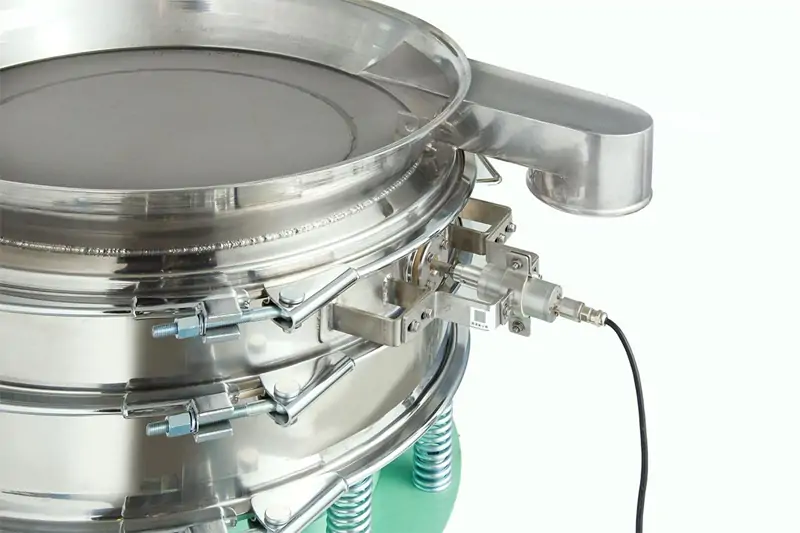
An ultrasonic rotary vibrating screen is based on a conventional rotary vibrating screen with ultrasonic vibration added to the screen mesh. The conventional vibration moves, disperses, and separates the material on the screen, while ultrasonic vibration acts directly on the screen mesh, mainly addressing mesh blinding and clogging during fine screening.
But finer screening does not automatically mean that ultrasonic vibration is needed. If a conventional rotary vibrating screen can already achieve the required particle size and throughput consistently, there is no need to add an ultrasonic system. First identify what is actually limiting the conventional screening process, then decide whether ultrasonic vibration is necessary.
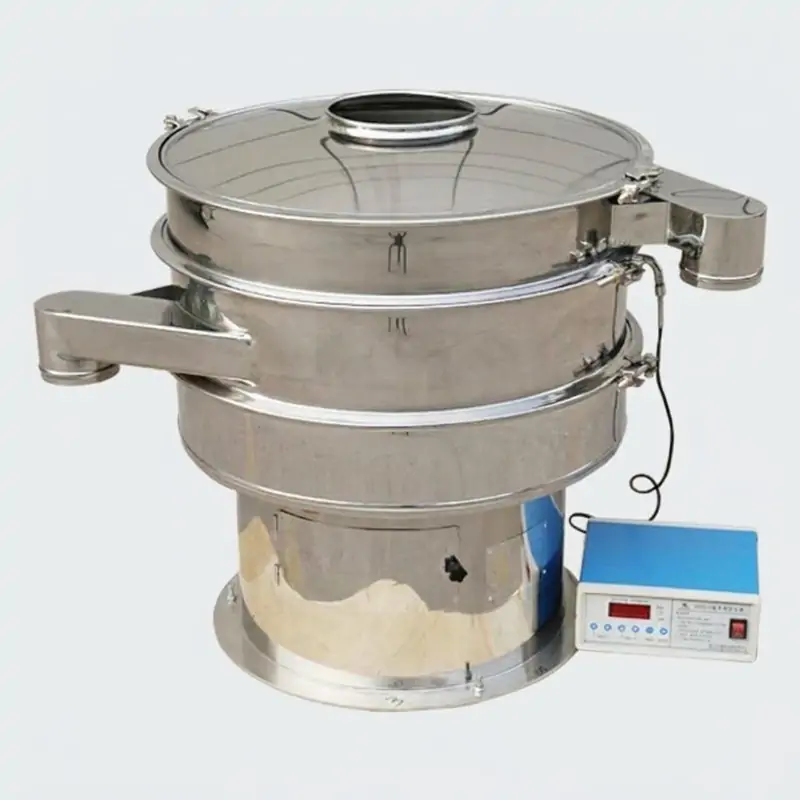
Why Does a Conventional Rotary Vibrating Screen Blind When Screening Fine Powders?
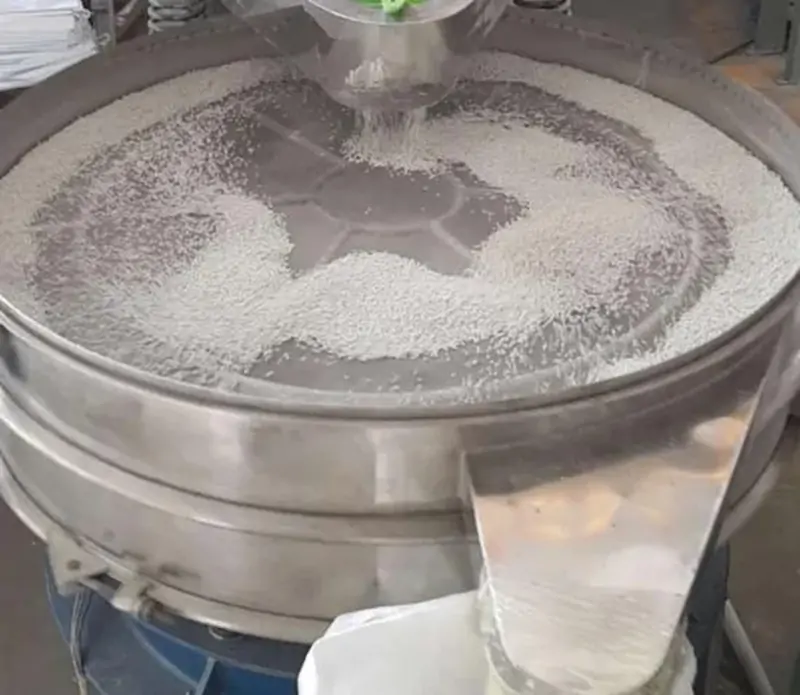
During operation, the material continuously moves across the screen surface. Particles smaller than the screen aperture pass through, while larger particles remain on the screen.
As the screen aperture becomes finer, screening becomes more sensitive to the condition of the mesh. Particles close to the aperture size are more likely to remain near or lodge in the openings, while fine powder may also adhere to the wires or around the apertures. This can be more noticeable with powders that tend to carry static charge or agglomerate.
After the equipment has been running for some time, some apertures may become blocked by powder. Fewer apertures remain open for normal screening, and the screening throughput can gradually decrease. A very obvious symptom is: the material is still moving normally, but it simply does not pass through the screen.
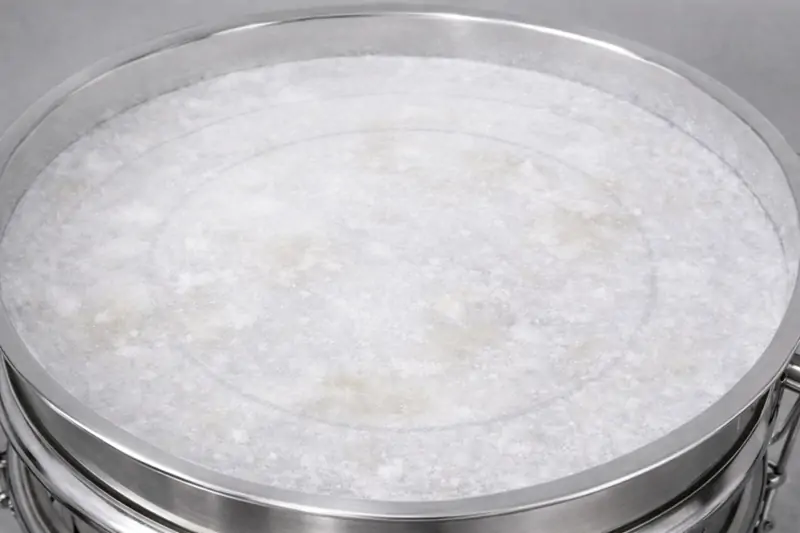
Therefore, when a fine screening process has a problem, do not immediately assume that the conventional vibration needs to be increased. First check whether the material is spreading and moving normally on the screen. If the material is moving normally but the throughput continues to decrease, inspect the screen for blinding or powder buildup.
How Does an Ultrasonic Rotary Vibrating Screen Work?
An ultrasonic rotary vibrating screen does not replace the conventional vibration with ultrasonic vibration. Instead, it adds high-frequency vibration to the screen mesh on top of the existing mechanical vibration.
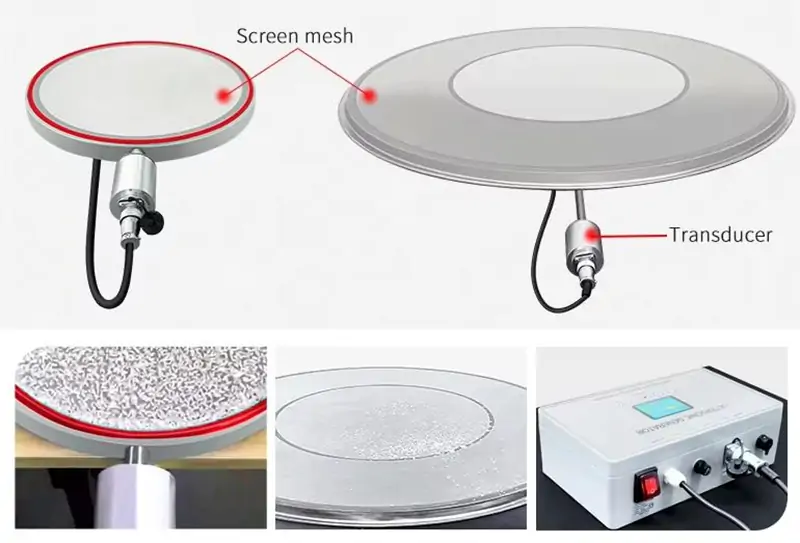
The conventional vibration mainly moves and disperses the material across the screen and allows it to pass through the apertures. The basic working principle of a Vibro Sifter Machine is to use mechanical vibration to move and separate material on the screen, while the ultrasonic system adds high-frequency vibration directly to the mesh.
When the screen mesh produces this high-frequency vibration, the contact between the fine powder and the screen wires and apertures is continuously changing. The powder is less likely to remain in the same position for a long time. For fine powders that tend to adhere to the mesh or lodge around the apertures, this vibration can help reduce continuous buildup and blinding and keep the apertures more open.
So, conventional vibration moves the material, while ultrasonic vibration helps keep the screen mesh clear.
Which Materials and Screening Conditions Are More Suitable for Ultrasonic Vibration?
Ultrasonic rotary vibrating screens are mainly used when fine powders tend to blind or clog the screen mesh.
Fine chemical powders, food powders, pharmaceutical powders, pigments, metal powders, and other materials can encounter this problem when using fine screen apertures. It is especially common when the powder is very fine, tends to carry static charge, or contains particles close to the screen aperture size.

First Check for These Signs on Site
If screening is normal at the beginning and the material moves normally across the screen, but powder starts to build up on the mesh after some operating time and the screened-through material gradually decreases, check whether the apertures are becoming blocked. You can also make a simple comparison:
- The screening throughput improves significantly after switching to a coarser aperture: First check whether the original aperture is too fine or whether the screening requirement needs to be reconsidered.
- The aperture size meets the requirement, the material moves normally, but the fine mesh still repeatedly blinds or clogs: This is when it is worth considering ultrasonic vibration.
Which Problems Cannot Be Solved by Ultrasonic Vibration?
Ultrasonic vibration mainly addresses screen blinding and powder buildup. Severe agglomeration, excessive feed rate, or an unsuitable screen aperture cannot be solved simply by adding ultrasonic vibration. These basic issues should be addressed first. Different screening problems may require different types of industrial screeners.
If you are not sure whether ultrasonic vibration is necessary or which configuration to use, you can provide Jiarui with the material, target particle size, screen aperture, throughput, and the problem occurring during screening. Our engineers can help assess the situation and recommend a suitable Ultrasonic Vibrating Screen.
How Can You Avoid Choosing the Wrong Ultrasonic Rotary Vibrating Screen?
When purchasing an ultrasonic rotary vibrating screen, the biggest concern is not whether you can buy the equipment, but whether you spend extra on ultrasonic equipment without solving the actual problem on site. When requesting a quotation, pay attention to these points:
- First confirm whether ultrasonic vibration is really needed: If a conventional rotary vibrating screen can already achieve the required particle size and throughput, there is no need to add ultrasonic vibration just to “screen finer.” Ultrasonic vibration is mainly used for fine mesh that repeatedly blinds or clogs with powder.
- Do not give the manufacturer only a mesh count: In addition to the screen aperture, provide the material, target particle size, throughput, and the actual problem occurring during screening. When applicable, the screen specification can also be checked against ISO 3310-1. This makes it easier to determine whether the configuration is suitable.
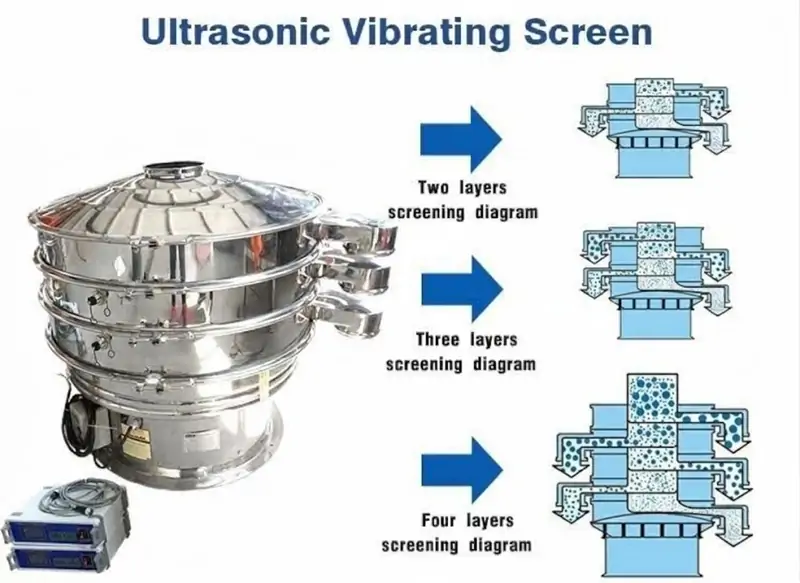
- Not every deck of a multi-deck screen needs ultrasonic vibration: Focus on which deck has the finest aperture and which deck is most likely to blind. There is no need to make every screen deck ultrasonic just to be safe.
- Describe the actual site condition clearly: For example, “Screening is normal at first, but the throughput decreases after some operating time, and powder buildup is found on the screen after shutdown.” This information is often more useful than simply saying, “I need a 300-mesh ultrasonic screen.”
FAQs
What problem does an ultrasonic rotary vibrating screen mainly solve?
It mainly addresses mesh blinding and clogging when screening fine powders. A conventional rotary vibrating screen can keep the material moving across the screen, but when the aperture is fine and the powder tends to adhere to or lodge in the openings, the number of usable open apertures gradually decreases. Ultrasonic vibration acts on the screen mesh and can help reduce this problem.
When does a conventional rotary vibrating screen need ultrasonic vibration?
If a conventional rotary vibrating screen can already achieve the required particle size and throughput, there is no need to add ultrasonic vibration.
If the material moves normally across the screen but the fine mesh repeatedly becomes coated with powder or clogged, causing the screened-through material to decrease, ultrasonic vibration can be considered.
What screen apertures are suitable for an ultrasonic rotary vibrating screen?
The screen aperture should not be used alone to determine whether ultrasonic vibration is suitable. The target particle size, material characteristics, and throughput also need to be considered.
The finer the aperture, the more attention should be paid to mesh blinding, but a finer aperture does not automatically mean that ultrasonic vibration is required.
Does every deck of a multi-deck ultrasonic rotary vibrating screen need ultrasonic vibration?
Not necessarily. The key is to identify which deck performs the finest screening and which deck is most likely to experience blinding. The fine screen deck that is prone to blinding is the main one to evaluate. There is no need to make every deck ultrasonic just to add more equipment.
What should I tell the manufacturer when requesting a quotation for an ultrasonic rotary vibrating screen?
At a minimum, provide the manufacturer with the material, target particle size, screen aperture, throughput, and the problem encountered during screening.
If you already have screening equipment, it is also useful to explain whether the material has never screened through properly or whether screening is normal at first and the throughput decreases after some operating time. The more specific the site condition, the easier it is to determine whether ultrasonic vibration is actually needed.
Can an ultrasonic rotary vibrating screen be customized for my material and site conditions?
Yes. Different materials, screening requirements, and installation conditions may require different screen meshes, deck configurations, materials, cleaning methods, and equipment dimensions. Jiarui can work with you to confirm the screen and equipment configuration based on your material, target particle size, throughput, and site installation condition.