
Что такое вибрационный трубчатый конвейер?
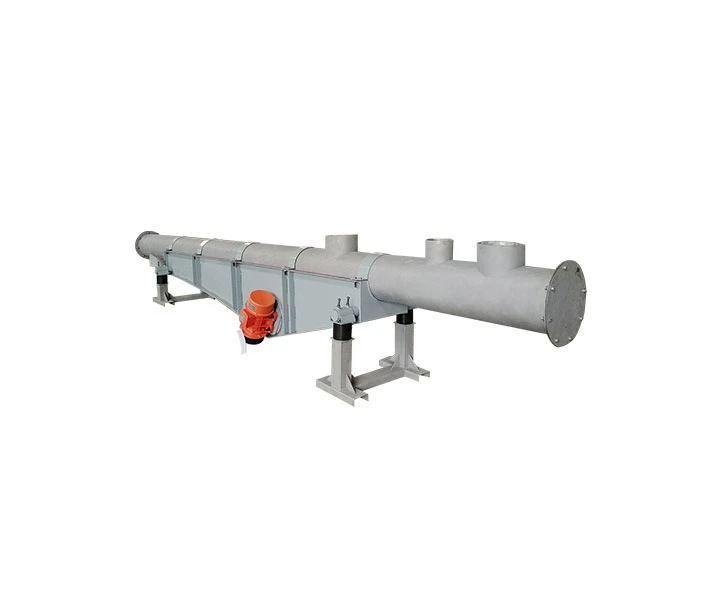
Vibrating tube conveyors are mainly used for conveying cement and fly ash materials in concrete mixing stations. They are also suitable for chemical, metallurgical, grain silo processing, storage, and other places. The conveyor features a small screw diameter, high speed, large conveying capacity, high precision, and excellent conveying conditions. The drive unit adopts a gear reducer, which has high torque, low noise, no oil leakage, long service life. The conveying casing is made of high-quality seamless steel pipe with flange connection. The overall rigidity of the equipment is good, and it has a large load-bearing capacity. During conveying, whether horizontal or at a large inclination, continuous conveying can be achieved. It allows arbitrary selection of working position and working condition, and is convenient for disassembly, maintenance, and safe and reliable operation.
Principle of Transport
The basic working principle of the vibrating tube conveyor is as follows: After the equipment starts, two identical models and specifications of vibrating motors or exciters, arranged symmetrically, operate synchronously in opposite directions. The excitation force they generate is transmitted through the vibration body—motor or exciter base—to the entire vibrating body—the feeding trough. This causes the trough to vibrate periodically, and thus the material inside the trough moves towards the discharge end in a directed jumping manner, ultimately completing the material транспортирующее operation.
Core Structure and Composition
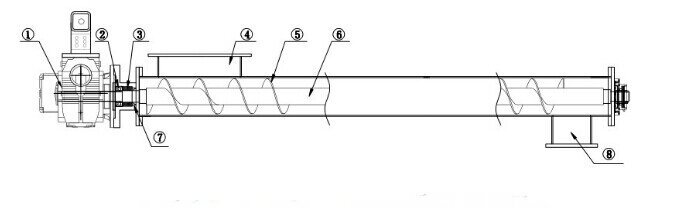
The vibrating tube conveyor is a linear vibrating inertial conveying device. Its basic structure and composition mainly consist of a power unit (two identical models and specifications of vibrating motors or exciters), a vibrating body (feeding trough), an isolation device (isolation springs), a load-bearing base (steel structural frame or other prefabricated platform), and related accessories.
| Component Name | Function and Material Requirements |
| Conveying pipeline | Material conveying channel, typically a round pipe, with optional materials including carbon steel (abrasion-resistant), stainless steel (for food/pharmaceutical applications), or ceramic-lined (for high-wear conditions), with common pipe diameters ranging from Φ100 to Φ600 mm. |
| Vibration generator | Core power source, such as a vibration motor, electromagnet, or eccentric shaft assembly, directly determines equipment performance. |
| Vibration isolation device | Usually metal helical springs or rubber springs, installed between the pipe body and frame, used to isolate vibration transmission and protect the structural foundation. |
| Racks and Supports | The entire device is supported by welded structural steel, which requires sufficient rigidity and strength. |
| Inlet and Outlet | It can be designed for multi-point feeding and multi-point discharging according to process requirements, and equipped with gates or sealing devices. |
| Система управления | It includes a frequency converter (for adjusting vibration frequency), a PLC controller (for automated interlocking control), and sensors (for material level monitoring). |
What problems can it solve for you?
The vibrating tube conveyor adopts a fully enclosed tubular structure, effectively preventing dust from flying in the workshop and avoiding external contamination. It can meet the requirements of high cleanliness links in industries such as chemical engineering, food processing, and pharmaceuticals. It inherits all the advantages of vibrating feeders while solving environmental protection and pollution problems through its enclosed structure.
Model Parameters
As a common feeding device in the транспортирующее industry, vibrating tube feeders have summarized some common models and their corresponding technical parameters for everyone:
| Model Specifications for Conveying | Pipe Diameter (mm) | Мощность двигателя (кВт) | Inclination Angle (°) | Transportation distance (mm) |
| 273-2000 | Φ273 | 0.25 | 0~5 | 2000 |
| 273-2500 | Φ273 | 0.25 | 0~5 | 2500 |
| 273-3000 | Φ273 | 0.37 | 0~5 | 3000 |
| 356-3000 | φ356 | 0.37 | 0~5 | 3000 |
| 356-3500 | φ356 | 0.37 | 0~5 | 3500 |
| 356-4000 | φ356 | 0.55 | 0~5 | 4000 |
| 356-4500 | φ356 | 0.55 | 0~5 | 4500 |
| 356-5000 | φ356 | 0.75 | 0~5 | 5000 |
| 356-5500 | φ356 | 0.75 | 0~5 | 5500 |
Ключевые преимущества
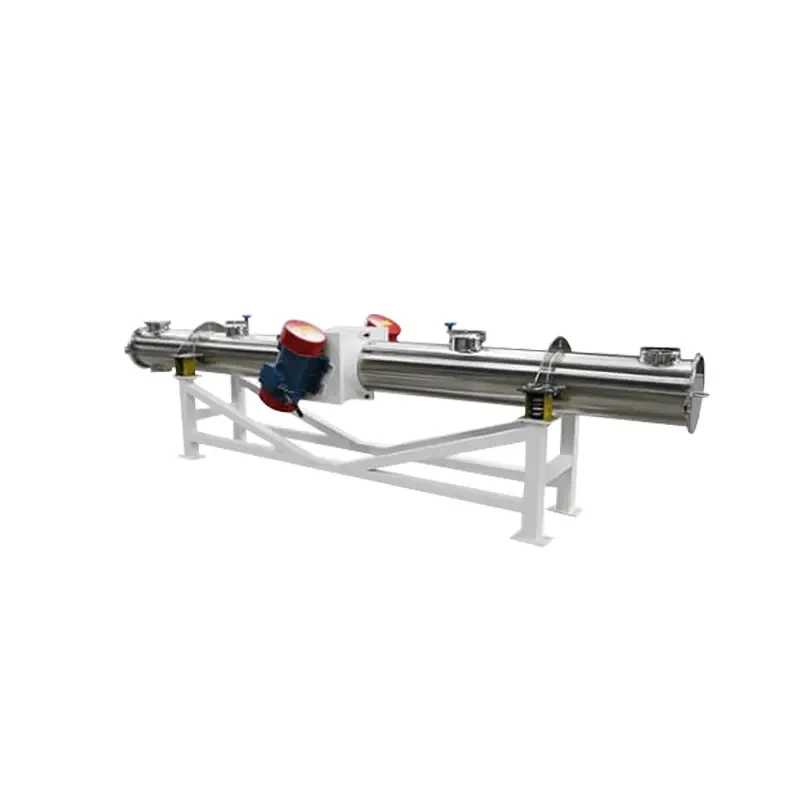
- High-Efficiency Material Conveying: A new suspended intermediate bearing frame is adopted, increasing the material conveying space and reducing logistics resistance. Combined with designs such as small diameter, high speed, and variable pitch, it ensures smooth, rapid, and uniform material flow.
- Flexible Layout: The casing uses high-quality seamless steel pipe, connected into an integral structure via flanges. It can continuously convey materials horizontally or at large inclinations. It can be directly connected and fixed to equipment without requiring a foundation, making full use of space and facilitating movement and disassembly.
- Diversified Connection Methods: Both the inlet and outlet ports can adopt various connection forms such as flange connections, bag connections, bag hanger connections, and universal joint connections.
- Reliable Sealing: Waterproof devices are installed at the connection points of the casing tube, and process holes are carefully improved to prevent blockages caused by cement lump formation inside the tube due to water ingress from rain, thus avoiding machine jamming accidents.
- No Lubricant Addition Required: Thanks to the adoption of innovative intermediate bearing materials that provide friction reduction, wear resistance, and self-lubrication, no lubricating oil needs to be added even after long-term use. This avoids adverse effects caused by the mixture of grease and cement on bushings and shafts.
Two types
Screening by vibration source
| Vibration Source | Частота | Амплитуда | Typical Application Scenarios | Vibration Source |
| Inertial type | Eccentric block rotating centrifugal force | Intermediate frequency (16~50 Hz) | Medium (1~5 mm) | The most widely applied and suitable for conveying most bulk materials |
| Electromagnetic type | Electromagnetic periodic attractive force | High frequency (50~100 Hz) | Small (0.5~2 mm) | Accurate feeding, quantitative control, fine powder material |
| Elastic link type | Eccentric shaft + connecting rod mechanical transmission | Low frequency (6~15 Hz) | Large (5~15 mm) | Heavy materials, large ore chunks, impact-resistant applications |
Based on their core working principles
| Особенности | Vibrating Tube Conveyor | Screw Tube Conveyor |
| Преимущества | Environmentally friendly with no leakage; capable of large inclination (up to 30°) and three-dimensional spatial bending; conveyor belt does not deviate; suitable for long-distance, high-capacity conveying. | Simple and compact structure; good sealing performance; capable of loading and unloading at multiple points; lower cost; good rigidity. |
| Limitations | Simple and compact structure; good sealing performance; capable of loading and unloading at multiple points; lower cost; good rigidity. | The mechanical parts are severely worn; the conveying capacity is relatively low; power consumption is high; it is suitable for conveying easily breakable materials; it is not suitable for conveying highly viscous or easily clumping materials. |
| Typical Parameters | The conveying capacity can reach up to 1,800 tons per hour, and the length of a single unit can extend to several kilometers. | The common spiral diameter ranges from 100 to 1250 mm, and the typical length is 2 to 70 meters. |
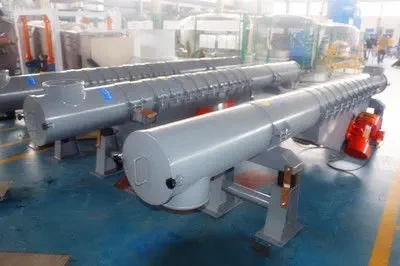
Technical Features and Parameters
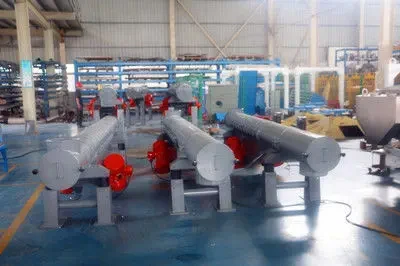
- Compact in size and high in speed, it ensures rapid and uniform material conveying.
- It has good rigidity and excellent sealing. The housing is made of seamless steel pipe, with flanges at the ends to form an integral structure.
- A cleaning device is installed at the discharge end. The entire machine operates with low noise, strong adaptability, and flexible arrangement of inlet and outlet ports.
- It can carry heavy loads and ensure safe and reliable operation.
- It exhibits strong adaptability, convenient installation and maintenance, and a long service life.
Application Fields
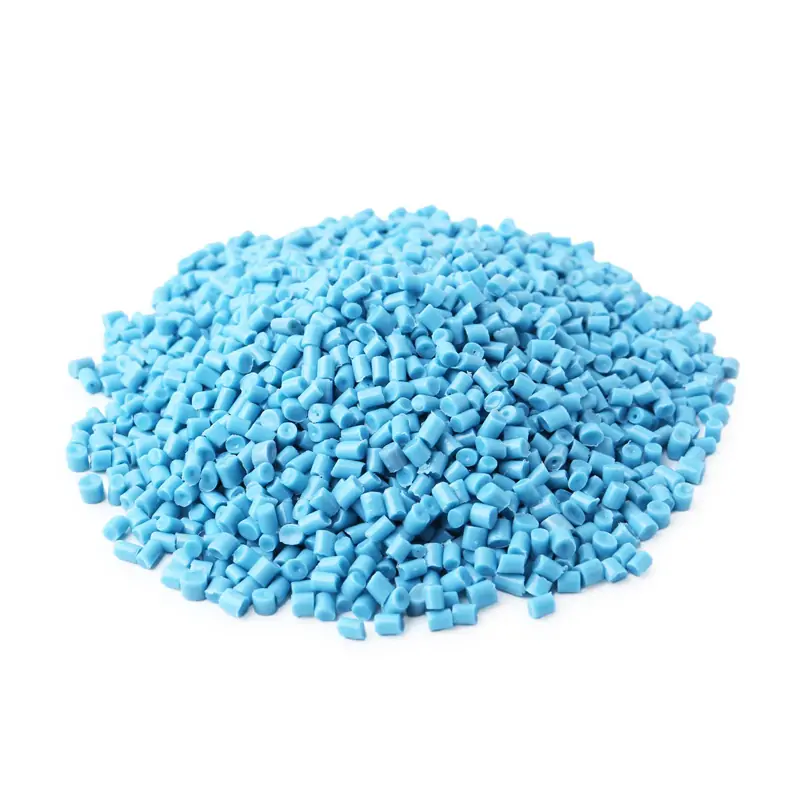
- Пищевая промышленность и Фармацевтическая промышленность Industry: For conveying powders, granules, etc., requiring gentle handling and no contamination.
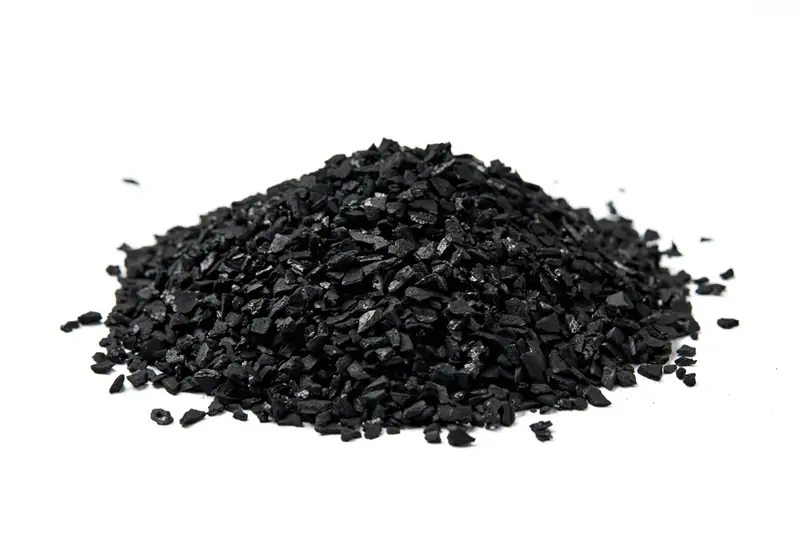
- Химическая промышленность и Building Materials Industry: Used in feeding systems for materials such as bauxite, silicon carbide, and magnesia sand.
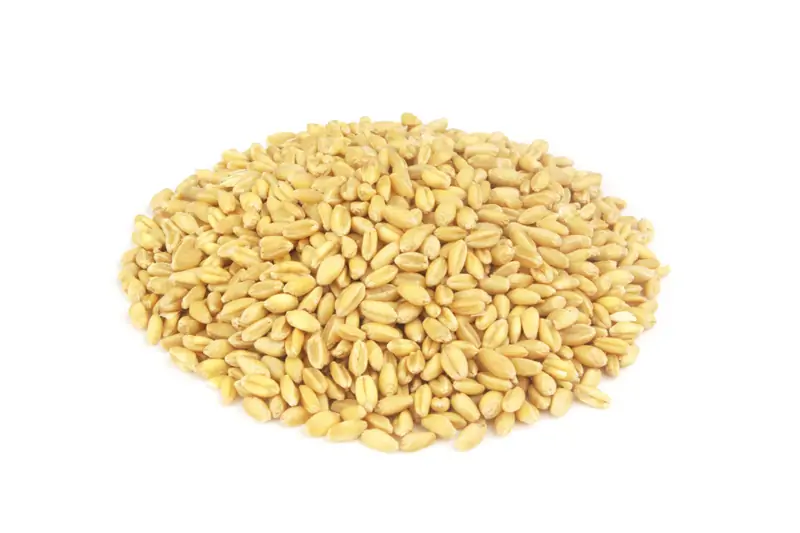
- Other Industries: Also widely applied in mining, metallurgy, coal, grain, glass, and other fields.



Руководство по выбору
During the selection process of vibrating tube conveyors, numerous factors need to be considered, such as material properties, conveying capacity, workshop environment, and on-site operating conditions. The following is a summarized specific procedure:
| Step | Evaluation Content | Key Questions |
| ① Material Analysis | Particle size, bulk density, moisture content, temperature, abrasiveness, corrosiveness | Is stainless steel material required? Is a wear-resistant lining needed? |
| ② Conveying Requirements | Transportation distance, lifting height, target production capacity | Can a single unit meet the requirements? Is a series connection necessary? |
| ③ Vibration Source Selection | Select based on control precision and material properties. | For precise measurement, choose electromagnetic type; for high production volume, choose inertial type; for heavy load, choose link type |
| ④ Environmental Conditions | Explosion-proof rating, hygiene rating, installation space. | Food and pharmaceutical industries require stainless steel and easy-to-clean designs; chemical zones need explosion-proof motors |
| ⑤ Additional Features | Is cooling, drying, and sieving required? | Custom jacketed cooling tubes or sieve structures are available. |
| ⑥ Control System | Is automation interlocking required for variable frequency speed control, | PLC communication, and level interlock? |
Common Faults
Vibrating tube conveyors are prone to various faults during long-term use.
Below is a summary of some common faults and their solutions:
| Возможные причины | Possible Causes | Solution Methods |
| The conveying speed has dropped significantly. | Amplitude reduction (spring fatigue) or excessive material moisture content: | Adjust the exciting force or replace the springs; reduce the material moisture content |
| The noise is too loud. | Bolt loosening, bearing wear, spring breakage. | Tighten bolts; replace bearings or springs. |
| Pipe cracking | Long-term resonance or weld defects; | Strengthen the welds, add stiffeners, and adjust the frequency to avoid the resonance zone. |
| Motor overheating | Bearing oil deficiency or poor heat dissipation | Add lubricant and clean the motor surface dust. |
Vibrating Tube Conveyor VS Conventional Conveyor
As one of the commonly used devices in the conveying industry, what makes vibratory tube feeders different from other ordinary conveying and feeding equipment? The following table summarizes this from various dimensions:
| Comparison Dimension | Vibratory Tube Conveyor (Enclosed) | Ordinary Vibratory Conveyor(Open/Chute Type) |
| Structural Characteristics | Fully enclosed round tube | Open U-shaped or rectangular channel. |
| Ключевые преимущества | Environmental protection and pollution prevention: Materials run inside the pipe, with no dust leakage, and they are not affected by external pollution. | Low cost and convenient observation: Simple structure, facilitating material observation and maintenance. |
| Применимые материалы | Powdery, easily airborne, volatile, or toxic materials. | Loose materials such as blocky and granular ones with no special environmental protection requirements. |
| Типовые применения | Processes in industries such as chemical engineering, food processing, and pharmaceuticals that have high cleanliness requirements. | Crushing, screening, and feeding for mines, metallurgy, building materials, and other industries. |
Заключение
Vibrating tube conveyors are also suitable for chemical, metallurgical, grain silo processing, storage, and other places. The conveyor features a small screw diameter, high speed, large conveying capacity, high precision, and excellent conveying conditions.